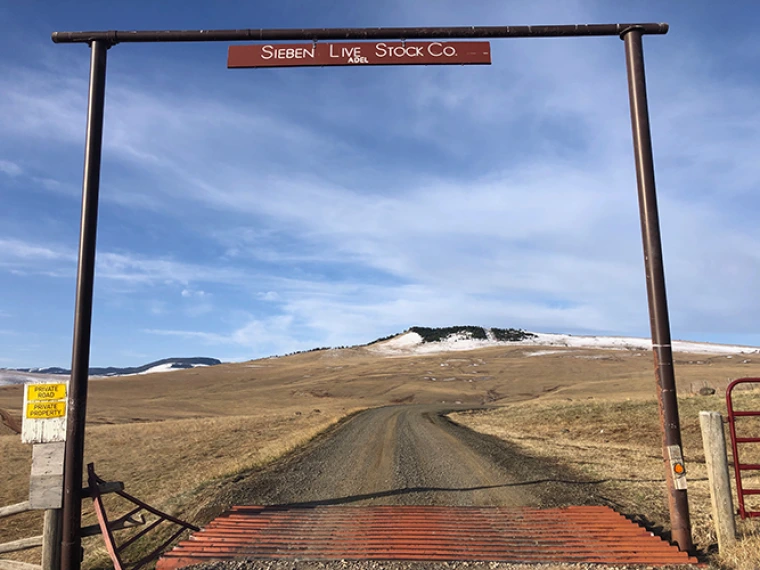
Gus Hormay worked with the Sieben Live Stock Company in the 1970s and 80s to help him understand rotation grazing principles. Chase and Cooper have adapted these ideas, centered on extended rest, to their context and needs. This approach has worked especially well on public lands managed for elk habitat. They received the National Cattlemen’s Beef Association’s Stewardship Award in 2003 in recognition of these efforts and results. In this second half of the interview, Cooper and Chase describe their blend of rest-rotation and short-duration, high intensity grazing, methods for winter grazing, and putting this all together in some mixed-ownership landscape grazing projects.
[ Music ]
>> Welcome to the Art of Range, a podcast focused on rangelands and the people who manage them. I’m your host, Tip Hudson; range and livestock specialist with Washington State University Extension. The goal of this podcast is education and conservation through conversation. Find us online at artofrange.com.
[ Music ]
My guests today on the Art of Range are Cooper and Chase Hibbard, managers of the Sieben Live Stock Company near Cascade, Montana. Cooper and Chase, welcome.
>> Thank you.
>> Good to be here.
>> Yeah, Cooper, you mentioned a new model of ranching. I can think several different ways that I might answer, you know, what that new model looks like. But what are you describing? Are you thinking of more ways to generate revenue on a ranch than just calf sales, or what else are you thinking in terms of a new model for ranching?
>> For us it’s — you know, 20 years ago Uncle Chase and the crew and the team made the leap to change calving from February and March to calving [inaudible] in mid-May, and we’ve since moved it to June 10th is our due date.
>> Wow.
>> And just kind of following that similar — that was pretty well done for — for two reasons, in my recollection. One was to better match our cows’ production cycle with the natural grass cycle of this ranch. And the second was to better match our enterprises with our natural resource space. And so we’re — we’re heavily weighted in the summer — in our summer country. We have three zones, basically; summer country, our shoulder country, and then our winter zone. And winter zone was our biggest bottleneck. That was — that was what really drove our stocking rate numbers or determined our stocking rate numbers. And so that switch — the winter zone also includes all of our hay ground. So that switch was made to try and match our cows’ production cycle with our resource space, too. And so when I’m saying a new model of ranching, it’s really an extension of what was started 20 years ago of — of allowing Mother Nature to do more of the work and the cows to do more of the work, in a way that — where both are set up for success. And that’s through grazing management and through proper genetic selection, basically. And so from grazing management, what my personal belief is, is when possible, non-selective grazing is the best. And what I mean by non-selective grazing is in a very short duration where every single plant is affected, to where every plant is put on a level playing field. And then what happens in that scenario, when followed by a long period of rest. That’s the other very important part of this equation, is the plants with the deepest root systems and the largest leaf areas are the ones that outcompete in that scenario, which are your desirable species. And so your — by doing non-selective grazing, we’re able to increase our forage harvest rate because every single plant is affected. And by how they’re being grazed and the amount of — the byproduct of that type of grazing is the amount of litter that’s trampled down. And so you’re building soil and you’re able to capture and retain more water. And you’re also — by grazing in that manner, affecting your plant species composition because you’re setting your desirable species up for success. You’re also increasing your forage production rate. And we — we’ve seen that across the — the ranch in the winter zone. On average, it’s been a 200% increase in the last six years. And then in the shoulder zone is also 200%, and then summer country is 110% in a six-year time span, is what we’ve seen on average. And — but in order to do that properly, we need genetics that match this environment and have a high doability on grass, early sexual maturity rate. A good match for this type of environment. And so we’re having to operate with a different type of selection criteria for our genetics. And so once you get your genetics right, which I see as another natural system, to where it’s not a linear — once you get something right, like, with our grazing, it’s not a linear increase. It’s more of an exponential increase. Once the genetic — genetics get —
>> Mm-hmm, mm-hmm.
>> — once you get your genetics right and your grazing management right — because for a while there our grazing management outpaced our genetics, and we’re still at that point.
>> Right, the results are multiplicative instead of additive.
>> Exactly. That’s a good way to put it.
>> Yeah.
>> Mm-hmm. And all of this comes — works together to where, at the end of the day, we’re effectively increasing our stocking rate in a way that is sustainable to every single leg of the stool that Uncle Chase was referring to.
>> Mm-hmm.
>> And an increased stocking rate will — we’re — we’re allowing our — we’re putting the foundation in place to generate more revenue. And so the economic resiliency comes into play, and that’s what needs to happen from the fragility — from a market standpoint. From the climate — here at the ranch, we have a weather station. And from 1980 to 2000 average precip was 22 and a 1/2 inches, and from 2000 to present day, it’s 16 inches. So dealing — building the resiliency in place from the soil up and through our cattle. As well to — you know, we’ve had record-setting years on both ends of the spectrum in the last four years multiple times. So dealing with these pretty wide swings, we’re — we’re just trying to stay on the front end of that, to where we can continue to be productive and we can grow more with less. And we can still generate not just revenue but a very robust amount of revenue. I hope to get to that point, no matter what curveballs are thrown. That’s what I see as being the new model of just this — and I — this really resilient ranching operation. Resiliency is another watered-down term, but it is — it is, I think, very important for what we do.
>> Yeah, I think it’s a useful one. I was going to ask you about rules of thumb. You know, this is one of those things that people either love or hate. You know, it sounds like one of the rules of thumb that is common to most ranches that have that kind of resiliency is to not — don’t take it all. One of the — something else Wendy Berry — Wendell Berry wrote in the book Jayber Crow, he’s describing a farmer, you know, before the era of fertilizer who — he says he was always studying his fields, thinking of ways to protect them. He was improving his land, intending to leave it better than he found it. His principle was always to maintain a generous margin of surplus between the fertility of his land and his demands upon it. Where he — wherever I look, he said, I want to see more than need and have more than I use. This idea of not taking it all so that, you know, if something goes wrong with the rainfall in a given year you’ve got something to fall back on. Would you say that that kind of concept of not using everything every year is one of the important rules of thumb? Or — and, you know, what other rules of thumb would you say you use, or principles, in terms of how to manage grazing?
>> In this environment, I think not using everything every year is — is prudent. And that’s something that Uncle Chase has had in place since the 1980s with the Gus Hormay rest rotation system. And so in our summer country at any given year, 1/3 of it will go untouched, basically. And then it’s about 20% in the winter.
>> Meaning 1/3 of the acres don’t get grazed at all?
>> At all.
>> Yeah.
>> Yeah, they’ll have a full year rest.
>> We have a — we have a rest rotation framework, a classic Gus Hormay rest rotation framework, within which Cooper practices high-end density, short-duration grazing all year long.
>> Inside of the rest rotation frame?
>> Inside of the rest rotation framework.
>> Yeah, yeah.
>> And so we’re — some would argue we’re over-resting. And, you know, I don’t know whether we are or not. But it — certainly, we’re guaranteeing that 1/3 of the range — well, actually it’s —
>> Right.
>> — more than a third. During the growing season it’s — it’s 2/3 because you don’t — you don’t — because of the treatments of rest rotation, so it’s — it’s more than 1/3. But by being in the rest rotation context, there’s also the benefit of — of — that’s — that’s a prerequisite for — for — for your cattle to graze on Fish, Wildlife and Parks ground. And so we have a huge super lease put together with FWP where we — we graze much of their game range, which is adjacent, for the benefit — well, for our obvious benefit. But cattle grazing — the way we’re doing it, high-intensity, short-duration within the rest rotation overall framework, allows us to — to have this lease, which is also improving the — the range for elk habitat. And, you know, much of our range on private land goes ungrazed [inaudible] 1/3 a year and 2/3 of it through much of the year, which is also habitat for the elk that don’t know the boundaries. So there — there are additional benefits that have accrued by — by the — the grazing structure that we have.
>> Yeah, I feel like I’ve got more questions piled up in my head right now to keep track of. But I want to come back to how the — how your interaction with Gus Hormay came about.
>> Sure.
>> But first, I want to ask the question that I’m afraid I will forget. Which is how are you applying what you’re calling short-duration, high-density in a rangeland setting? Because a lot of people would say, I mean, I work with pretty similar environments in Washington State and to a lesser degree in Oregon, where the — you know, the potential profit on the landscape through livestock doesn’t justify installing a lot of infrastructure, which a lot of people would feel is necessary to apply that kind of short-duration, high-density. And, further, there’s not enough water to get around to do that. So what a lot — what a lot of successful ranchers are doing — I say successful because I think they’re — have long-term high rangeland health, you know, are some modifications of short-duration. So is a short-duration, you know, a two-hour grazing period, or is it a two-week grazing period? You know, in my mind on a lot of rangelands, two weeks would be considered short-duration and higher density, for sure, than what had been done historically. And that does seem to work pretty well, you know, where the grazing period in a given — say, a 5000-acre pasture, you know, might be three weeks, okay? And then they don’t come back to that until the next year. Preferably, at a different time of year than they were there this year. That’s just one example. What does that look like on — on this place?
>> So in the — in the winter country, short — in the winter zone where our — what we call our mob, our four years old — four-year-olds and up are currently, it’s one-day grazes. Running a density of about 100 cows to an acre for one day. And in the shoulder zone, it’ll be more like three-day grazes. And this is utilizing a bunch of poly wire. Now keep — we do have — we’re just — there’s — we have a lot of live water everywhere. And the places that we don’t have live water, we have plans for or have put in pretty big water projects. Because now we know, which I’ll get to this point here in a bit, the economics of what actually grazing like this means now. And we can’t afford not to graze like this. And then in the summer country, the longest graze period, well, that’s — longest graze period would be about a month-long. And that would be on a four-service allotment where there aren’t any options, basically. Shortest graze period would be two days, and the average graze period, I would say, would be about five. Our — so that’s from everything from all of our yearling groups. We’ll have anywhere from three to four different yearling groups and then two to three different mother cow groups calving.
>> Kept separate?
>> Kept separate.
>> Yeah.
>> Yeah. And — and so to flesh that out a little bit more of how we landed on that, when I came home eight years ago — well, when we first started winter grazing, the average graze period was seven days. And when I came home eight years ago, it was four, four and a half days graze period in the winter. And then we’re now at one-day graze periods. And what we saw, much like what we were talking about of how it wasn’t really a linear relationship, it was exponential. Where when we went from four-and-a-half-days graze periods to two-day graze periods, our forage harvest rate increased about 30%. And then from two days to one day — or, four day to one day, it was double. And — and our cattle are better off. Our animal performance is higher, the ground is — is better affected, it’s less labor. It’s a win-win-win across the board. And so after doing that for years and incrementally getting to that point, we could safely push a pencil and say this is what this is worth to us. And this happened — I had this epiphany about four years ago where it’s just, like, we can’t afford not to do this. This is — we have to get this dialed in because of the — the — what it means financially. And in getting this dialed in, just from my short-term perspective, let alone the long-term perspective, of building our soil and changing our plant species composition for the better.
>> Yeah, so on the short grazes, you’re managing that by keeping animals in a — in a specific area using herding, or mostly with electric fence?
>> Mostly with poly wire. We — we will place animals sometimes — sometimes successfully, sometimes not. Never with day-in, day-out herding.
>> Yeah.
>> It’s mostly all with poly wire. And all of our cattle are very well trained to poly wire. And, you know, on these one-day grazes we’ll start at a water point and we’ll move away from that water point and, say, like a — it’ll be a seven or ten-day increment where they’re back trailing over what they’d grazed. But since they’d grazed it in a one-day timeframe or time period, that soil — that ground is so soiled they won’t really back pick that, you know, because the density was so high. And then in the summer country, we’re really limited by our terrain. There’s only so much that we can do because we run in some pretty rough country. And also, we’re — we’re fairly sensitive to the cow — we — we lessen up on the grazing density on the frontend of calving.
>> Yeah.
>> You know, give them enough space to help cultivate that mothering instinct and —
>> Yeah, the critics of rotational grazing would say that if you’re applying that kind of density, you’re lowering the kind of nutrition the cows are receiving because you’re forcing them to eat a quality of food that they might not otherwise. And — and then there could be some production losses from that. I would say, if I’m being the Devil’s advocate to the critic of rotational grazing, that that only — that only applies if you’re grazing down quite a ways into the plant canopy. You know, if — if they’re — if the animals are moving fast enough that they’re mostly high grading a plant community, they’re still getting that higher point of nutrition. And then you would probably say that if your genetics allow for an animal, you know, to maintain body condition [inaudible] with access to this kind of ground. And where they’re not having to be cherry picking the plant community, that also makes it sustainable. But how would you answer the critic who says, yeah, that’s all fine and dandy to say that you’re going to concentrate the animals and force them on to — force them to eat stuff that they might not otherwise. But that is going to result in poorer cow performance.
>> It can result in poorer cow performance. That’s without a doubt. And that’s a — that’s a really hard line to walk, and has been for us. You know, it’s — it’s a fairly tenuous relationship between animal performance and — and ecological performance. But I — I don’t — I think that that — that’s true, but I also think that that is false when done correctly. And also when getting your genetics right. But to your — to your point, you can actually do rotational grazing and increase animal performance because they’re — when done in that manner and with that end goal in mind. When you’re on — moving on fresh feed and if they’re just high grading the feed, that’s the best — that’s absolutely the best thing you can do for animal performance. That’s taking — that’s taking into consideration or assuming that they’re being handled well. If they’re not being handled well, and they’re getting moved five times more than they normally would have been and it’s extremely stressful, then no matter what, animal performance [inaudible] —
>> You’re burning off those gains.
>> Yeah.
>> Yeah.
>> Animal performance is going to tank.
>> Yeah. Yeah, we might have to do a separate podcast episode to talk about stockmanship. And maybe we can rope in Wit.
>> Yeah.
>> He and I were together at a workshop in northern Washington a couple years ago. Probably three or four years ago. So we met there. But, you know, we’ll have to come back to that one. Yeah, back to the question about Gus Hormay. How did that relationship come about?
>> This — this is a great story. Kind of backed into it, in a way, because dad had worked for years to — with FWP to try to incorporate the game range into — into our animal grazing. And then — so I picked up where he let off. And there was a wildlife manager at FWP, that’s Fish, Wildlife and Parks, named Joe Egan [assumed spelling] who was probably — early in his career was about as anti-landowner as you could ever hope to — to find. And somehow, he became enamored with Gus Hormay. Joe Egan became enamored with Gus Hormay, and just completely understood what Gus was preaching. And started to envision the benefits that grazing properly with the Hormay method could have for game ranges on freshening up feed and creating new plant growth and — and improving the forage base for — for elk. And so, all of a sudden, after dad was gone and, you know, I was trying to fill some pretty big shoes. And, geez, dad always wanted to graze the game range and, you know, this — this Joe Egan guy seems to be a pretty good guy. So started working with — with Joe Egan and — and —
>> You did?
>> Yes.
>> Yeah.
>> And we brought up Gus Hormay and we rattled around in a pickup for two or three days around this ranch. And Gus was in his eighties at the time. I think this was the last big job he did. And Gus got real interested and real motivated and drew all these intricate, intricate, huge maps of all colors — different colors, and every little tributary of every stream. And it just — they — they were pieces of beauty. And spent lots of time with him and I — I, you know, became a real admirer of what he was preaching. And I could see how it could definitely work — work — work well for us. And Joe Egan from FWP was equally impressed. And, you know, we got our heads together and the game range part of it happened under the stipulation that — that it’s in rest rotation. And so it was, like, 4500 acres, the game range, roughly.
>> Yeah.
>> And then we put in another several thousand — you know, 10,000, 12,000 of ours in a big, major three-pasture rest rotation — classic Hormay three-pasture rest rotation in the heart of our — of our summer grazing. And the game range was a prominent part of that.
>> Mm-hmm.
>> And then from there, branched out. Put one on our forest allotment. And then — so a large percentage of our summer grazing went into rest rotation early on, mid-80s. And it — we got — we got accustomed to it. We — you know, we got — it worked well. And then set a great framework for — I mean, this was kind of — this kind of took us to the moon, and then along comes Cooper and we’re on our way to Venus. You know, we’re just — we’re grow — we’re growing on what started as — as a crude —
>> Right.
>> — rest rotation. And I remember an adage at the time that both rest rotation grazing and short-duration, high-density grazing will get you to the same place; one is a Model T and the other one is a Ferrari. Three-pasture rest rotation is a Model T. Short-duration, high-density grazing is the Ferrari.
>> Yeah.
>> A Model T you can fix with your — with your crescent wrench.
>> Right.
>> If you have a wreck with the Ferrari, it’s a real wreck.
>> Yeah.
>> [laughs] and so we’ve tried to meld the two. And if we have a wreck now on that Ferrari, it’s within the rest rotation context, so it’s mitigated.
>> Right.
>> And we also have a lot of built-in additional rest because we’re in the rest rotation context.
>> Yeah.
>> And I’m putting words in Cooper’s mouth, but I would guess that he might say that we would not have rest rotation, we would do it all with high-density, short-duration grazing. But if we’re going to graze FWP ground, that’s not — that’s not — that’s not in the cards.
>> Mm-hmm. So the buffer is if you — if you manage the — the time a little bit wrong on a piece this year and feel like you hit it too hard, you’ve got some buffer because you could not use that for an entire year?
>> Exactly. With — under the rest rotation context is — yeah, the three treatments are graze, graze after seed ripe —
>> Yeah.
>> — and full rest.
>> Full rest, yeah.
>> And — and so during the growing season, 2/3 of any given area are rested. And so that’s — that’s a huge amount of rest.
>> Right.
>> And, you know, all of it is rested all year, but during the growing season 2/3 is — is rested. And so if there’s a wreck with high-density, short-duration, you’ve got a lot of recovery time.
>> Mm-hmm. Yeah, and sometimes even more than that because — because with — with how we’ve been grazing we have — we basically need more cattle in order to continue to adhere to that restorative — we’re — there — our ground has been receiving more — more rest than that. And in some places, the more productive places, it’s — it’s too much rest, really. Like, we actually — we need more cattle, which is wonderful. But the — going back to the question you’d asked a while ago about the principles of should you always leave some. We’re — we’re huge believers in that. In trying to rest as many acres as possible during the growing season. Not just — not just 1/3. I would — I would say as many as possible during the growing season. And then if you’re in a dire situation, then you have 30% more of the ranch to go to if you wanted to open up that other third, right? Which — which you’d get to —
>> Right.
>> — post-growing season. In which case you’d be doing negligible damage if you were to go to it because it was already post-seed ripe, basically.
>> Who — are you still grazing that game range? I assume it’s not Mr. Egan anymore.
>> We’re — well, we’ve enlarged that times four.
>> That’s the largest super lease in the state.
>> With 16,000 acres.
>> About that, yeah.
>> Super lease meaning multiple agencies —
>> No.
>> — or large?
>> Multiple different blocks within the game range.
>> Okay.
>> Tied together under the same lease.
>> Right.
>> And — and it’s — and it’s really written and managed from a watershed standpoint. Kind of your — kind of not really paying attention to where the property boundaries lie, it’s more of an area management plan. Yeah.
>> So there’s private, there’s FWP, there’s BLM and state lands. They’re all involved in it.
>> Yeah, I’m involved in some planning processes for similar — not quite checkerboard ownerships, but certainly, you know, multiple landowners, where they’re trying to manage one single piece under a — under a — a single geography under a single grazing plan, but multiple owners working together. Yeah, I really like that approach.
>> Yeah.
>> How would — how would — evidently, the game folks believe that that’s still useful [inaudible] —
>> Well, apparently. Apparently. You know, I think there’s some — I wouldn’t say that everybody is completely onboard with it 100%. But the proof is — the proof — I believe the proof is in the pudding, and the proof has been pretty persuasive. So, yeah, I’d say there’s more [inaudible] yeah, I mean, you could just go out and —
>> Yeah.
>> — and — and it’s the — the improvements are tangible.
>> Right.
>> You know, there are some — some sore spots that were not caused by us. They were caused through years and years and years and years of — it’s, you know — it’s the regular suspects. It’s lower elevations around water, you know, years and years and years and years and years of continuous use. And so they’re — they’re incorporated within the system. And you go look at that and say, oh, my gosh, the system isn’t working.
>> Right.
>> Okay, that’s an unfair assessment.
>> Right.
>> I think they’re probably better off under the system because of all the built-in rest, and then the [inaudible] animal impact is properly timed.
>> Mm-hmm.
>> But it’s hard to — it’s hard — it’s not — it’s kind of counterintuitive because this is what you see, but, you know, the fact is, that happened way before any of this was even —
>> Right.
>> — in anybody’s mindset, and —
>> Yeah. And it’s legitimate to ask the question, you know, which direction is it going?
>> Exactly, and —
>> I like to say people have this arbitrary environmental equality scale in their head and they see that spot and they think, well, that’s a six. Well, you may know that it was at a two —
>> Right.
>> — 30 years ago.
>> Yeah.
>> And it’s at a six today.
>> Yeah.
>> Then it’s probably headed, you know, toward an eight. Even if it’s not going to end up at a ten under the current management. But —
>> Right.
>> — the person who showed up four years ago says, well, it’s a six. That’s unacceptable. We need to have a better situation than that.
>> Well, along those lines, too, we — we do have — we’re doing — we’ve got a lot of range [inaudible] out that we’re regular — regularly monitoring to keep track of what’s happening.
>> Chase, you were quoted in the Angus Beef Bulletin article back in 2003 as saying the difference between the neighbor’s place and yours was like night and day. What do the neighbors think about what you’re doing? Is it the same neighbor? Did that neighbor ever read the article and get on your case about that?
>> I forgot all about that. [laughs] I’m still alive, I have all my limbs. He probably didn’t read it.
>> Probably not.
>> [laughs] Yeah. Yeah, and I’d say that wasn’t a very nice thing to say, but [laughs] — but, you know, I — yeah, and I don’t know how to — what I would say at this point. I mean, I think people were still raising their eyebrows a bit at what we’re doing. But, you know, we’ve had several workshops and, frankly, I think everybody’s gone home understanding a little bit more about what we’re doing. And I get the feeling that they’re — they’re supportive. You know, the — the — the challenge is it’s such a paradigm shift, you know? You get so entrenched in a way of operation that works for you, you know, to make a change of this magnitude is just — it’s huge.
>> Mm-hmm.
>> So, I mean, we’ve evolved to it, obviously, over decades and several different people, managers.
>> Yeah.
>> We’ve — we’ve — we’ve evolved to this over a long period of time and so it hasn’t been all that drastic for us to — but it — to, you know, look over the fence and say, my God, if I do that, what’s this going to take, you know? I think there might have been a little bit of emulation in the community, but the timing wasn’t right and the — the end result was not — was not great. So you’ve got to be careful, too, if you are going to go into something like this, just how and when you do it.
>> Right. Well, there’s — that’s where the — the art comes in.
>> Mm-hmm.
>> It’s more than just you woodenly applying some rigid practice. There’s — you know, there’s just — there’s daily decision-making that goes into the — into where and when and — I mean, when as in do we stay two days or four days, et cetera. And how to lay fences out in a way that works with the landscape, works with livestock movement, keeps animals healthy. One of the things that I’ve promised to do as part of this — the grant that funding the podcast, which is through the Western Center for Risk Management Education, is to do — is to talk a bit about how ranchers can — can tell their story to the rest of the world. Because I think that isn’t told very well. Do you guys have any ideas on — on how ranchers that are doing things well can promote sustainable ranching to the non-agricultural public that sometimes doesn’t think all that highly of livestock production?
>> Well, Cooper is too modest, but I’ll — I can — I can — I can say this, he — he — he speaks a lot and goes to several invitations around. And I think he does a magnificent job of explaining what we’re doing and framing it in such a way that it — it has relevance outside of agricultural circles. I had the opportunity to talk at a water conference a year ago and — and talked about increasing soil carbon, which is what this is all about. And, you know, how increasing soil carbon also accumulates water. And so the lack of rainfall we’re — we’re having now is being somewhat mitigated by grazing systems, and that got people’s attention. It really did. That I think Cooper does a lot of — way more public speaking than I do. And I don’t know how much of that is non-agricultural audiences. I think they’re probably mostly agricultural.
>> Yeah, most — mostly agriculture-related conferences. But it — that certainly is an issue, I think. And that’s a weak link of — there — there aren’t many voices and there really aren’t many platforms for us to be heard. And so, you know, there’s some misinformation and misunderstandings that certainly need to be — people need the opportunity to hear the other side of the story. But — and I think it’s on each and every one of us ranchers. And that’s part of the responsibility that I was alluding to earlier of how it’s multidimensional. Once you step into this role, there’s a lot of responsibilities that you have to shoulder.
>> Yeah.
>> And one of them is, you know, ranchers are introverts by nature, almost always. And so the last thing we want to do is stand up in front of a room with a microphone in front of our face and —
>> Yeah.
>> — and tell — and try to engage people in what’s important to us.
>> Or even worse, toot your own horn.
>> Yeah, exactly. And so that’s a — but it’s — we — we, as ranchers, need to be better about doing that. And, you know, the — we have — the ranch has a balanced scorecard, which is basically a — a list of action items that — that has measurable results that you can say, yes, we hit this or, no, we didn’t, at the end of the year. And all those action items take us towards our vision as a family. And one of those action items is engaging the public in conservation dialogue. And so we, as a family, have — have — at looking at our — at our vision, which is a many-generation family business with respect to land, water, wildlife, livestock, and people, that one aspect of making that vision come to life is engaging the public —
>> Yeah.
>> — in conservation dialogue. And so once that was put on paper, that’s when — when I’d get invitations, it’s like, okay, I’ve got to go do this.
>> Yeah.
>> And the first few times was really difficult for me to say yes.
>> Yeah.
>> And it’s — it’s still hard because time — my time is so limited. And so there’s always this prioritization of, like, well — and evaluation of, like, well, what’s this — what is this worth to us? You know, what’s the pay — what’s the payback? And I don’t know if there hasn’t been a time for me personally, when I have been invited to one of those, that I didn’t think it was worth my time, at the end of the day. Because there is a real thirst to hear these stories and people are so receptive. And they also have no idea. I just spoke to a master hunter program two Sundays ago and they — it’s the first time — and these are lifelong hunters. It’s the first time a lot of them had ever even spoken to a landowner.
>> Hmm.
>> They don’t even know what our perspective is like, you know? And that — for this state, for Montana, there’s a real — there — there’s, I would say, a misunderstanding in some aspects between sportsmen and landowners, and maybe some miscommunication. And it was very glaringly obvious at the end of that as one of the reasons why. It’s because our voices aren’t —
>> Right.
>> — well, it’s not that it isn’t being heard. We aren’t sharing our voice.
>> Right. Right, it’s not at the table.
>> It’s not even — yeah, it’s not even at the table.
>> There’s a really good short documentary on Netflix called Kiss the Ground. I’m sure you’ve watched it.
>> I think I’ve heard of it. I don’t think I’ve seen it.
>> It’s a must.
>> It’s worth your time.
>> Yeah.
>> It’s — Ray Archuleta has probably got the most —
>> Yeah, I know that.
>> — airtime in it as anybody. Gabe Brown is featured as well. But I’ve recommended that to several urbanites, some of whom have watched it. It’s excellent. It’s the best piece I’ve ever seen on regenerative agriculture. It’s — it’s well explained, it’s well done, it’s not tedious. It’s — it’s — I just can’t recommend it highly enough.
>> Mm-hmm.
>> Kiss the Ground.
>> Okay. Yeah, we can also put a link to that in the show notes for this episode. You mentioned hunters and the public. I was — I wanted to just mention in passing that I think the artist in residency program is one good way of communicating, you know, with people that — who probably ordinarily at least mildly antagonistic toward — toward ranchers. You know, and you — somebody like that that spends time at a place like this and changes their mind, they’re going to talk to other people who may or may not change their mind, but it — it’s a placeholder. But the other thing that — that was making me think of, is I’m curious if you look for some other ways to generate revenue on the ranch? You know, there’s a lot of talk about agritourism, especially on smaller places that are closer to an urban center where that’s potentially, you know, decent money. There’s a lot of — that’s a whole different skillset and workflow, you know, workload in trying to manage tourism. But, you know, a lot of ranches have — have been successful in, I guess, you know, selling access to the ranch, even if they can’t directly sell licenses. Like in Washington State you can’t — you can’t sell an elk. But you can rent somebody access to your land and, you know, they can use their elk license to go — whereas, in places like Texas, you know, you could — I don’t know what it is in Montana. But in Texas you could say, yeah, you can come here and, you know, for $500 you can kill a mule deer, and you stay until you kill a mule deer. Have you looked at any other ways of generating revenue like hunting leases and agritourism?
>> Soil carbon — not soil. Timber carbon.
>> Yeah.
>> We’ve did a huge deal on [inaudible] —
>> Meaning a carbon contract or timber harvest?
>> No, we sold our —
>> Carbon contract.
>> Yeah.
>> We sold the carbon-sequestering ability of the forest on Sieben Live Stock Company into the California compliance market.
>> Mm-hmm.
>> It’s a one-time sale and we have maintenance costs that go forward for a very long time. It’s a 100-year commitment, which we did willingly and it was worth our while. And we looked into soil carbon and it’s still got a ways — it’s pretty nascent.
>> Right.
>> You know, it’s — but there — there’s potential for — some potential for income there that — that, you know, could be capitalized upon at some point. But the measurement — there’s a lot of things that aren’t — aren’t quite figured out with soil carbon yet.
>> Right. And with a forested environment, most of the carbon storage is above ground where it can be measured and quantified. And so you can guarantee a certain amount of gain. With —
>> Yeah, it’s [inaudible] —
>> — the rangeland ecosystem it’s mostly below ground. And what you’d be getting paid for is mostly —
>> Yeah.
>> — not turning it loose, rather than necessarily seeking more carbon.
>> Yeah. Well, we’re — the forest is — it’s actually the carbon in the ground, but they can forecast it well based upon what’s —
>> Yeah.
>> — above the ground. And if you leave that in place above the ground, it’s a pretty quantifiable certain —
>> Indicator.
>> — quantity that you —
>> Yeah.
>> — can actually — that’s actually tangible, in a manner of — in a manner of speaking.
>> Yeah.
>> Yeah. So there’s — there’s two things.
>> Yeah.
>> And there — I mean, there — there’s been a lot of ideas for agritourism that’s been kicked around for 20 years and continues to be kicked around. But really, it’s someone would really have to want to do it and —
>> Yeah.
>> — or we’d have to hire some. We’d want to have to do it enough to where we’d have to hire somebody. And my time is — is really spent in finetuning these foundational blocks. Getting these foundational blocks in place for, really, the big engine that’s going to drive everything else. And then maybe once those are in place then we’ll start tackling some of these other ideas. But the right people would have to — would need to be on the bus in order for that to happen. We’re — we’re just — we’re wanting to get what we’re doing currently dialed in and get to where we’re doing it well and predictably before — before we get that done. Then without, really, the right person just showing — showing up and being a part of making that happen, like, an ag — an agritourism deal, then it’s not currently worth my time.
>> Mm-hmm.
>> We do some limited big game outfitting, and so there’s some — there’s some income generated from that, but we don’t have the desire to expand it.
>> Mm-hmm.
>> It’s possible — it would be possible to expand.
>> Right.
>> But we don’t — we don’t desire —
>> That would also require a person —
>> — we don’t have a desire to do it.
>> Yeah.
>> For multiple reasons we won’t go into.
>> Yeah. Yeah, recreational access can be pretty —
>> A two-edged sword.
>> — difficult, yeah. Maybe just to wrap things up, I actually mentioned that your dad, Cooper, has a — a book coming out soon?
>> He does, yeah. It’s getting published this month.
>> What’s that about? What’s the book about?
>> I’m probably not going to get this right, but this is my memory — not what the book is about, but it’s a great story of how he got to writing this book. Was he — 20 or more years ago, dad was really fascinated by the Civil War and was reading about — I remember him reading about the Civil War a lot. And — and then he was reading about Stonewall Jackson and then about Stonewall’s own troops who killed him by accident. And then he started following those characters back in history and started — he started writing about the Civil War, actually. And he started following those characters back in history. And it turns out that they’d served together in the Mormon War. During — when the secession when Utah tried to — when the Mormons tried to secede Utah from the Union, or the territory from the Union, and then before that to the Mexican-American war. And then — so this book is about the — well, the backbone story is a volunteer Mormon Battalion that marches from Iowa to San Diego, basically, as recruits for the Mexican-American War with their families on foot. And they went with a company of dragoons of the U.S. Army’s cavalry. Based — and it’s a historical novel based on — on real people and true events. And I think he’s changed names.
>> Wow.
>> But it’s fascinating. And then his next book would then be about the Mormon War and then the book after that would be Civil War. And he’s been working on this novel for 15 years, probably.
>> Oh, yeah.
>> So it’s pretty — a pretty landmark moment for him.
>> Yeah, I’ll have to get a hold of that book.
>> Yeah, it’s going to be called Beyond the Rio Gila.
>> Okay. Well, I’ve got a million more questions I could ask and we could probably talk forever, but you guys have given quite a bit of your time. And so I — I’m really grateful for your time and want to thank you again for being willing to be interviewed, and I look forward to continued conversation.
>> Great, thank you.
>> Thank you, Tip. Appreciate it.
>> Thank you for listening to the Art of Range podcast. You can subscribe to and review the show through iTunes or your favorite podcasting app so you never miss an episode. You just search for Art of Range. If you have questions or comments for us to address in a future episode, send an email to show@artofrange.com. For articles and links to resources mentioned in the podcast, please see the show notes at artofrange.com. Listener feedback is important to the success of our mission, empowering rangeland managers. Please take a moment to fill out a brief survey at artofrange.com. This podcast is produced by Connors Communications in the College of Agricultural, Human, and Natural Resource Sciences at Washington State University. The project is supported by the University of Arizona and funded by the Western Center for Risk Management Education through the USDA National Institute of Food and Agriculture.
>> The views, thoughts, and opinions expressed by guests of this podcast are their own and does imply Washington State University’s endorsement.
Resources Mentioned in this Episode
- Working Cows podcast interview with Cooper
- Kiss the Ground, documentary on regenerative agriculture
- Scott Chase’s (Cooper’s dad) new book, Beyond the Rio Gila
- Angus Beef Bulletin article (pdf)
- 2021 Rangelands journal article “Potential to improve winter grazing pastures: Sieben Land and Livestock study“. Authors estimate that It is estimated that grazing instead of feeding cattle during the winter can save 42% to 70% of the yearly input costs in the western United States and Saskatchewan, Canada.