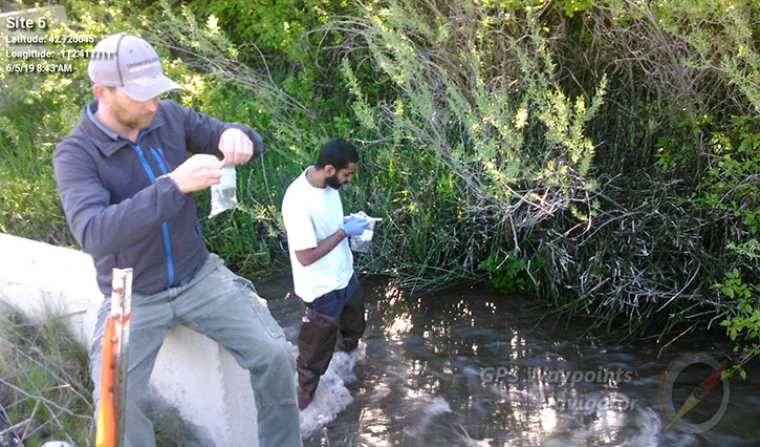
Microbial source tracking has gained accuracy in the last decade, and a multidisciplinary team at University of Idaho recently used MST methods to help US Forest Service managers identify causes of contamination of a stream listed by regulatory authorities for high bacteria. This is the first of a two-part episode with Eric Winford, Associate Director of the Idaho Rangelands Center; Dr. Jim Sprinkle, Univ. of Idaho Extension beef specialist at the Nancy Cummings Research & Extension Center; Dr. Jane Lucas, post-doc in Univ. of Idaho Dept. of Soil & Water Systems; and Alan Kolok, Director of the Idaho Water Resources Research Institute. Listen to learn about E.coli as an indicator species, methods to determine what animals are contributing e. coli to streams, potential targeted water quality improvement practices, and more.
[ Music ]
>> Welcome to the Art of Range, a podcast focused on rangelands and the people who manage them. I’m your Host, Tip Hudson, Range and Livestock Specialist with Washington State University Extension. The goal of this podcast is education and conservation through conversation. Find us online at artofrange.com.
[ Music ]
This week on the Art of Range we have the second half of a two-part episode with some folks from the University of Idaho who used a microbial source tracking study to identify what living things are contributing to fecal contamination of a stream in Idaho. For those that have not listened to the first part I recommend you listen to that first or the second part may not make much sense. Part 1 was Episode 68, it would be the same four people, they are introduced more fully in Episode 1, but we still have with us Eric Winford, Jim Sprinkle, Jane Lucas and Alan Kolok. I want to go back to a question that I asked earlier that I think we started to answer in a couple parts and never quite got around to the second part. I think I still would like to hear from a few people on what are some of the potential regulatory actions against ranchers just to help set the stage for what the stakes are in having some of this figured out. Because, as Alan pointed out, the way that we would solve a problem is significantly different if we’re trying to control human feces rather than livestock feces, you would take a completely different approach to trying to clean up the water body, depending on what, where it’s coming from. And so what are some of the things that could be done or have been done or would have been done in this scenario if it turned out that 95% of the fecal coliforms are from cattle?
>> This is Eric, I’ll start trying to answer that question. And really to go back to just the regulatory aspect of this real briefly, it’s the Forest Service was the land manager for the majority of the watershed. And as the land manager they are responsible to meet the water quality standards for the state, and so that’s true for the Forest Service, it’s going to be true for the Bureau of Land Management, and it would be true for private landowners as well. So the Forest Service needs to do whatever is reasonable to meet the standards and to achieve standards and prevent degradations of its waters. And so the importance of knowing who it is really provides the Forest Service the impetus to then go implement whatever appropriate practice is necessary. And if it had been shown it was livestock that could have included things like fencing livestock off the stream, it could have included changing season of use or reduction of number of livestock, or even removal of livestock from certain parts of the watershed. If it’s shown to be recreation, which it was in this case, then the Forest Service then can pursue actions like adding in more toilets, limiting some dispersed recreation sites, or increasing enforcement of recreation access and use. So the source is incredibly important because the Forest Service is then going to have to you know put time and money into its response, and that response could really affect ranchers. As you know, Tip, there’s a lot of issues with reducing livestock access around riparian areas, in some cases that leads to a pretty significant economic impact to the rancher, so there’s a lot of reasons for understanding the exact source of the E.coli.
>> Yes, and I would add that at least in the scientific community, and I’m using that term really broadly, there’s quite a lot of animosity toward livestock producers under the assumption that wherever cows go they’re contaminating the whole world. I’m obviously saying that tongue in cheek because I don’t quite see it that way, mostly because ecologically there’s all kinds of stuff out there and there’s all these microorganisms that are interacting and I think it’s just not nearly that simplistic. But there is a pretty high social cost to this belief that almost all of these water impairments are due to livestock if there’s livestock in the system.
>> Yes, so, Tip, I’d like to comment on that word assumption that gets used, and that’s one that just drives me nuts. Sometimes we can’t have good information and we have to make our best guess based on the information we have available, but oftentimes we can get the information we need to assist in science based decisions. And, as you know, that’s the mission of Extension is to use science to help solve problems and to increase the positive livelihoods. And so I think I was excited when we had the opportunity to gather information to answer the question and not just make a blanket decision or see it be made that would affect people and we didn’t really know if we were attacking it from the right direction.
>> And this is Alan again, and I’d just like to embellish upon what Jim said because Jim is absolutely correct, and that’s the fact that we all have to remember that the microbial genesis of human disease has been known to occur for about 120 years, since the early 1900s. However, as Jim said, our technology to be able to know, for example in this very specific case, what the sources of coliform bacteria are, that’s only been around for maybe between 15 to 25 years, so it has not been very long. So we had to, if the EPA or Idaho DEQ or anyone else, if they were concerned about coliform bacteria, and I’m not trying to defend them necessarily but I’m just stating a fact, they had to make assumptions, they had to look at most likely cause because they had you know 30 years ago in the 1970s, in the 1980s they had no molecular technique to be able to address what we’re now able to address.
>> Right, and doing nothing is not an option.
>> That’s exactly right. So they had to make assumptions, and again I don’t mean that as a defense of them, I’m just stating it as a fact. Its rights, and again looking at it from the question of whose child is this, right? Surely a child had a father, now we don’t think the father is the mailman or we don’t think the father lived in Kansas, he’s probably one of the family members or you know a boyfriend or somebody around the mother, right? So again and in this case if you have a rangeland and there’s a stream and it’s contaminated with coliforms and you don’t have molecular techniques the assumption is, yes, it’s probably the cattle. I’m not saying that that’s, you know the most fortunate thing now is we don’t — we no longer have to make those type of assumptions because we now have the molecular tools to definitively determine yes or no, as Jane was saying, was it the coliforms from the intestine of a bovine that were found in the stream.
>> Yes, I’m really hopeful that that could solve, not solve but begin to provide you know more finetuned solutions to some of these problems, but at least up until recently microbial source tracking was a little bit controversial and I don’t know if that was only controversial politically or scientifically, but at least up until relatively recently and perhaps still Washington’s regulatory authority has been unwilling to acknowledge similar microbial source tracking data in places where that’s been collected here. So I’d, this may be a rabbit trail, but sometimes rabbit trails are important, is microbial source tracking a valid technique that could be used, should be used, is it cost effective today?
>> And I’ll address that, and again you know none of us, we all watch, you know we’ve all seen the show, Crime Scene Investigation, well, in those situations there may be a drop of blood on a crime scene and DNA can be extracted from that drop of blood and we can definitively go back to individuals that are incarcerated, that have been incarcerated for 15 years. This is happening in the United States, and say, hey, you know what, we analyzed molecularly that drop of blood at the crime scene and it wasn’t you, you’re innocent, you know get out of prison, you didn’t do it, right? That’s not your blood. So my whole point here is that, as Jane was saying, these molecular techniques are solid, there is no question, providing that you have — and I’m not making any inference relative to any other labs, but I’m just saying — prior, providing that you have a competent laboratory that’s been vetted and knows what they’re doing molecularly, and Dr. Strickland’s lab, where Jane worked, here at the University of Idaho, certainly falls within that category. If that’s true that the results are coming from a competent laboratory you’re innocent or you’re guilty, period, there is no question. Now where questions can arise is if the techniques used are not competent for whatever reason or it may be the interpretation of the information is questionable. And I’ll give you a very specific example, as Jane was talking about earlier, we might say if we had put in our paper you know it’s racoons, it’s racoons, they’re the problem, get rid of the racoons. We never used the coliforms that are in high concentration in racoons, we never did that, that would have been unethical thing for us to say. So we had to parse between cattle, humans, wildlife. Who is the wildlife? To be honest, we have to say, well, we don’t know, we know that there are coliforms there, we know they’re not coming from humans, we know they’re not coming from cattle. Are they racoons? Could be. Are they geese? Maybe. Coyotes? It’s possible. Snapping turtles? Maybe. You know, but we can’t say anything, but we can definitively talk about you know cattle, innocent, guilty, humans, innocent, guilty, we can do that just like a crime scene.
>> You know, this begins to sound a little bit more like Murder on the Orient Express where everyone was a murderer. So let’s — I don’t think we’ve talked about the results yet, let’s get around to who the murderers are. What were the results in this study?
>> Eric, I’m going to let you take that one.
>> Okay, thanks, Alan. So the results were we did — maybe cover the method just really quickly, we did the coliform test, then we did microbial source tracking as well, so we had two different sources of information. One was how many sites had exceeded DEQ standard, and the other was which of those sites were then linked to a particular source, either humans, cattle or other, which could be, as Alan mentioned, dogs or snapping turtles perhaps. And so let me get that number right here, what we found are humans, we found human DNA bacteria’s were found at 62% of the sites and for 65% of the instances, so 22 out of the 34sites that we assessed, and some of those also had a co-incurrence of cattle DNA, but human DNA alone was responsible for 58% of the exceedances. And cattle DNA was found at 12% of the sites, so 4 out of 34 times where when we sampled, and other DNA was found at 29%, so 10 out of 34.
>> And the other could be various kinds of wildlife, dogs?
>> Yes, absolutely.
>> Et cetera?
>> It could be various types of wildlife, dogs, geese, deer, moose, but we know it’s not cattle or humans because we would have seen their — that signature, that microbial signature from them.
>> And, Tip, I’d just like to embellish a little bit on that as well because — and Eric did a great job of summarizing our results. Our results were both spatial, as Eric was just talking about, where we had multiple sites up and down the creek, but we also had a time component, meaning that we went out — what was it, Eric, 7 different times over the course of the spring and summer, is that right?
>> Yes, 7 different times before cattle were turned out and then after cattle were removed, so we could really capture both ends, and we also sampled before and after holidays so we could understand if holidays were a major contributor.
>> So in a way by sampling around holidays it’s kind of like with the cattle we could ask the question of was there a large population of humans present relative to times when there were fewer humans present? And very clearly, and it was primarily 4th of July and Labor Day, and after the 4th of July and after Labor Day no surprise both the counts went up and the proportion of the source tracking that implicated humans also went up, which was a real smoking gun.
>> Yes, if I can jump in here? So when we looked at humans it was somewhat addressed to opportunity, but also temperature. So, for instance, on Labor Day we had a lot of hits at a lot of sites for human DNA and that’s because the water levels were lower and the temperatures were higher so it was more comfortable for people to be recreating in the streams. And as opposed to the first time we sampled was right after Memorial Day, while the waters were too high and the waters were too cold, so no surprise as we had no hits from either humans or livestock. And the one thing I wanted to mention here is that the biggest occurrence we had with livestock was on July the 8th, and that can be tied directly to the temperature. So we know that livestock move into a mild heat load when the temperature and humidity get to a point to stress them and that’s at a temperature humidity index of about 72, which in Idaho is about a 79 or 80 degree temperature. So on that day before we sampled, on July 7th, the cattle were in that mild heat load situation for about six hours that day, so cattle are just like humans, they like to go where it’s cooler and in the shade and closer to water when they get stressed and so that’s what they did. And so that’s we see more of the problem on July 8th as opposed to some of the other days. We had days in August that cattle were present in the watershed, but there was not hits on livestock, but there were on the other sources.
>> I’m aware that in some of the testing that’s done — well, I guess I’ll back up — in the literature there can be significant spikes in fecal coliform loads in response to high flow events that resuspend stream bottom sediments where in the anerobic conditions in stream bottoms you can have fecal coliforms that remain alive and then they show up in the water column in response to a more turbulent flow that results in all of that being put back in suspension and moving downstream. I’m curious if it’s known whether there would be a difference in the relative contributions of different species with the fresh current fecal coliforms that are entering the water body versus what might be resuspended in a high flow event?
>> You know, Tip, that’s a great question. And I’m going to say that we don’t have an answer to that, even though I’m not — that’s not my area of expertise and I frankly may be wrong in that I don’t know the current literature specifically in that field. But it is a great question. And the other point relative to that is that when you think about it, and not to get overly graphic for your audience, but when you think about it the sediment bed is kind of consistent to what the internal intestinal environment looks like, right, because you’ve got this organic matrix, this stuff that the bacteria are feeding on and living in quite happily and it’s a relatively temperature consistent, organic material for food consumption, rich environment. So the, so my whole point is the intestine of a racoon relative to the bacteria that live in it, it doesn’t really look all that fundamentally different than the intestine of a person or the intestine of a cattle or the intestine of a horse or something else. So that I think that it would bear further investigation, but I wouldn’t be surprised that the relative longevity or the capacity to perform in the wild in the stream isn’t really all that different from coliforms from one animal to the next, to the next, to the next. Jane, do you have any sense on that?
>> So it is variable and that is a really great question. In general the lifespan for these bacteria is not very long because even though the sediment can be somewhat similar to what we like perceive as what a gut would be, it’s a pretty harsh change to move from inside of an organism to an external environment. So it’s definitely possible that some of these organisms might kind of fall down to the bottom and last for awhile, but most estimates are really between 24 hours and four days. And so I think it is absolutely possible that that can contribute and then you’d kind of asked this, well, if we’re still picking up those types of contaminants then they must have somehow gotten there, right? And so it’s maybe not pinpointed to the day, but we still know that they’re contributing. But I would say the vast majority of that bacteria is going to be pretty recent introductions because it is a pretty hard transition.
>> And one of the questions would be, are some of the more dangerous pathogens for human health, more durable or less durable than the fecal coliforms? In other words, if you know we’re using E.coli as an indicator are the things that we’re hoping they indicate more or less durable than E.coli and more or less likely to be persistent and still alive or pathogenetic if they’ve been suspended for awhile or buried for awhile?
>> That’s a really tough question as well, and the reason it’s a tough question is because in the environment bacteria generally don’t live as a small boat in the ocean, a single bacteria floating in the water by itself, surrounded by water, so it’s just you know a tiny life raft in the middle of the Pacific Ocean. Generally the way bacteria live is they aggregate into communities of themselves and other types of microorganisms, other bacteria, fungi, maybe plankton or aquatic vegetation, and they generate effectively a biofilm. Now in those biofilms there are pathogenic bacteria. Botulism is a great example of this. Botulism bacterium, which is what causes Botulism from poorly canned vegetables, for example, poorly canned food products. Botulism exists very nicely in the environment in a biofilm that has low levels of oxygen where it’s basically protected from the environment. So it really gets to what bacterium you’re talking about, and when you start talking about pathogens and its relative comfort zone in the environment. Some are really, really comfortable in the environment, some aren’t so comfortable in the environment. And you know kind of putting this, putting a slightly different brush on this, I’m talking about you know COVID-19, right, one of the early questions that scientists had relative to COVID-19 was how comfortable is this in the environment? Can it remain infectious in aerosol particles, particles of water that you sneeze out, would it remain infectious on a tabletop at a restaurant? So it’s the same kind of thing, and every microbe or many microbes respond differently in the environment, that’s the whole point.
>> Yes, well, thanks for indulging my curiosity here. I want to be respectful of your time, so I’ll attempt to wrap this up with some concluding questions. How did the Forest Service respond to these results? Because in one sense trying to clean up you know human waste could be more difficult than trying to deal with livestock waste I think.
>> This is Eric. I’ll try to answer that first, and the Forest Service responded really well, they were really interested in these results that we presented them at multiple instances to the region and the Forest Leadership Team and Recreation and the crazy managers. And they started pretty immediately with some initial improvements, and then these included improvements to Recreation from one site, they built some, improved a parking area and with that they were able to fence out part of the riparian area. They improved, I believe they had some funding to add some additional recreation enforcement to just have people go out and talk to recreationalists to let them know what the regulations were. And I think they were, had plans to improve some of the toilets available at some of the recreational sites. And they were also working to change some of the livestock management features. One water, one area they did fence out a particular riparian area and they added some Austrian water, which is a great way to get cattle out of the riparian area. So it, they really kind of have taken this to heart and are working to improve the water quality out there in the creek.
>> I’m curious, too, how did the Idaho DEQ respond?
>> So they’ve — would not have had as much interaction with IDEQ, we’ve given them the report, and have presented it to a couple of conferences where they’ve been in attendance, so they are aware of it. They I think are looking maybe perhaps at the source rather neutrally from a regulatory standpoint. They want to see the water quality improve, so I think maybe they were leaving it up to the land manager at this point to make the decisions on where to target it. Initially they had thought the cattle were the culprit, and now that we’ve shown some different science I think they’re just waiting to see what the response of the water is.
>> Yes, I want to drive into that just a little bit because that particular point has been used as a regulatory hammer in a number of western states. You know, it would be, it seems reasonable to me to say if we’re meeting standards then we don’t need to worry about too much, and the only thing that matters is addressing the dominant sources in order to try to get the numbers back down. But the position of the regulatory authority in several of the western states has been that their job oftentimes based on an interpretation of state water qualities laws rather than the Clean Water Act, has been that they are obligated to try to limit or prohibit any anthropogenic source of contamination. So this has been used to say that essentially, and I’m not mischaracterizing this I don’t believe, any place the body of a domestic livestock animal touches surface water it is a violation of the state’s water quality laws, if not the federal water quality laws, therefore, it doesn’t matter if cattle are only 20% of the problem, we’ve got to get rid of the 20%. Any thoughts on that?
>> Well, this is a point that I had thought to make a number of different times during our conversation today, and I think relative to this last question it’s really germane. And, as you mentioned a few minutes ago, humans are notoriously difficult to manage, as we all know if you have children that that’s unquestionable, right? Humans are hard to manage.
>> Here, here.
>> Cattle, on the other hand, in comparison are easy to manage, and if you want to keep cattle out of a stream you fence the stream and your job is done. Cattle aren’t going to get a bolt cutter and cut the wire, they’re not going to climb the fence, they are not going to take a shotgun and shoot the sign, they are not going to knock over a Privy, they’re not going to do that kind of stuff. So my point is that from a regulatory perspective if, indeed, the cattle are responsible they’re comparatively, compared to humans, easy to manage. Now getting to your specific question about, you know, if a cow crosses, if a cattle, if cattle cross a stream will that generate a concern? That’s not really a scientific question, that’s a political question, that’s a regulatory question. And that really is, I mean you can certainly address it, but that leaves the realm of science and gets into the realm of regulation. Now certainly these scientific criteria, or excuse me, these regulatory criteria are scientifically based, no one is questioning that, but whether the most probable number at which you’re going to make a decision is 0 or 10 or 100 or 500 it’s really a political decision, not a scientific decision.
>> So, Tip, can I comment here?
>> Have at it.
>> So I just want to maybe mention, reiterate that we had four exceedances with livestock, three of those four exceedances occurred on July 8th. So that was related to the heat situation, and I think there’s some opportunity for some real-time management and the Forest Service is still consulting with committees and how they graze that watershed. But say, for instance, a rancher if he knew that the temperature was going to get above 80 degrees on a particular day then he could expect that he might have more livestock activity on that stream and more contribution to the E.coli. So there is a variety of things that could be done from herding to, as was mentioned, off source water supplies to places for them to shade up off of the water, there’s just a whole variety of things that could be done. There is also this watershed has some higher elevation areas that are graze pastures, and so there could be something that’s simple, it’s just, well, let’s change the livestock grazing to be in those higher elevation pastures during the hottest times of the summer and let livestock down into the lower elevation areas when it gets cooler, before or after the heat of summer.
>> Yes, that’s good. To begin bringing this around to a close, on the Listenership of the podcast is approximately half ranchers and half what I would call natural resource professionals, people that are agency range guns, consultants, biologists, conservation district personnel, and I suspect there may be some people listening that would be interested in pursuing microbial source tracking in a land area that they’re probably responsible for. Now if that was the case do any of you have some suggestions for how they should go about trying to see if that’s a possibility where they’re at?
>> I’m going to be so bold — this is Alan again — and as Director of the Idaho Water Resources Research Institute, I’m going to be so bold as to say that they can contact me, they can contact me directly, and which is just what Jim and Eric did relative to this issue. And we can, we, meaning the Idaho Water Resources Research Institute, can make an informed decision regarding whether or not it would be possible in their environment and what they should look for, and how they should look for it, and experimental design, and we can assist with that. Now a caveat there, now obviously if your viewership, your listenership is from Washington or Oregon or Montana or somewhere else, of course you have experts in your state as well, but if you’re just, and I would encourage you to reach out to them. But if you’re just thinking to yourself wherever you are, I don’t know what to do for a next step, reach out to the Idaho Water Resources Research Institute, we can help with that.
>> Great. And, Alan, I think you said just before we began recording, that you wanted to say a little bit more about what the Idaho Water Resources Research Institute does, what it’s for?
>> Yes, the Idaho, Tip, thanks for giving me the opportunity to say that, and I’m going to make this more general, which is the fact that in all 50 states of the United States, plus Washington DC and the four territories, so there are 54 Water Resource Research Institutes across the United States. They are there to assist with these type of problems, so if you’re in Washington, Montana, Oregon, anywhere else outside of Idaho, as I said before, feel free to reach out to them and they may not have an expert on staff or something like that, but they would know who to put you in touch with. And certainly if you’re in Idaho or if you are somewhere else and you don’t know within your own state who to reach out to, which you can reach out to us, we would be happy to point you in the right direction and get you some preliminary information. That’s what the Water Resources Institutes back in the 1960s this is what they were set up to do, they are set up to help. We really have three functions, train the next generation of water resources professionals, assist with state water issues, and this is certainly a water issue among the states in the western United States, and get our message out there. And, Tip, you’re doing a wonderful job here, I’ll give you kudos, you’re doing a wonderful job today helping us get that message out there. So again we really are here to serve the community, so get in touch with me and if you, actually all you have to do, I’ll make it easy for you, just Google Idaho Water Resources Research Institute, our Facebook page will come up, comment on our Facebook page, and we will get back in touch with you.
>> Yes, I appreciate that, and we count also put the web address for the Water Resources Research Institute in the show notes, as well as your contact information, if you’d like. In the interest of time I’m just going to throw it back out and say is there anybody who would like to say something that you thought of that you haven’t been given an opportunity to bring up yet or any concluding comments?
>> Yes, just it’s Jim Sprinkle. Adaptive management or outcome based management is a big buzz in the range community right now, and so this is the type of that type of management. And instead of looking at the conditions on the range you’re looking at water quality estimates. The challenges is having the money to do these type of analyses, but hopefully it will get better as the technology gets more refined. But it’s, I just wanted to say that we had some great partners in this research, we had Local Extension Educator, Reed Finley, helping was sampling. We had the Forest Service partners that provided us funding, and then, of course, everyone that contributed to the study at the University at of Idaho. So, yes it’s been a great project.
>> And I’ll just — this is Eric, I’ll just echo what Jim said, that we’ve had a lot of great partners on this, you know we wouldn’t have been able to do this without the support of the Forest Service, both in terms of financial but also in terms of their local knowledge. And the same goes for the grazing permittees in the watershed, they were able to provide us with some ideas for where to sample that we wouldn’t have thought of ourselves. They really hope this kind of figure out when to sample and where to sample, and I think that made for a much better study.
>> I’d like to thank you guys, Jane, Jim, Eric, and Alan, for joining me today. This was tremendously useful to me personally and I think that it will be really useful practically to many of our listeners. Again, thank you.
>> Thank you, Tip.
>> Thanks, Tip.
>> Yes, thanks, it was great chatting.
>> Thank you for listening to the Art of Range Podcast. You can subscribe to and review the show through iTunes or your favorite podcasting app so you never miss an episode. Just search for Art of Range. If you have questions or comments for us to address in the future episode send an email to show at artofbridge.com. For articles and links to resources mentioned in the podcast please see the show notes at artofrange.com. Listener feedback is important to the success of our mission, empowering rangeland managers. Please take a moment to fill out a brief survey at artofrange.com. This podcast is produced by Connors Communications in the College of Agricultural, Human, and Natural Resource Sciences at Washington State University. The project is supported by the University of Arizona and funded by the Western Center for Risk Management Education through the USDA National Institute of Food and Agriculture.
>> The views, thoughts, and opinions expressed by guests of this podcast are their own, and does not imply Washington State University’s endorsement.