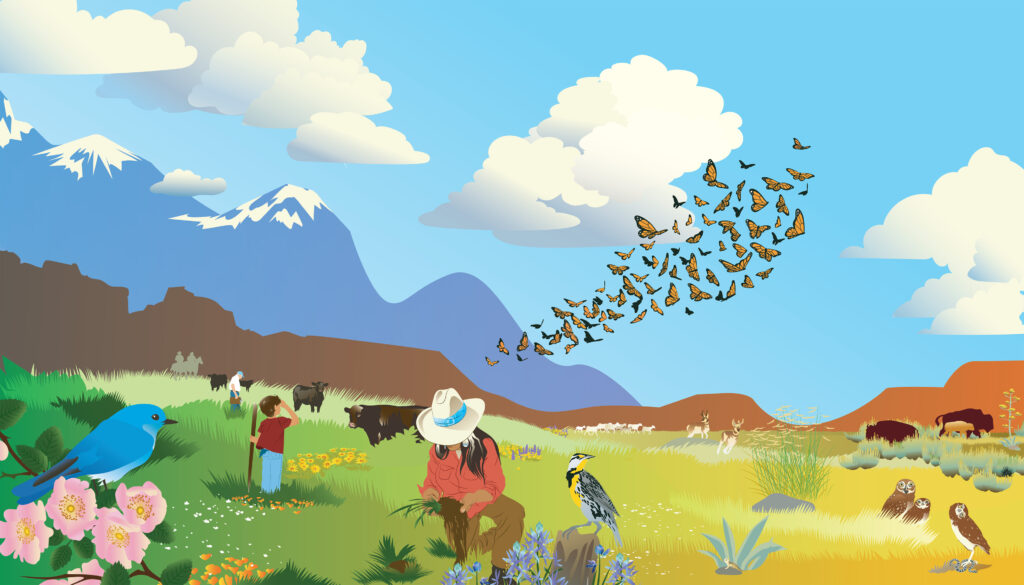
What if the key to making people care about rangelands wasn’t a fact sheet, a policy brief, or even a podcast — but interactive art that people can view, hear, touch, and smell? WSU Extension’s Stephen Bramwell joins the show to talk about a first-of-its-kind public art project that’s deploying multisensory exhibits across 18 states to reach audiences who’ve never thought twice about grasslands or the people who steward them. From tactile fiber samples and scent jars to life-size 3D sheep cutouts, this is rangeland outreach like you’ve never heard of — and you can host an exhibit or submit your own art at grasslandsproject.org.
Music by Lewis Roise.
Support for The Art of Range comes from RanchBot and the Western Extension Risk Management Education Center.
RESOURCES MENTIONED IN THIS EPISODE
grasslandsproject.org is the project’s main public-facing website. It is organized by senses (Watch, Listen, Read, Make, Explore, Educate) with videos, photos, illustrations, poems, and downloadable assets. This is also where people can submit artwork, host an exhibit, or contribute content.
Also check out the Rangelands Gateway website.
Tip Hudson: Welcome to the Art of Range, a podcast focused on Rangelands and the people who manage them. I’m your host, Tip Hudson, Range and livestock specialist with Washington State University Extension. The goal of this podcast is education and conservation through conversation. Find us online at artofrange.com. Welcome back to the Art of Range. My guest today is Stephen Bramwell. He is a fellow Washington State University Extension faculty member doing work in livestock, and I guess, what I would call integrated agricultural systems. He is currently coordinating a large-scale educational effort that’s using public art to raise awareness of rangelands in Pastoralist in this International Year of Rangelands in Pastoralist. But raise awareness sounds awfully sterile, and that’s one of the things that we’re trying to get away from. Before I get carried away with pontificating on sterile communication, Stephen, welcome to the show.
Stephen Bramwell: Tip, thank you very much. It’s nice to be here.
Tip Hudson: Yeah, I think I actually did a monologue on this from a while back because I had put some thoughts together for why arts-based education is important. Of course, if I had that to do over, I’d say a lot of things differently. But I think one of the big ideas is that the goal with communication, nearly any communication, is not just to inform. The goal is really to shape public or individual sentiment through a medium that’s more influential or takes a different mental pathway, I guess, than words. We’re accustomed to using words that we think are scientific and objective and declarative to just say things the way we think is the way things are. But words for all of human history, even words have been used differently, and we’re trying to use multiple media outside of words. I’ve said more than I intended to hear, but this is a topic that interests me. Let’s back up just a little bit. Before we get into the project that is the main subject of the conversation, Stephen, I think listeners need to know more about who you are. You’re currently a little bit like me, a mid-career faculty member doing outreach in Washington State, but how did you get there? Where did you come from?
Stephen Bramwell: Good. Yeah, thanks, Tip. Good question. I am a mid-career extension faculty and like you’ve mentioned, at Washington State University. Oh, gosh, how did we get here? [OVERLAPPING]
Tip Hudson: Where do you work?
Stephen Bramwell: Yeah, I grew up in Oregon, on the west side of the Cascades, and I moved on to working in the agricultural field in a pretty roundabout way. I often like to mention that as I was leaving for college, my grandparents visited. One of the things I remember most distinctively about that visit, when they were talking with me, was asking if I was sure I didn’t want a farm. I mentioned that whether I did or didn’t want to farm, I wanted to go on to college, but I’d keep it in mind. In an interesting way, and I grew up in a relatively suburban environment in Eugene, Oregon, certainly had really great access to the outdoors. Remember early years with a garden in the backyard. But it wasn’t a farming environment by any stretch of the imagination. I did take visits back to South Central Idaho to visit my grandparents, and they raised their family, raising sugar beets in South Central Idaho near Rupert. I always enjoyed those visits. Speaking of the senses and sentiment that really influences people, which is the subject of today’s topic, what I remember most distinctively are the smells. Of largely manure and coming from the city, that was distinctive, but it wasn’t overwhelming. It was more of a comforting I’m coming back to my grandparents’ home type of a feeling. Fast forward several years, and I found my way getting interested in community development in an international setting because I studied international studies and community development at the Jackson School of International Studies, actually at the University of Washington. One of the culminating experiences of that, and this gets to be a slightly longer story, but I’ll try to keep it to the point, was a visit to India and a community that was really engaged in trying to feed itself from the produce and product from a number of farms in the area. This was a community that was developed around ideals of community collaboration, cooperation, international openness. I got involved interviewing and talking with the farmers in that community to try to figure out some of the coordination to get food into the central kitchen, where meals were made for folks. It struck me that food played the central role in community development, and the ability to procure that food locally in a secure manner was really important. I pivoted at that point in my college career. I went on to work at several farms on Vashon Island just outside Seattle, went up to the San Juan Islands, worked on another farm there. In the course of travels to South America, actually met a graduate student who was studying in the soils department at Washington State University. You could say the rest was history. I finished up my internships and working experiences on farms, went back to get a graduate degree in soil science. Then, from there, ended up working in a number of settings and community colleges in the Evergreen State College, where I taught a local farming class called Practice of Sustainable Agriculture. I developed this passion for the educational side of agriculture, both from the point of view of helping young folks get involved in growing food in starting businesses, and pursuing a more tangible, tactile undertaking in life than is sometimes found in office environments, you could say. Then on the flip side, I was very interested over time, especially once I started working for Washington State University, in what the public knows about agriculture because clearly support for our farmers, for working landscapes, for this twin service of both food and habitat that I think is really achievable on many, many farms. Wasn’t something that I saw in my work, as I started getting involved in extension is something that most of the public was aware of. That’s a nutshell background of how I got to where I am.
Tip Hudson: I think I didn’t know much of that. That’s really interesting. I think this is probably a good time to talk about what is the project, and then we can go quickly into what some of the background was because we probably this is a little bit unusual in terms of outreach, and so I think it’d be worthwhile for you to talk just a minute about the overview of what the project is, and then you can describe where it came from because at this point, I can’t even remember where it came from, and I’ve been part of the project.
Stephen Bramwell: Sounds good. The project is a effort to integrate an artistic approach into our efforts to educate the public, as we say, the general public is not a category, but we’ve used that term nevertheless. To educate the public about rangelands and pastoralists, and the many derivatives of those terms that a lot of people are more familiar with or more comfortable with. Shrub step environments, grassland environments, ranchers in terms of whether sedentary or semi-mobile. Then, traditional pastoralists in a number of environments around the world. What we set out to do was to come up with some type of a combination of artistic products to put together exhibits in local communities throughout as many US states as we could. We envisioned that we would recruit artists, partners, and collaborators, and that we would recruit hosts in various public venues to help us set these up. It’s definitely evolved along the way, but that’s the overview of what the concept was. We envisioned that we would connect with, like, an artistic direction team that would have the wisdom, knowledge, experience that we don’t as a collection of rangeland professionals, grassland professionals, extension professionals to put together this concept of recruiting art, developing a concept and then getting it deployed, around predominantly the American West, but more broadly speaking, probably to an extent, North America. We have a little bit of collaboration in Mexico and in Canada, and certainly the biome itself spans those borders. Then, at the same time, we have collaborations out in some of the island locations in Tinian or Hawaii. That’s a part of the region that is within the funding region where we were able to get funding for the project, which was through Western SARE.
Tip Hudson: Yeah, I would say that even in, like, our general day-to-day efforts tend to be working with people who are food producers, ranchers, and the people who are involved in that field. This podcast at least historically, primarily goes out to ranchers and what I call natural resource professionals, people who have livelihoods that are involved in making decisions and influencing rangelands. But trying to reach people that are not in that social universe is a whole different undertaking. It’s also not exactly the stuff that Western SARE has, I think, funded in the past. Where did the idea for the grant project come about? How did you get connected with some of these art folks, and how did that come to being a full-fledged concept?
Stephen Bramwell: Yeah, good question. I think your lead-up to the question, even itself, is worth discussion. It’s interesting that yeah, most of our constituencies, most of our partners are within this producer slash scientist realm. In most of our communications, I think, as a result, and the way that they’re even designed by funders are to be fed back to in large part those audiences. When you look at the funding or the reporting structure for Western SARE, and for good reason, they’re focused on developing sustainable agricultural practices that can be tried, developed, tested, and then disseminated. Then the results of that adoption communicated in terms of success or otherwise, how it goes. Yet you also have this reality that a lot of us recognize that when it comes to working in threatened environments, especially those environments like rangelands and grasslands that have suffered a lot of reduction in extent and a lot of reduction in quality, we’re not reaching other audiences that we probably should be. One of the original kernels that went into our grant proposal was a finding from a workshop at the 2023 SRM meeting that found an ill informed public and policymakers were the primary priority for outreach and communication for the society or at least among the people in the room at that workshop. that concept, which we came to think of as reaching beyond the choir became enshrined from the beginning of the project. The other one was using other modes of communication than facts and figures. I think, in a way, the origin of that had to do with the very notion of the International Year of Rangelands and Pastoralist itself. I think an inherent acknowledgment that the stories, the photographs, the culture, the cultural fabric, the literal fabric, the fibers would be really effective at this communication beyond the choir. Those were the two central premises that guided the project at the outset. When I started looking for inspiration for this, because right away, it was really clear. I was going into the deep end pretty quickly, and I couldn’t feel the bottom of the pool any longer. I think there was a collective sense that, like, this is the opportunity, the IYRP, to do this work. One of the phrases that stuck in my mind from the beginning was, we need to get uncomfortable.
Stephen Bramwell: This is something that the late Jim O’Rourke mentioned. I think some of your viewers might be familiar with Jim and the fact that he passed this last year and was really a leader in getting the IYRP established. In one of the first times that we presented about the concept of this, Jim was still alive, and that phrase was raised in the room at the SRM conference where we were discussing opportunities for outreach. It was like just inherently, I think, understood that if we’re going to be doing outreach, we need to be creative this year, and we need to make ourselves uncomfortable. When I first started looking into some of the literature, one of the papers that I found was a paper. It’s a bit dated now, but it’s one of the few that was really helpful. It’s called Not Preaching to The Choir, Communicating the Importance of Forest Conservation to Non Traditional Audiences. It was written by Nalini Nadkarni who actually coincidentally was a faculty member at Evergreen when I first started teaching out of graduate school at Evergreen there. I was aware of Nalini’s work, and she worked in tropical rainforest canopies and biodiversity conservation. She went on to do really creative types of strategies to try to spread the word. She wrote this paper, and it was a call to all of the rest of us doing work in science to get creative about how we reach non traditional audiences. One, reaching non traditional audiences. Two, not letting just media channels intermediate for us to public audiences, and then three doing it in ways that are truly going to be effective. So this art concept came up because the landscapes and the people lend themselves, I think, and always have to artistic depiction. Then we wanted to do something that was really potentially pushing the envelope. One of the phrases in the grant proposal we wrote down was that art oriented education provokes reflection and expands awareness through the effective or emotional domain. I’m not an educator or a researcher familiar with how art can be utilized. But I can understand that language that we need to provoke reflection and we need to expand awareness. If that’s what the effective domain means that art’s effective at achieving, then I can get that far. You had a further question about how this came about. I hadn’t gotten to that point yet, but I wanted to talk a little bit to some of the rationale for why we started and where some of the ideas came from.
Tip Hudson: No, I think that’s great. Even with what I would call our primary target audiences, it can be difficult. It’s not an easy thing to accomplish behavior change. Even saying that sounds presumptive, like we’re telling people what to do. Part of what interested me about this project is that somewhat almost below the level of conscious thought, this was part of my thinking behind a podcast like this where people are just taking in a wide diet of ideas. I’m not proposing to tell people what to do, but if you receive a broad education and a wide range of influences, I think one of the things that made me think about it was some work from Fred Provenza about metabolism and catabolism. Metabolism is breaking down food into its constituent parts, and then catabolism is the body taking those components and building it back up into what it needs. You’ve got to give it enough material to build what it needs to start with. So with ideas, I think you give people a lot of stuff, and then they can synthesize that into context specific decisions that work for their environment where as so called educator, sometimes I know enough to propose that, but in many cases, I don’t. So our job is both to educate, again, that feels like a sterile word and inspire and give people the raw material from which to make their own good decisions. This is almost one step further than that because you’re like a smell. You can use words and imagery and textures to try to provoke the memory of a smell, but you can’t communicate a smell in any of these visual or auditory mediums. But you can put the pieces together where people have a more multisensory experience that is influential and absolutely affects behavior to get beyond just awareness to more of a deeper appreciation. I think Igshaan Samuels did a pretty good job of describing the global significance of rangelands and the fact that these are hugely important to everybody on the planet. Yet they’re the places that people tend to not think about because it’s the stuff you just drive past and ignore when you’re going down the road. Yet they’re pretty significant both culturally and economically and socially. I feel like this project is trying to capture a little bit of all of that to influence people in a more effective and significant way.
Stephen Bramwell: Yeah, those are great points and interesting ones, and I think it helps to take that step back. I think that’s part of what we are doing with this work to step back a little bit with regard to the question of what is effective in education. You’re mentioning this metabolism, catabolism, you disassemble the building blocks and then reassemble it. Probably somebody who’s knowledgeable in how the brain works during the educational process could describe to us that people don’t maybe assemble their lessons in all the same way and sometimes in ways that we probably think they might. I think intuitively, any of us who have spent time in the classroom in combination with our work in the science or research field, I think there’s a little bit of advantage we might have because the way that students learn are really diverse, and it’s not just a matter of placing facts in the frying pan and they cook it up in just the way that we expect they will. One simple phrase, too that has been stuck in my mind for a long time based on my educational experiences because I taught at Evergreen for five years, and I went on to teach at Community Colleges for another three was that you just put a flame there or a spark and you’ll get a fire or you’ll get a flame. If you put the right inspiration in front of people, that’s what’s going to be the fuel. Actually, I guess you could say it a different way. They may provide their own fuel to really build the fire, and it might not just be the figures in the tables that you put up on the PowerPoint slides, although those obviously contribute. Yeah, I think that’s an interesting part about this. It is a risk getting back to that question of what funders are likely to fund. One of the reviewer responses for this project was that we had an enthusiastic team and it was a wide reaching team across multiple states to make the case that we could do an educational initiative and we could do legitimate research about what’s effective, from the point of view of influencing viewers and teaching them about these landscapes. But one of the comments was that it was a high risk and potentially high reward project, which is a grant recipient and gave me a moment of pause, organizing the project, but it also, I think it was validating the they saw the opportunity and that we were all going to figure something out along the way. That’s really the goal of the research because it’s a research and education grant is what is effective in arts education, which is a really big question, and we will not crack that entirely. But I’m already seeing that we’re learning a lot based on the exhibits that have been deployed across 18 states across some of the feedback we’ve gotten from the exhibits I’ve put up locally in my location, which is in Thurston County of Western Washington on the west side of the cascades. We’re seeing that in preliminary ways, anyway. But this last quotes that also stuck out from this article by Nalini was that this work is sometimes seen as a distraction from our obligations academically, public communication, communicating in popular press ways or in popular press mediums. There’s a little bit of a back pressure in the academy to this. I think there’s really pretty legitimate and secure ways we can navigate that. If we are in university settings, we can attach good research questions to this outreach because what I found, too, in preparing the grant proposal was I could really find very little that talked about the combination of art and science education from a point of view of actual to the extent in legitimate qualitative and quantitative social science research protocol, but specifically like natural sciences, education, knowledge of landscapes, knowledge of agricultural environments, specifically, of course, is what’s of interest to us, but of course, spanning that threshold between native ecosystems and managed agricultural ecosystems and using art to communicate that. When it came to making the case in the proposal, I couldn’t find that much. There’s a fair amount out there having to do with like using murals in public spaces to engage passers by, even really specific subject matter, like marine biological conservation. In areas, I found some good papers down out of Chile had to do with public art along seashore or seawalls, promenades, that kind of thing, in ways that would connect people to the marine resources that were just out in the water next to them, and in the ecological and cultural value of those. But there was very few and getting to your question about how we connected, one way that I tried to do this, especially from the point of view of developing the research proposal was scanning the literature for any type of arts based science communication and then emailing people all over the US and even other countries and asking them if they would serve as the evaluation specialist on the project, what they knew, how connected they were to the arts community, if they had any further recommendations for reading about research that focused on integrating art and science and natural resource management education. I couldn’t go that far, and I’m not a specialist in that research field, so I’m sure there’s other people who know a lot more about the literature than I do. But I’m not bad at scanning the research literature, and it felt like there’s not a whole heck of a lot to guide us.
Tip Hudson: I can imagine there would be I’m just thinking the devil’s advocate position here. I can imagine there are some listeners who are thinking art as education. Yeah, go back to Evergreen. Yeah, can you say a little bit more about what you did find, even though the literature is pretty thin or maybe just your own convictions on why this could be an effective way to shape people’s opinions.
Stephen Bramwell: Yeah. So that’s a good question.
Tip Hudson: Because I would say my response to the rancher is that our goal is to make people care about what you do for a living. That has pretty significant public consequences in terms of policy sentiment. There’s a lot of stuff that’s downstream from people either feeling positively toward food producers, and I don’t like the term food producers, but farmers and ranchers, I think it does have some implications, but I’m curious what led you to continue on this path knowing that you were going to get that pushback from grant reviewers, from possibly participants?
Tip Hudson: Everybody.
Stephen Bramwell: Good question. Well, initially, when I was thinking about this, the international year of Rangelands and Pastoralists was obviously the motivation. I was attending I guess it was probably the 2023 SRM conference, and sitting in on some of the planning sessions, it looked to me like there was probably an opportunity to coordinate a coalition of people wanting to do something across state lines. At the same time, I was thinking really seriously about a sabbatical through Washington State University, and I was searching around for subject matter for that, and I had done a lot of work locally with our South Puget Sound Prairies, because much of those are in private ownership, and yet there’s a lot of ESA listed species. There’s this real imperative for conservation communities to collaborate with private lands, owners, working lands owners, farmers, ranchers. I was looking at how it could combine some of my work traveling with a initiative to do some type of outreach. I really enjoy photography, so that became for me the link. Photography, me and my not always associate with fine art, like paintings, or performance art, or poetry. But it fits into overall artistic realm of expression. It’s something that I grew up with, something I love. I use it within my work daily basis. It’s one of the most, I think, powerful tools I have, even in developing extension publications to develop high quality photographs to help to make points to demonstrate processes to illustrate the work that we’re doing. I think for me that was the motivation in terms of keeping me going, and everybody can. That’s entry level art for those of us who don’t work and we can all recognize a good picture when we see one, and then everything else opens up from there to poetry, to painting, to illustration, to graphic comics, to all these other opportunities that we could use as artistic medium storytelling. At that time, I started communicating really closely with Laurence Fakhar, who is the communications coordinator, has been doing a lot of communications coordination for the FAO, Food and Agriculture Organization. She’s really central within outreach for the IYRP effort with Barb. Then through that, we just started building the network of people who are interested in this. They really saw that we were all going to be limited in time coming into the year 2026 for the International. The more that we could collaborate together, the better. It wasn’t really challenged to be perfectly honest. Everybody thought, because there was a sense that we need to get out of our comfort zone, this is a perfect opportunity. We can attach all the facts and figures we want to it. But to be frank, when we brought it up, it was almost like everybody had already been thinking the same thing. At least within the SRM circles that we spoke with, that we need to get videos that get famous. If not famous and at least influential individuals into these videos. We need to get into public venues where people aren’t hearing and seeing these landscapes. I just think naturally, since we’ve all worked in these places and with these people, we know they’re beautiful. We know they’re evocative. We know they have stories to tell. It honestly wasn’t much of a reach from an organizational perspective. It was a reach from the point of view of finding the scientific underpinnings to say, this is a legitimate.
Tip Hudson: To justify.
Stephen Bramwell: To justify it. You could see some of that in the reviews. But I think we got really good responses on the concept from Sarah when we approached him in person at some of these conferences when they have tables. They’ve been supportive along the way. But it’s been a translation process of what it will mean to evaluate the effects of using art in these public places for influencing people’s knowledge, their attitudes, their behaviors, the classic logic model impacts that we’re looking for. There’s a challenging translation process there that I think is very real time because we’re only one year into the project. It was funded in April, but we didn’t get awarded until June or July. Then it was a real mad dash to recruit all of the artists and the art direction contractors that we wanted to work with from summer through winter of this last year, and then actually have exhibits to start putting in the mail to people in February. That’s a really compressed time frame to work on. We’ve gotten, I want to say 22 exhibits or 25 somewhere in there out the door, so far to 18 states, working with about 53 different collaborators, with folks. Don’t tell Sarah, but in Mexico and Canada, also.
Tip Hudson: I’m sitting here being reminded of one of my favorite quotes from the author of the book Little Prince. I’ve probably used it before, but it’s worth restating, I can’t pronounce his name. It’s some French person, Antoine de Saint-Exupéry, He said, If you want to build a ship, don’t drum up people to collect wood and don’t assign them tasks and work, but rather teach them to long for the endless immensity of the sea. If people want to go to sea, they’re going to find a way to build a ship and nothing’s going to stop them. But if you just tell people what to do, that sometimes is not effective. That applies across a lot of stuff in life. What are the different media that are involved in this project? You’ve mentioned a little bit about some public displays that include more than just words and pictures. What else is involved?
Stephen Bramwell: That was an interesting process when we first got going. I think the first lesson for folks interested in deploying art is start working with people who are in that field, who are artists who have worked with public art displays, developing them. Because the realm of what’s possible in some instances hasn’t even occurred to us. What we should use, we may have some little inkling of, but what we really could use will be much wider. That was one of the first things we learned, and it was really fun. We worked with a firm, Haddad Drugan out of Seattle, Washington. There was some roundabout connections through a co worker I work with who knew them. They had done some on farm art installations. They’re landscape designers by trade, and then went on to coordinate public art installations, not only around Seattle and parts of western Washington, but out further afield in grasslands, they developed a large installation in a grassland state. I can’t remember exactly where it is now, but it was a larger than life depiction of a bowl with horns up on a hill made out of sticks. You could see it from afar, but you had to walk up close to it to experience it. It drew you into this landscape. They had all other interesting art installations on the waterfront in Seattle, with the light rail that’s been going in around Seattle with stations. What came out of those discussions was all sorts of different opportunities, and we rapidly got to the point that the goal would be multisensory in so far as we could, like you mentioned smell and it’s hard to get to a smell certainly not in a video or a publication, but even in a physical exhibit. But every scent that we could potentially drawn, we wanted to. The outcomes or the exhibit products that we’ve arrived at so far is there’s a super graphic, which is an illustration. It’s like a painting, but it’s like it was graphically designed, but it’s got the feel of an illustration that someone has drawn, and even the concept of a super graphic was new to me that you would take one whole side, and what we arrived at was this would be some walk around exhibit because it would have three dimensionality. You should explore it so it should involve movement. It should involve touch. Obviously, sight. We could only do sound if we involved some technology like push buttons, you might encounter in a museum where you hit a button and you can hear an audio, a story being told. As part of my sabbatical when I was traveling, I visited several different museums that were focused on educating about herders and shepherds, one in particular at the National Park in Hungary, and they had these scent perfume bottles where you could puff them and they would have different sense of artemisia or time. You could actually get a sense of the smell of the landscape, some of the grasses of the area. Those were areas that with a little more time we could have done. We started this and so what we did is we went wide. I think that’s a really important point. We came up with a bunch of ideas. We had a tool kit, and what we did is we would meet with all the potential collaborators in the different Western states, and we’d sometimes have pretty full meetings of 30 or 40 people, and we’d go through a list of all the things that could be on this thing. Maybe there would be a video screen, so you could watch a video of a place or see the sights and be listening to the sounds of it. Ultimately, with the time constraints that we had, we narrowed down to touch. We have fiber elements. There are some flip wheels within the exhibit. This is imagine a large trifold of panels that’s six feet tall and they articulate so it can be an accordion shape. There’s content on both sides. These flip panels draw out. Especially kids, they’re put at a height. It’s designed for children to spin them. There’s a picture on one side, and there’s information on the other. There’s a series of boxes that we can put in seeds or acorns or bits of fiber and wool, bits of hide, and they’re all at that youth level threshold between youth and adult. Because we had this concept that one of the main ways that we can get people to stop is if their kids are interested. It had this playful theme that came out early on, and that’s where the illustration came from. We looked at photographs of landscapes, we looked at paintings of landscapes, and we looked at illustrations of landscapes. Anybody who’s followed any type of illustration art will know there’s international competitions where people submit their illustrations, and they’re vivid because it evokes every aspect of you might imagine about how landscapes could be depicted from the mythical, magical, the ecological, the cultural, political economic. I mean, anything can go in illustration because somebody designs it and integrates all these elements purposefully. We landed on this, it should be playful. It should attract kids, and then it’ll attract adults, which is the real target audience to have some knowledge change. Those were the main elements. We arrived at an image collage. We arrived at this large super graphic illustration, which is ecologically accurate. All of the elements in it can be interpreted. There’s an interpretive card, 8.5 by 11 laminated sheet that’s got all the different species, flora, and fauna in this image. It’s a composite, which is another powerful aspect of an illustration. When we go to take a picture to illustrate a point for the public, we can only get what’s in that image, but an illustration can span elevation gradients. It can span moisture gradients, temperature gradients, any diversity, we interpreted that on the illustration for viewers. This is a composite image from high to low elevation, from moist to dry environments, but all within rangelands of the world to illustrate their great diversity. From left to right, you get this sweeping panorama from high to low and moist from wet to dry. It’s mostly focused on North American rangeland gradient and grasslands. That’s a really important piece of it.
Stephen Bramwell: Then, like I said, these tactile elements with the fibers and the reach-through flip panels, and the image collage. Then the pieces that we designed for takeaways and that the arts team helped us to coordinate were posters, sheet cutouts so that you have a little template for cutting out a sheep. You cut out different parts and you color them, and then they fit together into a 3D model so you can make a small stand-up sheep. There is a larger almost life-size 3D sheep, which something listeners might be interested in is some of the more influential components of the exhibit when it comes to viewers. But then there’s the last couple pieces, coloring books, coloring pages, designed a seed packet so that people can fill the packets with ecologically appropriate seed for their location. But that’s got the illustration on it. There’s a continuity in the design that all starts with that super graphic, and it threads through all of the digital assets, all the educational assets to give it a continuity to the whole piece. Then, to the extent we can just trying to create as many multisensory opportunities for viewers. Lastly, there’s a panel that’s not blank, but mostly blank that can be populated with a different content that people can stir up locally. It could be acorns from a California rangeland that fill this cubby, could be obviously photographs. You can drill fibers into the bottom of one of the display shelves. You can put out fiber products like knitted or crocheted products that could have a story and you could talk about it. Then there’s instructional pieces in the toolkit, which is also generated by a partner, Jordan Freeman, who contracted, who wrote up the overall how-to guide for how to use this exhibit, and then had a lot of different educational opportunities like scent jars to replicate what I saw in Hungary. There’s these bell jars that you can create scent jars out of them. There’s basic instruction so people could actually walk up and sniff that. That could be on the shelf and a number of different other interactive opportunities. Those are the areas that were so important to have help with because either we wouldn’t think of, we had never heard of, we wouldn’t have the time to design them, let alone write them up and put them into a toolkit to disseminate out to people for creative ideas of how to use art in their education. There’s a ton of good resources beyond just the exhibit, beyond the posters that are wrapped up in that toolkit.
Tip Hudson: Stephen, you’ve alluded to the fact that a number of these resources and even the ability to request one of these displays is on the website that you’ve put together for the project. We will list that website in the show notes, but it’d be worthwhile maybe just to call that out here and describe briefly what all is there. This group that is listening to the podcast is mostly the choir. These are the people who live and work in rangelands and may feel like they don’t know how to communicate with people that don’t know about rangelands, and one of the objectives of this project is to make that a little bit easier. I think you’ve actually done a pretty good job with that. Where is the website? What’s on it? Say a little bit about how people can do some of this on their own.
Stephen Bramwell: Yeah, absolutely. The website, the URL is grasslandsproject.org, and that is where we have a lot of the educational resources that we’ve talked about placed. It’s definitely an exposition site in and of itself. It’s meant for very much a public-facing interaction. This was one of the main goals to have as a companion product to the actual physical exhibit when we proposed it to Sarah. The QR codes on the exhibit leads to this webpage. Then this was designed and developed with Rangelands Gateway as a new essentially library collection. We worked with the University of Arizona on this, and then this became the intake portal for a lot of the art. Importantly, this is still the intake portal for a lot of the art. Probably one of the first functional pieces that was designed was a mechanism for intaking all sorts of different files, audio files, audiovisual, and then linking them through to what’s also designed as a sensory exploration webpage. When you go into grasslandsproject.org, you see the landing page. There’s what’s the problem, what this project is doing. As you scroll down, it’s organized by the senses. Watch, listen, read, make, explore, and educate. Obviously a lot of the videos, a lot of the photographs and illustrative work is in the watch. We have relatively less content, but we’re working on recruiting it in listen. Somebody recording a poem could be uploaded. Soundscapes can be uploaded. Then there’s a pretty informal but sufficient, what would you call it? Refereeing or a review process where we see what’s coming in, just check it, and then we just hit publish, and it publishes straight through. Anybody listening here can submit content of any number of different kinds, even a poem or a story that’s on a document that can go into the read section, and we have some preliminary entries in there. The actual digital assets, as you might say, are under the link that’s called Educate. If you go in there, there’s links to all sorts of the different work products that we designed. The posters, the seed packets, the coloring book, coloring pages, postcards, instructions for a coloring crochet square, how to do this 3D sheep cutout activity. That’s an opportunity. There’s a link to under Get Involved. There’s a bunch of different opportunities here for folks. They can submit artwork, which is the first link. They can contribute content. They can create their own story by making a video. I’ll talk about that in just a moment. They can host an exhibit. Just to date, we have 33 of these committed. We’re pretty much up against the funding line that we have for making them, but we’re going to probably shift a few things and we can probably fund a few more. People, if they’re interested, should reach out and we could see what we can do. They’re also not that expensive. If you get enough people or even just a few who want to have some fabricated.
Tip Hudson: With their own funding.
Stephen Bramwell: We can make them for right around $2,500 and put in a work order with the fabricator that we’re working with. This is like a maker firm out of Tacoma, Washington, called Visual Options, and they’ve been awesome. That’s another point I would make to listeners, too, is that there’s all sorts of maker communities and businesses out there. If you can scheme something up that you want to make and plaster it with stories and art, there’s a firm, a small business out there that can still manufacture things in a workshop on site with tools that they use. It’s not all just stuff that we can buy on Amazon. That was eye-opening for me that we could work locally with folks.
Tip Hudson: Stephen, you recently did a sabbatical in Europe, working with what we’re calling pastoralists, and this was a chance to be immersed in real places with real people. I think people sometimes, up until recently, had the idea that sabbatical just meant you didn’t work for a while. That’s probably the impression of that outside of academia and the term certainly sounds like that. We’re going to do a separate conversation an episode about the sabbatical, but this can function like a teaser. I guess I’m particularly interested in how did that tie in with this project with the IYRP and arts education?
Stephen Bramwell: It was integrally involved right from the outset. I think, part of the fact that I was going to be going overseas and hit upon this idea of visiting locations with grazing systems that were pretty well embedded in their local ecologies, sometimes referred to as species-rich grasslands, semi-natural, semi-native grasslands. That played in right away to the overall of art-based approach for communication and organizing a group of folks in western states to put up these exhibits and to work together. I knew that I was going to get a chance, like you mentioned, to go to real places with real people, and not only that, extraordinary beauty, extraordinary ecologies, extraordinary flowers, extraordinary wildlife, and so I was really looking to it for inspiration. In a way, I would I think of sabbatical for me, was an opportunity to try to rekindle that fire, rebuild that flame of inspiration. That, in part is also, I think, why the arts approach is a durable for me, trying to move it forward. It would just be that opportunity to really dive deep and immerse myself in some places that are in some cases really when we refer to rangeland and these grasslands and shrubs-steppe environments, desert environments is being threatened, especially in terms of them being managed somewhere in the middle of that spectrum between native ecosystem and the managed agroecosystem, places where there are increasingly fewer and fewer of them. It gave me that opportunity to be there in the real world where these pressures were exerting themselves on people. Granted, it was in Europe, so the educational campaign is focused on American populations, but we took this local to global theme because it is the international year. All of the exhibits have local content, regional continental content, and then global content. Being overseas gave me a chance to contribute a couple photos to the project and then also meet a lot of people who could contribute material. I’ve really continued to use that. One of the poems was recorded by a fellow in Hungary, a herder videotaping his cattle at night reading a poem. That’s one of the first audiovisual entries that I made to the collection at Rangelands Gateway. There’s others that I’m still working on uploading. It’s been really fun because it’s given me the chance to support folks in the US and to work on this project with local content and then draw in the global context, which I think ultimately provides viewers, too, that inspiration that, wow, we’re part of something so much bigger and so important, these global grasslands and rangeland.
Tip Hudson: Yes. I look forward to hearing more about that.
Stephen Bramwell: I look forward to talking about it.
Tip Hudson: Thank you for your time today, and thanks for tackling this project. I think this is a significant and quite important effort, both just because of the nature of the topic, but also this novel approach to trying to influence people and let people know about the world out there that they often don’t know about. Thanks again for your time.
Stephen Bramwell: Well, we sure appreciate the opportunity to promote the work that we’re doing Tip so thanks for having us on.
Tip Hudson: Thank you for listening to the Art of Range podcast. Links to websites or documents mentioned in each episode are available at artofrange.com. Be sure to subscribe to the show through Apple Podcasts, Podbean, Spotify, Stitcher, or your favorite podcasting app so that each new episode will automatically show up in your podcast feed. Just search for Art of Range. If you are not a social media addict, don’t start now. If you are, please like or otherwise follow the Art of Range on Facebook, LinkedIn and X, formerly Twitter. We value listener feedback. If you have questions or comments for us to address in a future episode or just want to let me know you’re listening, send an email to show@artofrange.com. For more direct communication from me, sign up for a regular email from the podcast on the homepage at artofrange.com. This podcast is produced by CAHNRS Communications in the College of Agricultural Human and Natural Resource Sciences at Washington State University. The project is supported by the University of Arizona and funded by sponsors. If you’re interested in being a sponsor, send an email to show@artofrange.com.
Speaker 1: The views, thoughts and opinions expressed by guests of this podcast are their own and does not imply Washington State University’s endorsement.