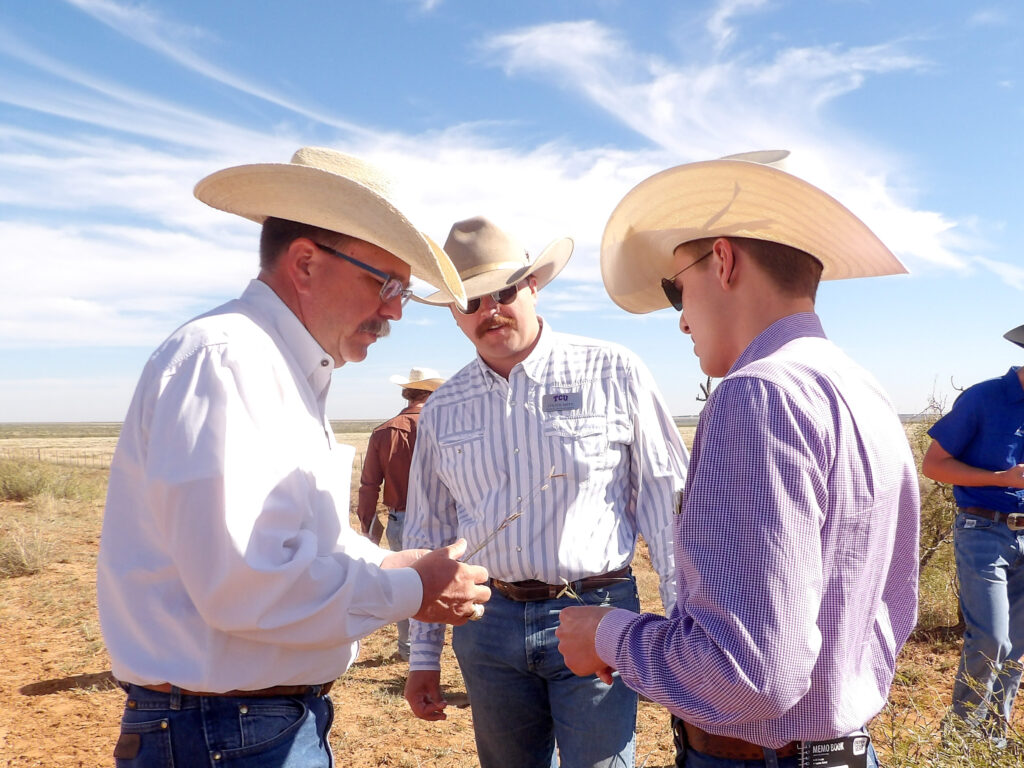
In 1956, a group of Texas ranchers decided the training their kids needed didn’t exist yet—so they built it themselves, and it’s still running. Lee Knox, the Houston Livestock Show and Rodeo Professor in Ranch Management at Texas Christian University, describes TCU’s nine-month, 35-credit certificate program that packs soil and forage management, animal husbandry, business, and marketing into a single intense year, backed by 1,200-plus alumni who host field trips, mentor students, and post job openings. Lee also reflects on a career spanning extension work, two decades with NRCS, and a lifetime of running cattle on leased ground—including why the return of fire to the Southern Plains is a backhanded compliment to better grazing management, and how hunting revenue brought Texas landowners and wildlife groups to the same side of the table.
The Art of Range is supported by RanchBot and the Western Extension Risk Management Education Center.
Host: Tip Hudson
Music: by Lewis Roise
Producer: Matt Ziegler, WSU College of Agricultural, Human, and Natural Resources Communications
Mentioned resources
Texas Christian University Ranch Management program and TCU’s Bachelor of Science degree in Ranch Management
Check out episode 164 with Rick Machen about the King Ranch Institute for Ranch Management
Tip Hudson: Welcome to The Art of Range, a podcast focused on Range lands and the people who manage them. I’m your host, Tip Hudson, Range and livestock specialist with Washington State University Extension. The goal of this podcast is education and conservation through conversation. Find us online at artofrange.com. Welcome back to The Art of Range. Today’s guest is Lee Knox, a professor in ranch management at Texas Christian University. I’ve been asked a number of times in the last few years about what programs for ranch management are out there for young people who want to do ranch management, maybe moving beyond an internship or in response to a supervisory or manager level position, and then they realize they’d benefit from some more formal training. My degree was in Range anecology and it prepared me well for what I’ve done in life so far, but that has not been managing ranches. There are only so many of these ranching programs out there, and I think TCU is one of the oldest. A little while back, I visited with Rick Machin on the show, and he talked about the King Ranch Institute for Ranch Management Program, which is a little bit different thing than Texas Christian University’s Program. Rick said that I should talk to Dr. Knox, so we’re going straight to the horse’s mouth. Dr. Knox, welcome to the show.
Lee Knox: Thank you, Tip. You do neither drop the doctor or I do not have a PhD.
Tip Hudson: Well, I don’t either and I call the doctor all the time, so you’re in good company. I recently had the pleasure of speaking with you and your current cohort of students in person there in Fort Worth, and I was very impressed with the students and from what I could see of the program. Maybe let’s start with an overview of the program, and then we’ll get a little bit more into your background and how you ended up here. I did not know much about this program until just a couple of years ago. I knew about I think one that, no, it’s not coming to me. No, I just recently learned about this, but it is one of the older ones. How long has this been around, and do you know how it came about?
Lee Knox: I do. The program started in 1956, and ranchers from the from Central Texas, primarily in the Rolling Plains had got together and visioned about a ranch management program, the trained professionals that they could they could potentially hire and maybe even their kids could go through the program and then come back to the ranch as professional managers of property. It was created, they looked at several universities. I’m in Texas Aggie, so they did go to college station and visit with A&M also, but they decided because they wanted strict sideboards on the program, they didn’t feel that even in the 50s, a state university allowed them to put the sideboards that they wanted onto the program. So they approached Texas Christian University and created a program, like I said, back in 1956.
Tip Hudson: That’s interesting. How big is the program? Is this both undergraduate and graduate work?
Lee Knox: The program is strictly undergraduate work and it’s a nine month certificate program. However, we do have a track that you can get a bachelor of science degree through the College of Engineering and Sciences, also. It just looks a little bit different, but even those undergraduates, they will spend nine months in a cohort through the branch management certificate program.
Tip Hudson: That’s interesting. You only been there since 2024, is that right?
Lee Knox: That’s correct, I’m the newest faculty here. We just hired somebody else, so I will no longer be the newest pretty quick. I knew about, I learned about the TC Ranch Management Program when I was an undergrad at A&M, back in the 90s and it was well thought of then and it continues to be. The vision of the program from the original people that put it together was not only the animal husbandry range and forage management component, but also a really in depth business component and marketing component, and then they wanted this all done as fast as possible because a lot of ranchers, they rely upon family labor a lot and family management, and they didn’t want to lose children off to college for extended period of time. The program is very condensed and can be very stressful, but it’s 35 credit hours in a nine month program. We start every August with a new set, and we graduate them in May. Our graduation is Thursday.
Tip Hudson: Wow. What kind of students do you tend to attract? It sounds like oftentimes they’re people that are in ranch management, managing the family’s place or someplace that they’ve been hired to run, and then they end up here. How many of those students do you have versus, I’m calling them kids. Kids that are coming out of a bachelor’s degree or other prior training, and this is their starting point rather than a midpoint.
Lee Knox: Great question. We don’t have a traditional student, we range from 18-42 this year, and I would say, around 50% already have a bachelor’s degree, and 100% already have some kind of college credit. Then and then our undergrad program, which is really growing. That set is usually around 10-20% of our students are in our undergraduate program, and they’re spending their senior year with us, they’re in their certificate side.
Tip Hudson: They come from all over the place or mostly from Texas?
Lee Knox: Primarily Texas and Oklahoma, but you never know. This year, we have North Dakota as the farthest north. The farther south is Australia and barely beating Brazil. Then from the East Coast all the way to the West Coast. We geographically diverse, which makes our program real easy to build a range management program that’s tailored towards Central Texas and Central Oklahoma. But whenever you have students from all over the world, essentially how do you teach these processes, not just in a local geographic area, but how do you teach about range management and how you manage rangelands across the world?
Tip Hudson: How many students do you have at a time or what’s the capacity of the program?
Lee Knox: The capacity is 36, and we haven’t been at capacity for a long time. We tend to stay in the 20s, the high 20s is a really good number for us. But we’re looking at possibly breaking 30 this year, which will be great, and so logistically, it makes it a little tougher. We do five week long field trips, and we travel in suburbans, and so it takes a fleet of suburbans to get to get students transported and hotel rooms and all the parts that we do. But we have those plus numerous day trips and field work that we do in the general local area say, within three hours of Fort Worth, something that we can handle with a day trip. We do several of those a year, and so getting above 30 makes that logistically much more difficult. But we’ll figure out a way to do it, and we want to make sure that we continue to provide the educational experience to as many as we possibly can.
Tip Hudson: It sounds like it’s pretty intense. What attrition rate do you have once people get into it and realize this is gonna be pretty tough?
Lee Knox: I have a limited experience, but what we noticed is the students that don’t really want to be students, they go home at Christmas time, and that’s always less than 10%. The ones that are serious and want to work hard, typically, we have a capstone management plan, and that’s due during spring break. If they complete that capstone plan, then they’re going to graduate as a general rule. If we have somebody that doesn’t finish the capstone project, they will not graduate, but we do allow them to finish their credit hours if they want to.
Tip Hudson: Well, you’ve only been here for a couple of years, and it sounds like we might be a similar age. I actually turned 49 on Monday. So I went to college at the University of Idaho, starting in 1995 and was there through 2000. For quite a while, I felt like I was typically the youngest person in the room, and that’s now no longer the case. You’re in a somewhat similar position, at least based on the dates of your college experience, so you must have done something before you came here. How did you get involved in ranch management and then to have an interest in teaching something like this and whatever your career was before this.
Lee Knox: Great question. My heart lies in rangeland, and I have a unique background in that. My grandparents were involved in production agriculture, but my parents, my father was a professional soldier, an officer in the Army, and so that when you’re raised moving around a little bit, you don’t build a ranching empire, from there. In the ranch profession, I think it’s a great story, I spent the night with a family, I was in seventh grade and they said, by the way, we’re going to do a ranch contest tomorrow at Junction, Texas. Do you want to participate? I said, what do I have to do? They said, well, you got to learn some plants and do plant ID and then there’s some other stuff. We went to the pasture and learned some plants that night, and I went and took the contest the next day. I said this is really amazing the forage has something to do with beef cattle production. At the time, I was already in FFA and forage and everything. It started from there and then change of degrees at A&M and being involved in the range program at Texas A&M, and upon graduation, graduate degree because there weren’t any jobs really in Texas back in the early 90s or early to mid 90s. Went to New Mexico State for a Master’s of Science in Range in animal science. I’ve always been on the edge of both of those fields, I actually have as many animal science hours as I do range management hours from a collegiate standpoint. A few years doing extension work, which I really, really loved extension education. But I decided to change for personal reasons and go to the Natural Resources Conservation Service and spent over two decades in primarily Central and West Texas with the Natural Resources Conservation Service. That’s been my professional track and as a sideline, I’ve owned cattle continuously since I was 16-years-old, and so I’ve always ranched on lease grounds somewhere on the sides somewhere. I guess that’s passion so when TCU was looking for somebody that was trained and skilled in range management with extensive livestock production background, I gladly raised my hand and jump ship from the federal government and came to TCU at Fort Worth, Texas.
Tip Hudson: Maybe we’ll jump back over to the program. I can think of some of the things that I feel like I don’t know that I would need to know if I was trying to manage ranches. What are some of the components of the program? You alluded to a few things that there’s a strong business and marketing component, and that would definitely be one of the things that I would need if I was interested in doing that. What’s the general overview of the content of the program?
Lee Knox: The program it’s broad based and so it starts with soil and water conservation and the forage components range management plus forge and pasture management. That builds the basis of the ranching industry, and then from there, all of the the harvests that forage correctly and turn that into high quality protein, we have to really do a good job of taking care of the livestock. Animal husbandry which including beef cattle production, feeds and feeding, reproduction, animal health. All of those are different classes that they have to take so all the animal husbandry. We’re changing it more than likely to more of alternative enterprises, traditionally a sheep and goat component. The sheep and goat component will stay and it’ll be a significant part of that, but we’re probably going to add some additional alternative enterprises into that program. Quite a bit of ranching business management, employee management and accounting to go along with that. That’s the big picture or my big selling point for somebody with a bachelor’s degree is especially somebody maybe has an ag business degree, chances are they know more about ag business than I do, and that’s fine, but to be a good ranch manager, we’re going to fill in all those other gaps, all the forged component, all the animal husbandry component in the marketing side to help them be a better, more rounded ranch manager in the future.
Tip Hudson: What percent of students are going back out to manage a family place, and what percent are working as a, for lack of a better phrase, a hired ranch manager for a larger outfit?
Lee Knox: Traditionally, since I’ve been here, it’s held true, and in looking at the alumni, we do need to visit about the alumni at some point today, too. But looking at the alumni, about a third of our graduates go back home to a family operation. About a third go into production agriculture management or foreman, management, camp person, somebody that’s going to be in production and maybe needs to spend a little time in production before they become a full blown manager, but they’re going back to the ranch to work for somebody else. Then we also have a third that go on to the service industry, and that might include we have numerous lawyers that are alumni that they go on to law school and become lawyers. We have graduates that work for Cattlefax and graduates who work for livestock marketing facilities and companies or work in the general markets. Then we have numerous that go into the ag lending sector. About a third, a third and a third is our running average over time.
Tip Hudson: It had not occurred to me that with a program that’s been running since 1956, you would have a lot of alumni at this point.
Tip Hudson: To what extent are they still connected with the program, and how do you interact with them?
Lee Knox: Our alumni, we’re probably in excess of 1,200 of them now. The alumni, they provide a lot of our support as far as when we travel. We will spend a portion of our time will be spent with alumni on their operations and looking at how they manage those. During those week long trips, we go to the two enterprises a day. Usually, half of those end up being alumni and they support us, and they support us with helping the students on their travel with food and some other things also. They also support the program, monetarily as far as, providing some assistance when we need additional resources, they always are glad to step up and help us with additional resources and do things. Then they also service, we have a mentor mentee program with them. As every student has the opportunity to have an alumni mentor to help them through the process and through the program. Those are the primary ways that they help us, and they’re very active. Then they also support from a technical side, if we need assistance on the technical side, we will definitely reach out and help and lean on their expertise, whatever segment of industry they’re in.
Tip Hudson: I had not noticed until I did just a little bit of research before the interview that TCU list you as the Houston Livestock Show and Rodeo Professor in Ranch Management. That would seem to be evidence of some kind of industry support, if not something like an endowed position. Do you know the history of that? It sounds like you do have strong industry support. I’m also wondering, to what extent does that support students’ abilities to participate in the program financially?
Lee Knox: Wonderful question. All of our professorships are endowed through the industry, and so that’s taken, that’s our relationship over time and within the industry, and we’re well supported through the program for that. Also probably more importantly is, we are a private university, and that typically means that tuition is rather high compared to a state university which is true. Fort Worth is actually a pretty large city and rent can be rather high here. Support from the industry as far as the students we have and the alumni, we have tremendous scholarship support. The tuition for the program, is depending on what category student you are $50,000-$60,000 a year for that nine month program. That’s a pretty substantial capital outlay. However, if you apply for scholarship, they’re all managed in house. I wouldn’t say they’re merit based, but there is an incentive to do a good job and be participatory as far as wanting to participate and be engaged in the program, not just in the classroom, outside the classroom. When it’s all said and done, we have enough support to pay for a vast majority of that tuition over the year, so that part is great. The other one is, is we also have a fund that pays for all of their travel. We stay in hotels, they do have to have a roommate. But whenever you book 15-20 hotel rooms at a time, there’s quite a bit of money that goes with that. All that is now paid for. Out of pocket is some tuition, not nearly as much as the price tag on the website, and then their cost to live. We actually have support within Fort Worth, our students are so well loved that we have renters that hold back wanting our students because they know they’re going to take care of their rental facilities. They’re not here to party. They’re here to learn. We actually have the rental community actually really loves our students too.
Tip Hudson: That’s impressive. It just occurred to me there are an increasing number of ranches put together that have absentee owners that are looking for somebody who can do a good job running a place, and that’s not always easy to find in rural America, even in a ranching community. I’m just wondering if, say, for example, I’m an owner or one of several owners of a ranch and I was looking for somebody. Would your list of students be one place that a person could start looking for a manager?
Lee Knox: Most definitely. We actually have a system in place for job announcement all the way down to a questionnaire. If somebody is looking for somebody, they contact. We have great administrative support here, and our program coordinator, she will take those, make sure the right questions are asked, and then those job postings go out to our entire alumni group as soon as they come in. Not only to our current students, and actually, we don’t send those out to our current students till after midterm. But not only to our current students, but also to all our alumni. We probably average in the spring two or three of those a week and so that’s a very good way to if you have a position to advertise that in a very professional pool of young people.
Tip Hudson: That’s good to know about. What would you say are some of the challenge? Two questions that are probably related. One is, I’m wondering what kind of challenges do you hear about after the fact with graduates that are going out to manage ranches? I’m curious, too, probably in response to that is, do you know how the content has changed over time in terms of emphasis or content?
Lee Knox: Because of our relationship with our alumni, there’s tried quite a bit of conversation going back and forth. The content has remained at a core component, but as science evolves and we learn more, we’re going to put that towards part of our curriculum. Probably the best thing that I think we do as a program is, and I strive really hard to do this is not to really teach the facts, but to teach the processes. How do you learn? How do you build those relationships? Who do you rely upon in the community whenever you’re new to that community to learn about the ins and outs of ranching in that part of the world? Not only that, and then what resources are available that’s even just on the Internet that we can utilize to learn more about the area than which it works. We spend a lot of time teaching the process and less about the facts. That being said, if somebody raised in the Southeast, lands a job in the Central Plains, and that’s where they want to work and contribute to the livestock industry, and then how do they learn that? Where do they find those tools and everything we teach? Well, everything I teach, all those tools are available free on the Internet. That’s why we use that. Whenever they move to a new location, they’re not having to pay a subscription or do anything special. Those tools are made available there. It’s amazing what you spend a little time. You can find lots of really good mapping tools that are free that are available worldwide.
Tip Hudson: I think I want to shift gears for the rest of our time here and ask you some maybe reflection questions on your time in the ranching industry. What would you say are some ecological concerns of yesterday that we’ve made progress on that you’ve seen over your career?
Lee Knox: Probably the one that’s amazing. We don’t really recognize it anymore is, especially in the southern plains, the fact that that prior to the late 1980s, the thought of even wildfires was not even thought of, and a lot of people, contribute wildfire expansion in maybe not in the Inner Mountain West, but in the southern plains, they’ll say, well, fire has something, it’s climate change related or things like that. Really is as a range industry, we have taught a whole generation how to actually graze better and leave and harvest efficiency is better than it was and leave forge for all the other ecological processes. But in so doing, we now have a fire season on the Southern Plains, and we did not have that a mere 40 years ago. Of course, that’s whenever you’re burning in a wildfire, that is catastrophic. I do not want to belittle that event, but at the same time, we need to be proud as a range profession, knowing that we have actually taught a whole generation of grazers to leave something there that actually could burn in the wintertime. Now we need to work on, teaching them how to plan for and guard themselves against wildfire scenarios. That’s the next step maybe in the range profession, especially on the Southern Plains. I think that’s a really good pat on the back for the industry. I think we forget that how much better our rangelands actually are managed compared to the way they were maybe 50 years ago.
Tip Hudson: Yes, and this was not obvious to me, having grown up in the South, and so I’m saying it out loud here just to state the obvious. In Texas in the Southern Plains, almost all the land is privately owned. Where in the Western United States, a very large percentage of land is publicly owned, and therefore subject both to public land management agencies policies and principles in addition to, however, the rancher works on running things. But I would it almost seems like that’s that’s that feels like a bigger shift in the South, just because it represents a lot of individual private landowners moving in the same direction as you’ve just described.
Lee Knox: No, that’s true. Not all of that is ecologically based. Part of it is economically based, too, but at the same time I agree with you, the fact that private people care about they want to steward their resources better. That’s a marked change over time. Everybody views that what they’re doing is right. But maybe that’s actually not true from when you cross from this fence to the other and this land owner to the other. As an industry, I think there’s actually more pressure for the landscape to look more productive and more hill than it did maybe in the previous generations.
Tip Hudson: One of the things that I’ve encountered is that it seems like there’s an increasing number of large ranches, maybe not even, it depends on what you mean by large, but a lot of ranches in the west and the South that are utilizing hunting leases as a mechanism for income. Depending on how compelling that is monetarily, that would certainly be a pressure that’s pushing people toward better habitat. To what extent do you think that has influenced this management shift?
Lee Knox: To some degree it has, and management for bobwhite quail and pheasants, their landscape that they need is maybe a little bit better managed landscape than it’s strictly livestock operational landscape. That has changed. Land ownership has changed a lot, especially in Texas and towards the hunting, and that is actually moving north now. Actually, as you move up the plains, there’s more and more value associated with property because of a hunting component. The interesting thing about that is there’s parts of the world that said, w, we don’t really need cows anymore, and we’re just going to operate this ranch off of a hunting enterprise and what we’ve seen is those are actually turned to be pretty unsustainable. Still from an economic driver, livestock production is still a major component and from a income standpoint needed on a lot of these ranches that have that livestock component. There’s a lot of wildlife habitat that can be managed well along with proper livestock grazing. They can be hand in hand and even complimentary to each other instead of against each other.
Tip Hudson: It does seem that there’s a sweet spot somewhere there, and I don’t know why people in general get stuck on the extreme ends of the spectrum because I was reminded of an essay that Nathan Sarah wrote some years ago describing the concept of sustainability and I was making the case that we trapped out nearly all the beavers and killed all the bison. But that’s not because beaver trapping and bison hunting are unsustainable in and of themselves. It just means you can’t kill all of them. I think the same thing applies with grazing. There’s an in between between eating everything that’s green every year and not grazing at all. At this point, I would argue that my professional opinion is that in most cases, the healthiest habitat is in the middle. Most range ecologists would say that these are disturbance driven ecosystems, meaning that we need herbivory and fire at some level and at different proportions and different landscapes to keep it healthy. If you don’t have that, we see this, I guess, in the extreme on wetlands that have no grazing and no fire. They move pretty quickly toward the tallest stature dominant tall grasses and reeds and cattails in the environment. That progression can lead to a situation that is not good habitat at all.
Tip Hudson: I would even argue that probably the optimum for economic success or financial return is probably somewhere in that middle ground where you’re balancing individual animal performance with herd performance and maintaining habitat characteristics. It seems like people are beginning to find that sweet spot. Is that what I’m hearing?
Lee Knox: We are. And we can look at a South Texas scenario where you remove the grazing and then a native plant that was probably a decreaser. Actually, over time, becomes ”an invader” because of removal of livestock grazing. Then it’s detrimental to the wildlife component. But it’s actually that grass probably responded as a decreaser, 100-150 years ago whenever South Texas was initially stocked heavily with livestock. We do see that. It’s amazing to me. I teach a 25% harvest efficiency. I believe in a 25% harvest efficiency in most of the work area that I work and if it’s amazing economic driver that we can take 25% of that force that’s grown. 10% of that can be turned into a high quality protein that somebody can eat. I can run the math all day long at either 5%-10%, whether it’s a Calcaw or a yearling outfit. That can be turned into high quality protein that we can actually market and sell, and that’s the basis of the ranching industry. It’s sustainable and it’s sustainable for hundreds of years. Probably the nice thing is, we’ve seen a switch in society, and maybe it’s just who I’m around, but we do see a switch to where there’s more value associated, especially in Texas to large expansive ranches that provide not only high quality protein from a beef or a lamb or a goat scenario, but also that open space that provides wildlife habitat for not only, game animals, but endangered animals without those large expansive ranches, those animals wouldn’t have habitat. The society is actually starting to value those large expanses and those dark areas that they can actually still see stars in and things like that. It’s been fun to watch that change over time, where they don’t have to be protected with a government agency, they just have to be a viable economic enterprise, and we can still run graze livestock sustainably on those and produce a commodity along with that other component.
Tip Hudson: That may have been one answer to what was going to be my next question. We’ve mostly been talking about how the ranching community and the range professional community sees these things and how they’ve shifted. But, what have you seen in how the public perceives ranching? It sounds like one of them is that there’s growing recognition that wildlife habitat is, especially in the South and Midwest, mostly on private land. What are the changes do you see in the public perception of ranching?
Lee Knox: We’ve seen I think to a measured degree that we’re not destroying the environment anymore. And I think that’s through a lot of work of a lot of people presenting the side that we’re not actually trying to destroy the environment with our production practices that we just want to work for the betterment of us and society as a whole. That has shifted some. We still have, if you look at the population of Texas, it’s all focused in a triangle from Houston to Dallas in San Antone, Austin area. That is the bulk of the population in the state of Texas and it’s as droughts ebb and flow and the availability of water becomes an issue and doesn’t, then they start typically we start seeing a look towards the ranching industry. Well, they actually provide us with clean water and watershed, and we actually need them. Those lands well managed where we get our water from that’s a unique scenario. A whole lot less as a general rule, when we sit at a table we’re no longer across the table. Looking at an enemy, we’re all as a general rule, we’re coming to the table as a group now with a larger purpose. As a whole community, and where we’re not against the enemy across the table. It’s a partner that we’re at the table with now.
Tip Hudson: That’s a good point. That is really interesting. It seems like there’s longer running partnerships between the ranching community and the wildlife community in the South because of that, that are relatively new in the West. We now have things like the Audubon Society Conservation ranching Program, efforts from a lot of these wildlife groups to work with ranchers. Not so much to force a change, but, it seems more to acknowledge what has often been the case already that it is habitat, and the best thing we can do is work together. Maybe this is not a safe question, but have those partnerships been effective in the South, and to what extent do you think that those kinds of programs have helped shift ranchers perspectives?
Lee Knox: It has. Tremendously, there’s actually the Ticks Wildlife Society and our Association, TWA. There’s organizations that are, because there’s been the ability to monetize maybe wildlife to a greater extent in privately owned states, those organizations tend to be the biggest supporters for land rights, the biggest supporters for habitat change, the biggest supporters for good science. Also, probably one of the other biggest supporters for youth education and creating a younger education that our younger society that actually understands the importance of rangelands and wildlife lands and the working landscape as a whole. That may have been our advantage that we didn’t know about it, but the fact that essentially, since the ’70s, we’ve been able to monetize the value of hunting on private lands. And because of that, they’re more at the table with us a whole lot faster.
Tip Hudson: Are there trends that you think are discouraging, either in public perception or in just things you see going on in the world of ranching and range management?
Lee Knox: Well, we’re in our part of the world and actually probably through a good part of Texas and Oklahoma, there’s a big migration to the south and to where industry is. With that comes a lot of people. With that becomes a lot of demands on our resources. That demand may be energy. We’ve always been an energy heavy part of the world, and a lot of our ranches have energy income. Whether traditionally, that would have been oil and gas then with the wind energy, that had changed quite a bit. Then now, with solar and now the AI boom that’s all going on, there’s been a devaluation in parts of the world from the idea that this property no longer is greatest in use is a rangeland and now it maybe somebody views it as it may be a better use for maybe a solar farm. Then, with the idea that we’re going to make it sound better by running sheep underneath the solar panels, but it’s still energy driven value. That’s probably been a part that’s been difficult to deal with. Then, the other one that goes along with it is, oil and gas exploration is geographically limited. You have to get that products where it can be to the free market, and that requires a lot of pipelines of land disturbance. Then electricity has to be transported, and that requires transmission lines and all sorts of other things that maybe dissect the rangelands of this part of the world quite a bit and change and make them less continuous maybe.
Tip Hudson: Are there other mechanisms out there that enlight conservation easements that are compelling enough that they compete with these, I guess, what I would call more extensive energy uses? I guess, by extensive, I mean things like a solar farm as opposed to a straw on the ground that pulls up oil. Solar panels, when you do that, they’re everywhere. Like it or hate it, that is what it looks , even if they’re far enough apart that they grow grass. Are there any conservation programs like easements or something else that can compete at all with these other uses?
Lee Knox: There is. The Easements have been used extensively in Texas and done correctly. They have been really significant and really have helped with inner generational transfer from that component also. But also just preserving a landscape. Those easements, being from a part of the world where the federal government doesn’t own much land, we typically don’t to give land to government agencies and whether that be state or federal. That easement has been a mechanism of stewardship that a lot of times keeps those lands as working lands as a working landscape and prevents the development of that. There’s places that are for sale right now at 15-$20,000 an acre that might have been valued from a recreational and ranching component at $2,000 an acre just because of their proximity to power lines and the potential for maybe having solar development or AI development or something like that. Those easements have been utilized, and they are quite successful, especially if there’s been a lot of forethought put in place before that easement has been placed on the property.
Tip Hudson: Last question. Do you have any thoughts on what messages you would give to young range professionals who are trying to do what I think we’re describing in this conversation, trying to balance. I don’t know if balance is the right word, but, trying to combine running a profitable ranching business in the same space that we’re maintaining optimal other ecosystem services and goods. What advice would you have for young ranch professionals or young ranchers?
Lee Knox: Probably the basis of the ranching enterprise in, no matter when you boil it down, it actually all goes back to what we learned in the seventh, maybe even in the fifth grade now. That we take solar energy and the plants convert that to plant biomass, and then we harvest that. Being as making sure all those mechanisms are properly functioning, ensures that we’re able to harvest a greater amount. That 25%, whether that’s 25% of 1,000 pounds or 25% of 3,000 pounds, that’s a decision made by the operator who’s managing that. From that standpoint, making sure we’re doing everything we can to capture that solar energy well. Then, we’re also stewarding and managing that animal well where they can harvest that in an efficient manner. Not only harvest in an efficient manner, but also convert that in an efficient manner to protein. It’s unique that I get to work in a field that if you do everything right, it’s amazing how much production can come out of an area that people the general public would drive by and say there’s nothing there of value. As a general rule, I’m a big proponent of continuous education and trying to learn from any opportunity you can. As a recommendation from a guy that’s now getting pretty gray in hair is to a young professional is stay involved, keep learning and it’s amazing how the industry, what we have learned in just my lifetime in my professional career, which is roughly just a quarter of a century, how much better we are now than we were 25 years ago.
Tip Hudson: I think I agree with you both in terms of your analysis of where things are and the messaging. I’m encouraged by our conversation. Lee, thank you for your time. We’re going to put some links in the show notes so that people can learn more about the TCU Ranch Management program, and I look forward to continued interaction, and thanks for your support of continuing education by talking to some folks through this podcast. Thank you.
Lee Knox: Well, Tip, thank you very much for your time, and I’m a devout listener to The Art of Range, and I really have appreciated what you have done for the Range industry. I don’t know how long you’ve been doing it, but I’ve been listening since COVID, so I appreciate your efforts, and I appreciate what you do for the range industry across the world. Thank you.
Tip Hudson: Thank you. Thank you for listening to The Art of Range podcast. Links to websites or documents mentioned in each episode are available at Artofrange.com be sure to subscribe to the show through Apple Podcast, Pod Bean, Spotify, Stitcher or your favorite podcasting app so that each new episode will automatically show up in your podcast feed. Just search for Art of Range. If you are not a social media addict, don’t start now. If you are, please or otherwise follow The Art of Range on Facebook, LinkedIn and X, formally Twitter. We value listener feedback. If you have questions or comments for us to address in a future episode or just want to let me know you’re listening, send an email to show at Artofrange.com. For more direct communication from me, sign up for a regular email from the podcast on the homepage at Artofrange.com. This podcast is produced by CAHNRS Communications in the College of Agricultural, Human, and Natural Resource Sciences at Washington State University. The project is supported by the University of Arizona and funded by sponsors. If you’re interested in being a sponsor, send an email to show at Artofrange.com.
Speaker 1: The views, thoughts and opinions expressed by guests of this podcast are their own and does not imply Washington State University’s endorsement.