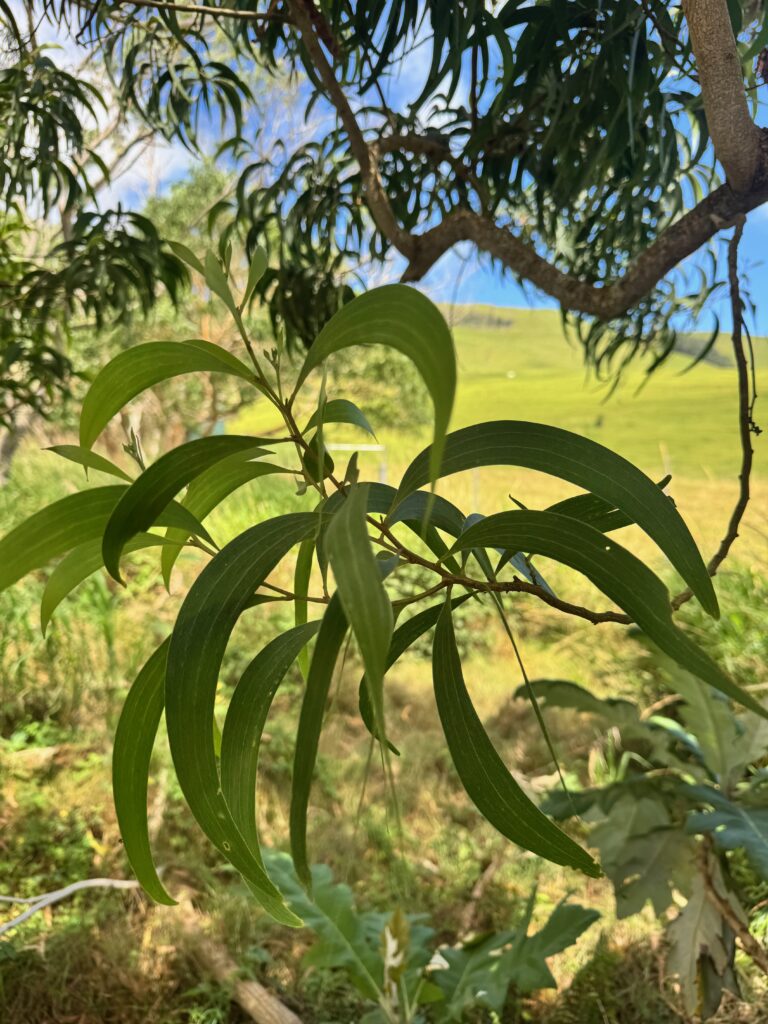
From Gold Rush–era farming and sugar to today’s diversified operation of cattle, elk, sheep, a winery, and wind turbines, Sumner Erdman, president of Ulupalakua Ranch on Maui, traces the ranch’s history. He explains how the loss of Maui’s sugar and pineapple industries affected ranching, how an explosion of axis deer combined with drought forced herd reductions, and why rainfall records show droughts getting longer since the late 1990s. Sumner also talks through ideas to drought-proofing the ranch, using cattle to reduce fine fuels and fire risk and protect a restored native dryland forest, the trade-offs between wind and solar power, and why he prefers agricultural conservation easements over traditional ones. Pay attention to learn about the unique physiology of koa trees and why they’re ecologically important, and not just beautiful wood.
The Art of Range is supported by RanchBot Monitoring Solutions.
Host: Tip Hudson, Washington State University Extension
Producer: Matt Ziegler, WSU College of Agricultural, Human, and Natural Resources Communications
Music by Lewis Roise
Mentioned resources
ʻUlupalakua Ranch — ulupalakuaranch.com. The ranch currently partners with eight different organizations on protecting and enhancing native habitat on its land. mauinow
Auwahi Forest Restoration Project — auwahi.org. This is the “dark square” Sumner points to on Google Earth. The project began in 1997 as a community-based effort with ʻUlupalakua Ranch to save tracts of endangered dry forest, and the ranch committed progressively larger tracts as it succeeded. For a short read, Hawaiʻi Public Radio’s Auwahi: From Forest Failure to Restoration Success in 20 Years reports that native species cover in the restoration areas rose from 3 percent to 82 percent over two decades. auwahihawaiipublicradio
Koa tree biology — learn more from Hawai’i Department of Natural Resources
Rangelands article (2000) — Ranchers and Biologists in Hawai’i, co-authored by Sumner on the same rancher–biologist partnership.
Maui Nui Venison — Wikipedia overview, useful context for the axis deer discussion. The company was founded in 2015 to address the invasive axis deer problem, and as of 2023 Maui’s deer population was estimated at 50,000 to 60,000, growing about 30% a year. You could also link their own site at mauinuivenison.com. Wikipedia
Auwahi Wind — CleanTechnica: Wind Farm Completed in Maui. The 21 MW farm on ʻUlupalakua Ranch uses eight Siemens turbines plus a 10-megawatt storage system.
Maui Cattle Company / Mahi Pono — Hana Maui article on the Mahi Pono partnership. Mahi Pono, which bought 41,000 acres of former sugar land, became majority partner in Maui Cattle Co. and owner of its slaughterhouse; local beef was cited as only about 6% of meat consumed in Hawaii. hanamaui
Tip Hudson: Welcome to the Art of Range, a podcast focused on rangelands and the people who manage them. I’m your host, Tip Hudson, range and livestock specialist with Washington State University Extension. The goal of this podcast is education and conservation through conversation. Find us online at artofrange.com. Welcome back to the Art of Range. My guest today is Sumner Erdman, who is the president of Ulupalakua Ranch. I hope I got that somewhere close, which is on the slopes of the volcano in Maui. It’s one of the few large cattle ranches on Maui. As I understand, you’ve been here most of your life. Sumner, welcome.
Sumner Erdman: Thank you. I’ve been here my whole life.
Tip Hudson: Your dad started the ranch?
Sumner Erdman: My dad bought the ranch in 1963 and then I was born in 1965. It’s hard to say when the ranch actually was started, but you would go back to its modern agricultural basis to about 1845 with a guy named Torbit. There were actually a couple of people lease land for him that didn’t, and then Torbit came and got the lease and then purchased what is today Wipolco ranch. He grew corn and potatoes for the California gold rush here. And because everybody forgets, California really had very farming at that time, had some ranches and stuff, had basically nothing. Everybody forgets that the royal palace in Honolulu had electricity before the White House. It was pretty advanced in that Central 1800s. He was growing corn and potato, chipping it to California and selling it out there. No Lloyd’s of London existed. His boat got a leak, and the crop was ruined, and he was ruined. Then captain James McKee, who was a sailing captain, who as the story goes, he was a whaling captain and got hit over the head with a meat cleaver by the cook or somebody on his ship and got vertigo and could never go back to sea. Whether that’s true or not, I don’t know, but he ended up buying Ulupalakua and lived here part of the time, and he built it to its size, more sizable thing. It was a sugar mill under his term and then slowly turned into a cattle ranch in, but was always a little bit diversified. But the cattle ranch really became a cattle ranch about 1,900, came solidly a cattle ranch under the Baldwins in the 1920s. Then my dad came in ’63 and went back to diversifying and added the winery and sheep in the 70s, the elk in the 80s. Then subsequently, I’ve added wind farms and telecommunication sites.
Tip Hudson: I haven’t heard anybody yet tell the story of how sugar came and went, but to what extent was that a big deal on Maui?
Sumner Erdman: It was huge. What most people don’t fully realize is sugar didn’t start as the big sugar plantation down in the central valley, although it was about the same time, Hana Ranch, which is in Hana, was also a sugar plantation that turned back to a ranch. I can’t tell you why that one happened. This one happened because of weather. We’ve been prone to droughts forever and the sugar plantation had a bad drought that caused it to shut down here. I don’t imagine that’d be the problem in Hana at 100 ” or rag or whatever they get. But there’s might have been transportation or some other issue. But a lot of the old ranches did have sugar on them at one time. But most of those had turned to cattle by 1900 or turn of the century. The large plantations did exist and they’ve all left us. They’ve all gone out of business. I’m probably going to speak a little bit out of turn, but very large percentage of all those pineapple and sugarcane plantations have turned back to cattle pasture and back to ranching. But at the same time, the pineapple for us probably had a bigger effect because we used to be able to feed the skins of the pineapple. When they can the pineapple, we’d turn the skins. At first, they used to turn it into a brine and then a silage mix and we could feed cattle with it. We had feed lots until that was gone in the late 90s, actually, early 2000s, I guess. We could feed that pineapple during droughts. It was about the only feed we really had. We also had molasses from the sugar cane. Not having the pineapple plantations, not having the sugar cane has had that effect on cattle ranches. As far as the state of Hawaii is affected majorly, it made us completely dependent on tourism. We don’t no longer have large agriculture to bring us any other economic opportunity. You don’t have the jobs. The thing about sugar canes and pineapple plantation [OVERLAPPING] very labor intensive. You were talking thousands of jobs versus ranches which you’re talking in the tens. The other thing, like the sugar cane plantation. We really saw it on Maui where all the subsidiaries dependencies that you normally don’t think about. The sugarcane plantation was the Xerox guy on Maui’s largest customer. All of a sudden it’s gone. He lost a major part of his business. The fertilizer companies that brought in all the fertilizer crops, they lost their biggest customer. All of a sudden we’ve lost a lot of small subsidiary industries that we all used or used to use on top of it. I’m getting hit by the COVID about two years after that and then two years after that or three years after that, I’m getting hit by the fires in Lina it’s made it very tough on Maui.
Tip Hudson: This was originally a cattle ranch and a little bit more diversified now. What does the annual cycle look like for running a cow here?
Sumner Erdman: Very different than anywhere in the US. When I was a kid, there were about eight different herds. They were basically bred about the same time in two different breeding seasons, but about the same time, but a little bit more scattered out with one other herd done at a third time. Over the years as the droughts hit, and I combined herds for efficiency and grazing efficiency and everything else. We’ve gone, so we just breed twice a year now, which protects us from weather uncertainties, protects us, makes our bowl costs cheaper, makes our labor a little bit more efficient because you’re not having to try and get all of it done at the same time and positions us for the local fresh market a little bit better.
Tip Hudson: I’m not a meat scientist, but I’m aware that finishing cattle on forages is a different thing than raising them out to a slaughter weight on forages.
Sumner Erdman: Very different.
Tip Hudson: But you’re slaughtering them here and selling it here.
Sumner Erdman: Yeah, and we are finishing them on forages. Although, as Greg told you, we started Maui cattle company years ago, and the guys that bought the sugarcane basically bought the majority of that. They are growing other crops and do have some wastage on those crops. They are looking to start a feed lot again. We’ll be doing that very soon if they’re not already. But we will also still finish out on forages to further that difference between feedlots, is that we’re on tropical forages.
Tip Hudson: Silos and water.
Sumner Erdman: Yeah, a lot of silos and water. That makes it even tougher to do, it can be done. You just have to be pretty keep your eye on it.
Tip Hudson: Correct. You’re probably finishing at lower weights.
Sumner Erdman: You’re definitely slaughtering at about 1,000 pounds versus 400. You’ll get some of them up to 1,200, but I would say 1,000 is really what you’re going to get to.
Tip Hudson: What’s the processing capacity here? Do you fill it up?
Sumner Erdman: There’s two slaughterhouses. One of them is a portable slaughterhouse that’s been made permanent. The other one’s an antiquated slaughterhouse that has some efficiency issues it is old and was built for a much higher throughput. But it would guess 100 head a week would probably push the limits on Maui right now. Fortunately, unfortunately, we don’t have 100 head a week anymore.
Tip Hudson: I’ve seen the land base for your place in Haleakala. There’s not a ton of other land out there. How many other cattle operations are there here that are of commercial scale? There’s still a Hana ranch?
Sumner Erdman: Yes, you still have Hana, you have Cow poo in Kaonoulu, and Soccer galas. They lease a bunch of land. There’d be seven of us no Brigas which would be right on the edge. With Haleakala club being the lamb mass, the largest. Probably livestock units would be the most.
Tip Hudson: Greg indicated that they’re pulling their hair out over access to deer. Do you have similar problems here is the different than this?
Sumner Erdman: We all had it. That was interesting because we all had access to deer. We all hunted them. We had a hunting policy and trying to get so many and I was pretty comfortable where we were keeping the balance pretty intact. When the sugar cane went out in 2017 and 2019, as Mahi Pono was trying to get all of turn over that sugar cane, they didn’t get all of it before there were a couple major fires. What none of us realized was how many deer lived in the sugar cane. I remember talking to Greg and both Haleakala and Kaonoulu about it. We all pretty much came up with the same figure that within weeks of that fire, our herds doubled to tripled. They completely ran us over. What happen that coupled with drought, forced us to really reduce our herds. But I know you’re aware of Big Island and their ranchers. They didn’t have axis deer, and their numbers are still down. I would have to say that we were just hit with drought and deer. But we have Maui Nui operating now, the deer hunting. Technically is a third slaughterhouse, but they only do Cervidae and their capacity is a little bit more than 100 a week. I might be low on that 100 a week, but Maui Nui Venison does up to 100 a day.
Tip Hudson: There’s a market for that? Is all that being sold here, or are they selling it over to the mainland?
Sumner Erdman: It’s sold on the Internet. You can buy some locally. You can buy it here. But it’s sold on the Internet as Maui Nui Venison, and it’s sold all over the US, and they can’t quite keep up with the number.
Tip Hudson: Good. That’s a wonderful thing.
Sumner Erdman: It’s a good thing.
Tip Hudson: How did you end up with elk? Was that somebody’s wild hair idea? How in the world did that come about?
Sumner Erdman: My dad and I are involvement in New Zealand or I should say, we got into it more of my dad’s involvement in New Zealand. Well, we weren’t farming in New Zealand at the time. He had a lot of friends, and he traveled there a lot and looked at their farming operations, and especially their red deer operations, and their beginning years what they call the Deer Wars, when they started capturing deer and farming them down there. He watched that and so he decided we needed to do it here as well. That’s pretty much where it came from. That said, what we do know is that McKee, who I talked about owned this place in the late 1800s, we guess it was at the same time at the turn of the century when they were setting up Yellowstone, they actually got some of the wapiti out of Yellowstone, and they’d sent some to New Zealand. That’s where New Zealand’s wild wapiti came from. My guess is that’s where McKee somehow got hold of two of these animals. We know he brought them over here to Ulupalakua oddly enough, only we found out about it years after we did it.
Sumner Erdman: We don’t know what happened to them. Obviously, they didn’t survive. There was no other mention other than he brought two into Ulupalakua. As much as I like to say my dad did it, it really we were not the originals.
Tip Hudson: You just sell them for meat now?
Sumner Erdman: We sell it all as elk burgers in our store.
Tip Hudson: That’s neat.
Sumner Erdman: Yep. Works really well.
Tip Hudson: Yeah. I apologize if it seems like I’m jumping around. I’m trying to be careful with time, and I’ve got a number of questions that I think are interesting. Wind turbines are hugely controversial in the ranching community on the mainland. You got guys that say it takes up a really small footprint, and it’s good money, and it’s electricity. It takes up a fraction of the area as solar panels for the same amount of power, especially if you’ve got continuous wind. But you’ve got a few wind turbines here, and I think I read that Hawaii has the goal of being energy independent by 2045.
Sumner Erdman: Yeah.
Tip Hudson: Which makes me wonder, where in the world does electricity come from now? Because I don’t see any dams generating hydro-power. I assume there’s no coal around here. Where has Hawaii been getting the electricity?
Sumner Erdman: First of all, I’m in the camp that it takes a fraction of the land as solar. But I’m not opposed to solar either. It does produce electricity 24/7. I’m probably more in the camp of doing it, but I have a really good friend who’s in the other camp. I have quite a few friends that are in the other camp. I like it. But to answer the Hawaii question, there is a little bit of hydro power on Kauai. There’s one very small hydropower plant on Maui. I’m not sure about the big island. We do have the solar and Maui has the two wind turbine farms. I probably should say technically it’s three because even though it’s all Kaheawa 1, and 2, or Kaheawa 2.
Tip Hudson: The one going up the spine of West Maui is the most obvious one.
Sumner Erdman: Yeah, that’s Kaheawa, it was done in two different segments, and then ours in Auwahi the backside of island. The big island has a lot of geothermal. But the majority of Hawaii’s electricity is cheap oil.
Tip Hudson: Really?
Sumner Erdman: Yeah.
Tip Hudson: Just burn it. It’s efficient. Interesting. How old are the wind turbines here? The ones in Washington go back about 20 years. There were several new plants that went up about 20 years ago, and that seemed to be the beginning of the wave.
Sumner Erdman: Yep. These went in 2012. They’re supposed to have a 25-year life with another option to renew them. Those went up just about the same time. Kaheawa one, I think it actually went up in 2010 somewhere around there. Going back to Hawaii’s because of what this podcast is about and trying to educate ranchers and others; we actually had a permit to have a solar farm on this ranch, as well. We do have one in our ranch in Oregon. The public outcry from the closest neighborhood.
Tip Hudson: For the solar proposal.
Sumner Erdman: Yeah. Forced the company that was going to build it to pull out. They pulled out of the state of Hai. Wow. There are numerous, numerous examples of that in Hawaii. It’s part of the reason that they keep moving that date. I believe the original date was 2030 or 2035 now. You’re saying it’s 2045. I think it might even be 2050. But I think that’s something everybody has to understand is we’re never going to get there if we keep having these issues.
Tip Hudson: People aren’t turning the air conditioners off?
Sumner Erdman: No. The Stone Age did not end because of a lack of stones. We’re still going to be using electricity. It’s just how we’re doing it, and how we’re making, and how we’re getting there. The argument’s also huge. You look at electric vehicles and their need of rare earth minerals and silver. We’ve got a lot of figuring out to do.
Tip Hudson: Right. As long as that mine’s not in my backyard then I’m going for it.
Sumner Erdman: Yeah. The scary part about it is Americans need to wake up because Americans are the ones saying. “We want all those products. We can’t have those mines in our backyard.”
Tip Hudson: Right. We’re going to put everybody else’s backyard. Australia and South America and Canada. There’s fewer people. I’m just curious what’s the main objection to the turbines here? Is it mostly just visual or do people feel like there’s some environmental cost that’s unacceptable with the turbines, or is it mostly the viewshed, which I do understand?
Sumner Erdman: It’s both. There are some people that complain about the noise and some other things about environmentally with them. We have them. I go down there unless you’re right up next to them, I can’t hear this humming that people claim they’re hearing, but maybe people do. I don’t. But there definitely is there definitely you do have bird strikes. You do have bat strikes. Actually, on bats, you don’t have a strike. They actually I didn’t understand this. because they can avoid the turbines, but they fly through them and then get into a wind vortex and their lungs can’t take that wind vortex. It causes them to basically fall to the ground. You do have those, and those are real, and we have a way to work through those.
Tip Hudson: Yeah, that’s interesting. We have a pretty large turbine farm just east of Ellensburg that you may have seen if you’ve been there, but it went up. I think they started construction in 2007 or thereabouts, and they’re big turbans. The top is when the blade is up, the top is like 450 feet in the air. Actually, they’re contracted with a company that does bird mortality surveys, and they have a lot more bird mortalities from the glass windows on the visitor center than they do from all of the turbans combined. Of course, they like to joke that your cat, the grill of your car and your windows kill way more birds than wind turbine.
Sumner Erdman: That doesn’t mean it’s not important, but I would agree with that. Lights, we have a lot more bird deaths, especially endangered birds from the lights down by the hotels disorienting young seabirds. We probably have that with bats there’s probably a lot more bat kill from other causes than we. Discussing Hawaii. I totally agree with that. It doesn’t get all the attention, right?
Tip Hudson: No, it doesn’t, just for comparison, what I read was that you got eight turbines that generate a little over 21 megawatts.
Sumner Erdman: Correct. They actually do 23 megawatts, but they can only sell 21.
Tip Hudson: How many homes is that power?
Sumner Erdman: Ten thousand.
Tip Hudson: From eight turbines?
Sumner Erdman: What’s the environmental impact of 10,000 homes in their use of electricity? Who knows?
Tip Hudson: The petroleum power plants, I assume they’re shipping in oil.
Sumner Erdman: Yes.
Tip Hudson: You’re not drilling it here, I don’t.
Sumner Erdman: No, we don’t have any oil. It’s all shipped in. The sugar company used to burn the sugar mills. That’s actually the thing I did forget. The sugar Mills actually used to produce about 5% of our electricity? 5-10% burning the gas or the dried sugar cane? They would also, though, bring in coal because they had to contract to deliver that. They’d bring in coal for the five months, four months they didn’t have sugar. But now it’s all just bringing in oil. I could be wrong. There might be a couple of coal plants left in the State of Hawaii. I don’t know about. But most of the ones I do know about it, it’s Indonesian oil oil.
Tip Hudson: In some ways, a windmill is a very old technology.
Sumner Erdman: Yeah. There’s one other thing, when we go back to that argument of solar versus wind, one of the things is solar farms because they’re only producing for eight hours a day, you have to have batteries to store them. It’s a lot of lithium ion batteries. The wind turbines have to have the lithium ion batteries as well, but not as many because it’s not for storage. It’s actually just to smoothen out the power. Because on the wind turbine, it’s flashy. Which you have with the solar as well, but they also have to store it. All issues, I look at all sides of the issues. The problem is we all need to, and we can’t be CIDs. A CID being a single issue, emotionally driven person. We just can’t, we have to understand whether it’s an EV car or it’s a solar farm, or wind farm, or oil, or coal, there’s a trade off to it all. None of these things the end all. They all have they all have a cost, and we have to accept what those are and decide what costs we accept.
Tip Hudson: I’m biased toward ranching, but partly because I feel like it really, truly is one of the only methods of agriculture, where we can have food and fiber production in the same space that you have all these other ecosystem services. I actually had not given a lot of thought to the fact that as agricultural enterprise, that means that there’s shrinkage in the economy compared to other agricultural enterprises that employ more people, have more spin off industries. I’m accustomed to looking at it from the other direction, where people often feel like because the ranch is in places that are otherwise natural landscapes that they would prefer to see it without cows and just let it be a natural landscape. You have some conservation easements. You guys are branching in a place that has, tropical forests and endangered birds. Go ahead.
Sumner Erdman: Actually, go finish where you’re going. My brain’s going 100 miles an hour. I love this topic.
Tip Hudson: If I’m being a critic, I would say that somebody who doesn’t like the idea of having cattle in otherwise natural landscapes would say that this argument that ranchers often make that it’s either cows or condos is a false choice. It’s a false dichotomy, and that maybe that’s only the case in places like this where you have extremely high development value, and therefore, it warrants doing something like conservation easement, but other than that, you’d be better off having a nature preserve.
Tip Hudson: What would you say about the relative value of having a nature preserve versus the ranch that’s actively managing the land, but it means that you’ve got cows or goats or whatever else is out there. You may have other angles you want to go with?
Sumner Erdman: I’m probably going to turn it turn your question on its head in a very interesting way. For Hawaii, one of the few places where we’re we’re seeing open rangeland or open lands, undeveloped open lands, that used to be part of the sugarcane plantation, they got them out, and like you said, we don’t want anything on that. They’re actually going back in actually, our livestock manager is one of the people doing it. I know a couple other people they’re actually putting cattle back on these lands out near Lahaina, because that’s where the fire came rushing down the mountain and that’s, where all the fuel was to burn that whole town down. It’s more than just condos. It’s fires. It’s also invasive species, and that’s where we really go. We work with a couple of different organizations, but mainly one, the Hawaii restoration project. If you look on Google Earth on the back side of ours just above our wind turbines, you’ll actually see this dark square in the middle of our pasture. We’ve worked with these guys to restore a dry land forest from 200 years ago that nobody’s seen in 200 years, and the cattle are integral to protecting that because we graze around to keep the other native or to keep the invasive species out to keep the grass mat down, so it’s not a fire hazard and to protect it from those open pasture doesn’t have as many bugs and insects that can go in there and negatively affect that forest. We work actually with these reforestation environmental groups in a positive way, and it can be done and should be done in that way. To graze it according to specific objectives that allow those plants to reproduce and reduce the competition. For us, what it really does, probably the most important thing, those native plants that were reforesting and that evolved in our mineral cycle, in our water cycle. What we find is that when it rains, they capture more rainfall. When their leaves blows across the fence into the pasture, the cattle will always go there to graze and that grass is always greener, healthier because as that leaf decays, it’s picking up the minerals in that. It’s at the surface for that grass. It’s a symbiotic relationship, and people need to start looking at them that way. Yes, I love that question. That’s why I was thinking about it because we’ve been dealing with it for years in that concept.
Tip Hudson: What about the cows versus condos issues here? For most people, that’s one of the reasons to do a conservation easement because ranch family might be concerned that their heirs would be or there, they are tempted to sell it off because that’s your retirement program. Especially when you’re dealing with estate taxes, and that often forces their hand, where in order to have the cash flow to make the ranch keep going, you’ve got to find a way to sell off land. Is there active land conversion happening in Hawaii, or are there already mechanisms to limit that?
Sumner Erdman: There’s a lack of water, and there are mechanisms to limit it. Although I’d probably go to this argument. All those condos are on the beach. Not a lot of cattle grazing on those beaches. That would probably be where I’d go. But we didn’t do a conservation easement. We did a agricultural conservation easement, which is completely different from an actual conservation easement. Conservation easements scare me because when you read a lot of total conservation easements, and due to some bad mitigation sites we have with the wind farm that we’ve worked at on our land, those areas some of those pockets have to be: because of fish and wildlife service actually have to be put in a conservation easement. And we had to get the land trust that has our agricultural conservation easement to get those conservation easements for obvious reasons, are very restrictive. But what I think is more worrying people really need to look at, especially from the legal side, is those restrictions make them very expensive and very difficult to manage. If you have a weed problem or something in one of those areas, it is very difficult to get in there. You have to jump through a lot of hoops and by the time you get through half those hoops, that weed problems tripled. So I’m not a fan of conservation easements.
Tip Hudson: To the cost, if you’re going to extinguish development rights in someplace like the west slopes of Maui to do any meaningful acreage, it’s going to take a lot of money to manage it.
Sumner Erdman: Yeah. If you put in a conservation easement, a lot of conservation easements, yes: the reason a lot of times ranching families do them is technically, you can still ranch them. But if there was a ranching family thinking about doing, I’d tell them, go look at an agricultural conservation easement before you pull the trigger because the ranchers that I know who have put a conservation easement on it have run into some interesting issues, especially when they’re trying to raise cattle, isn’t it?
Tip Hudson: Like, you can’t build a corral over there.
Sumner Erdman: Yes, can’t build a corral. You can’t bulldoze here to build your fence line. You can’t build a road there. You can’t do this or you can’t do that. Whereas, in an agricultural conservation easement, you can do whatever you need to do to keep.
Tip Hudson: To support the agricultural use.
Sumner Erdman: Yes. So if there are any ranchers listening, I would recommend you go to the agricultural conservation easement over a conservation ease.
Tip Hudson: Here, the same land trust can handle both types of easements, or are they different organizations?
Sumner Erdman: I know they can. Island Land Trust can because they don’t always like to, but that’s not true. They have lands that are in there, but I know from just dealing with us, although they don’t really like to have to get into it because it’s a little more interesting to have to manage a conservation in easement that’s this big: in a agricultural conservation easement that’s that big. But yes, either one can. Some of them specialize in agricultural conservation. Some of them specialize in conservation easements, but both of them can. They can do.
Tip Hudson: Your comment about the area where you’re working to restore the type of forest species assemblage that presumably existed before European settlement makes me think about something that I think I read that you’re working on drought proofing the ranch. That reminds me of a comment from Sam Fuhlendorf, who was a fire ecologist out of Oklahoma, who said six patches make you six times less likely to be entirely wrong. Meaning if you’ve got some diversification in your forage base and plant community types, and especially in a place like this, where almost every square foot, has a different precipitation regime, temperature regime, soils, like the amount of geological and soil diversity is massive. It would seem like one of the things you would have to do is figure out, how do I manage plant types on all of the different locations, landscape positions on the ranch to make sure that something’s going to grow there that will work under a wide variety of conditions. Yeah, Greg mentioned, too, that he feels like you’ve seen a different pattern of rainfall, less reliable. Wintertime, spring rainfall patterns. The drought pattern is different. So what are you doing or what’s your thinking on how to increase? I don’t really like the word resilience because it’s become the new buzzword. But that is what it is. How are you trying to make yourself a little bit more drought proof?
Sumner Erdman: Planting trees that are more adapted to catching rain, especially up on, or ridge tops. In our hind level areas? We’re looking at things like electronic fences to give us better ability to do that. Definitely putting in fencing, but I’m going to back up a little bit. We have 100 years of rainfall data at this headquarters. Don’t have for the entire ranch in that perfect setting, but we do have a lot of data from the rest of the ranch, but right at our headquarters, we have 100 years. And what Greg said is totally correct. If you go from ’25 to ’97. During all those years, there was never what I consider a drought, which is 70% or less of median rainfall. And on an annual basis. And I do it on 12 month deal, but I also revolve. I do January through December, February through February.
Tip Hudson: More the water year.
Sumner Erdman: Yep. It actually did help me find the worst drought that the ranch ever had. The worst 12 months. I remember these old guys telling me about these drought this one drought, and I could never find it on our annual data, but when I found it, it was actually a drought 1944 through ’45, started in April and ended in March. It was less than 9″. It was 8.8″ of rain.
Tip Hudson: Here.
Sumner Erdman: Here.
Tip Hudson: Holy cow.
Sumner Erdman: For the 12 months. The reason you couldn’t find it was when it ended in that the right before it started, there was a huge rain in February and March and April went dry. And when it rained again in March or ended in March, April that next year was huge. There are these big rainfall issues on the ends of this 12 months dry time. But going back, more importantly, prior to 1997, we’d seen very few we’d never seen a drought that lasted three consecutive years. That was the maximum you’d ever seen. 1925-1997, we’d seen three of those. 1997-2026, we’ve had three droughts that have lasted at least five years. Oh, wow. Going back to what Greg has said, there’s definitely been a change. The other thing that I’ve found is what we used to call the wet months November through March. Their mean rainfall has dropped considerably. The dry months, July, August, September, we’ve actually had an increase in median rainfall. It doesn’t counteract the drop in the wet months, but it’s definitely a change. Biggest change I’ve seen, and this goes back one step further. Our highest rainfall, we ranch from sea level in one spot to 5,000 feet. The maximum rainfall is about 55 inches median rainfall a year. 55.5, the lowest median rainfall is 10 in one spot down by the ocean. Everything in between on those. We’ve always had a diversification of grasses like you’re talking about, that have to grow in different places. What’s scary to me and going back to what you said, one of the other ways that you can drought proof yourself or give yourself some resistance or give yourself a better fighting chance is not to have a monogamous grass type or a monoculture. For years, while we had that rainfall difference, the majority of this ranch was acou grass. Mm hmm. It was dominant from 1,200 feet, up to really about 4,000 feet, and when I say that, it still existed all the way up. It just wasn’t quite as dominant above 4,000 feet. You saw Orcharch fog and sweet vernal and some other grasses that would come in, especially in the wintertime. Kikuyu grass is almost non existent today from 1,200 feet to ’22 to 3,000 feet.
Tip Hudson: Really?
Sumner Erdman: Yeah.
Tip Hudson: Is that from the two-line spittle bug or from other factors?
Sumner Erdman: No, we don’t have the spittle bug.
Tip Hudson: Only on the big island.
Sumner Erdman: Yeah. And we do have some other bugs that have hit it. I’m not really positive what it is. We have had the USDA the Star or extension service from the UH or Department of Ag. We’ve had them out here, and we’ve looked at the grass and we have we found these bugs in there, and they’re these a couple of different types. But the problem is, these bugs have all been here since 1920 or earlier.
Tip Hudson: It’s not not a new thing.
Sumner Erdman: They’re not new. They’re not the cause. Now is it? Kikuyu grass comes from Kilimanjaro and it’s a pretty consistent type weather pattern. Is it the inconsistent weather pattern that doesn’t like it? We don’t know. But what we do know is it’s gone. Our annual bunch grasses that we never saw above 1,200 feet, we’re not seeing them higher. We’re seeing some native plants going up the mountain. That’s probably more temperature in those annual grasses being able to come up and those native plants being to go higher. But it is changing. But to answer your question, I’m looking at all of these factors, they are all going on around me right now. The one thing I do see, is to get trees, even though some of the natives are doing like coa trees are very adapted to catching rainfall. But I’m also looking at Cook pines in Norfolk Pines, the Pacific Pines. We can’t grow them all the way at the top of the ranch, but putting them on some of these ridge lines in places where cloud do come past to try and just slow down the clouds. Breaking down. Force them to give us a little bit of moisture.
Tip Hudson: When you say catch more moisture, do you mean canopy that’s intercepting it so it’s not hitting the ground or you mean, like, root mats that absorb and hold more moisture in the soil later?
Sumner Erdman: I’m doing both. I’m looking at both. A coa tree is incredibly fascinating. What we think of a coa leaf is not actually a leaf. It’s something called a philod which is growing of the stem. The leaves are these little things that are horizontal to the ground. It catch water like a normal tree. A coa tree’s philod is actually perpendicular to the ground, and it’s designed as the fog comes in. It causes the oyster to condense on it, and it’s curved down towards its root. And so we’re looking at those as well. I’m looking at every aspect of how do you stop. Unfortunately, hopefully he hears this, and he’ll remember who he is. I don’t remember his name. I was giving a speech at the Quivira Coalition. We’re getting close to 20 years ago. There was a rancher there from Wyoming, and I happened to sit in on his top. He made a phrase, and it has always stuck with me. He said, “Every time a raindrop falls and hits the ground, its sole purpose in life is to get to the ocean. Our job is to make it take as long as we can.” And I sat there and thought about it, listening to this guy, and I’m going, “Okay.”
Sumner Erdman: Here’s a rancher from Wyoming who’s watching the raindrop hit his ranch and he’s thinking about it trying to get to the ocean. He’s 2,500 miles from the ocean. I’m sitting here watching in Hawaii, watching the rain on these mountains that are so just floated over the ocean. I’m watching that raindrop hit the ground and go to ocean. I haven’t thought about, how do I slow it down?
Tip Hudson: His hits bare ground and immediately evaporates and then floats off in the cloud. Yours just runs downhill.
Sumner Erdman: I think his point was even if he didn’t have bare ground, it was going to hit the ground and eventually mark its way to the Missouri. But I was dumbfounded that he could think of that, and I couldn’t but that’s what I’ve tried to do ever since. The deer really caused a problem for that. Because we couldn’t manage the movement of the deer, it’s pretty funny. We’ve had a couple of big rainstorms and we’ve had guys with videos and talking about the ranchers and how they’ve overgrazed the land and everything else. Unfortunately, what those guys haven’t realized is the land in question, where that did happen was overgrazed, I’m not going to deny it. But I had not grazed a cow on it for four years or five years before the rain. When I stopped grazing it, it had grass on it. The wild deer took everything. It took everything, it was just bare ground.
Tip Hudson: Are they also eating whatever trees or shrubs are trying to start? Do they eat that as well as the grass?
Sumner Erdman: Yeah. We have to put deer fencing around everything we’re trying to.
Tip Hudson: Well, it sounds like there’s a market for Koa wood. We were in an art gallery down in town last night, and the guy was saying they can’t get enough Koa wood to make stuff with. It sure is pretty. I still don’t know what a Koa tree looks like, so that’s on my list.
Sumner Erdman: I will show you one today.
Tip Hudson: I’d love to see it.
Sumner Erdman: It’s funny you say that. I won’t mention those ranches. There are some ranches that are growing Koa, specifically for that. I grow Koa specifically for the mineral and water cycle. Now, will my kids or my grandkids or whoever’s running this place in 50 or 100 years [OVERLAPPING] But it is a beautiful wood. It’s a gorgeous wood. It is very expensive and there is a market for it.
Tip Hudson: There’s a friend of mine who’s a extension forester has a favorite, I don’t know if it’s Chinese proverb, but he likes to say that a nation grows great when people plant trees that their grandkids are going to sit underneath in three generations from now
Sumner Erdman: We need to start thinking that way. We really have.
Tip Hudson: It’s a long game.
Sumner Erdman: Unfortunately always think of the short game and we can. We need to get broad based on a whole bunch of different faults. For Hawaii, for us, we really need to think about it and we haven’t learned any lessons. We like to say we have as people do talk about, we have more, there are more endemic extinct species in Hawaii than in any other land mass in the world. But we haven’t learned from that because we are still bringing in things that are killing not only or endemic species, but species we brought in before. We have one that’s killing all of the eucalyptus trees that we have around us. It’s just wiping them out very quickly.
Tip Hudson: Are they native here?
Sumner Erdman: They’re not native.
Tip Hudson: I didn’t think so.
Sumner Erdman: They are a water sucker, but they still were a tree for us and they were their habitat for native bats. They are dying quickly, and I’ll show you a couple examples pretty easily. I just found out about another one I had never heard of a woman who’s a friend of mine who lives down the road, she does some farming, and she delivers and sells farm supply veggies and honey and eggs and things to people. My wife and I buy from her. I just saw her and asked her how things were going. She told me her honey hives were decimated by the hive beetle. I’ve never even heard of a hive.
Tip Hudson: Mites and other things that take out honey bees but not that one.
Sumner Erdman: Now, it’s a hive beetle, she just showed it to me. She said, It’s like a little pineapple looking bug, just a tiny little black bug, but it lays its eggs in beehives. And then she showed me a picture of the larva. The larva, and what the larvae do is they eat the honey and the bee larva and everything. Basically, destroy the hive. But the larva are huge. They’re massive. It’s a little tiny bug, but I never even heard of it. There’s a new thing. We have a new invasive species in Hawaii every year, multiples. We haven’t learned we need to stop this. Half the time it’s innocent people. There’s a new finch I’ve seen flying around in it. Somebody bringing a pet in and then releasing and not realizing that’s going to disturb the whole ecosystem all over again. But I hope we do learn it as a society at some point, but Hawaii really needs to learn it.
Tip Hudson: You would think of all the places you could potentially limit it. This would be one of them because there’s only no one can just drive across with a bird. I got to come through a ship or an airport.
Sumner Erdman: I was on the Department of Agriculture Board for a long time here, and I’ve listened to every politician in the State of Hawaii saying how we need to protect our Ag. We got to do this. I’ve never seen any of them say, we’re going to up fund the Department of Ag and put more restrictions on quarantining things to bring in. All I’ve seen them do is make it easier for people to bring it in. You’d think, but no.
Tip Hudson: For some reason, I hadn’t actually expected to be talking much about fuel control and fire mitigation here, but I see now that that would be a really big deal, and it surprises me the parallels between here and Eastern Washington where we have these feedback loops with invasive species that then create fire, and the fire creates an environment that’s conducive to the invasive species, and around and around and around we go. But there’s only so many ways to deal with that, and I have been advocating for using livestock as a means of controlling fine fuels, because if you use any kind of a mechanical treatment, now we just create a dead plant instead of a live plant, and it’s even more fire prone, same thing with herbicide, what do you see? Is that catching on? To what extent is the state open or the community open to looking at maybe livestock grazing in places other than private ranch land, specifically for fire mitigation?
Sumner Erdman: That mindset is starting to open, and it really took the Lahaina fire to open people to start looking at it, thinking about it. Hopefully, the traction will keep going. But I agree with you. As I tell all my guys, the problem with a herbicide when my guys want to go spray the first new invasive species we see, I said, no, we’re going to pull it. What I tell all my guys with a herbicide is, I have never seen a herbicide pay you back. It’s a cost that goes out, generally is going to kill everything else that’s in there, meaning that other invasive species can, something you don’t want is going to come into that space [OVERLAPPING] It doesn’t work. I’m not against herbicides. I do know there are places where they make sense. We do use a little bit in limited areas mainly around our water tanks where we can’t graze them because unlike Eastern Washington, we don’t have to bury our pipe, so we have a lot of above pipes and a lot of PVC pipe. We can’t graze around our water tank features and things like that. But other than that, I don’t want it out in the pastures or anywhere else.
Tip Hudson: Was there anything that you think would be useful to talk about or tell people that I didn’t ask about?
Sumner Erdman: Probably something more of interest to everybody. It can be useful, I guess. As I said, we have a ranch in Central Oregon, Prineville in New Zealand and here. There are things from each of those places that I can take from one place to the other. But I cannot ranch those three ranches the same. Obviously, it’s easy to go well, the climate and everything, but it’s also the culture that it’s around there because that culture dictates what I can hire out to do and what I have to do myself, what markets I can look at and what markets I can’t. How do I manage the prime example is here in Hawaii, I have to manage a drought or a deer end drought. I have to manage it by seeing it three months in advance. I have to realize it’s coming on because if I all of a sudden get hit in a drought, two things I can’t do. I can’t go by 200 tons of hay, it cost me way too much money. A bale of hay, a ton of hay would be worth well over, I don’t even know what a ton of hair would be worth here. Nobody buys it. Little tiny bales are 100 bucks. It’s got to get shipped. You can’t feed your way out of a drought. We don’t have a livestock barn. There’s no sail yard. If I’ve got stockers, 400 pounds or 500 pounds or lighter, yes, I’ve got some buyer who’s going to buy and he’ll ship another mainland or there’s another couple of guys that do local markets and things in Honolulu or something. I can dump some of the small hounds. But cows, I can’t. I have no place to go. When I’m coming out of a drought, I have to realize that’s going to be a long term problem because I have to use my own. I can’t buy them. That makes me manage differently here. Every place is different. I think everybody needs to think about that. The number one question you get when people find out that well, while we don’t really anymore, because we do sell most of our stuff to Maui Cattle Company and stays here locally. But when I did tell people that we did for years, we shipped cattle out. They said, how can you afford to do that? We don’t have to feed that, cows and calves are cheap for us to raise. That calf to market is very expensive for us to do. But we don’t have that feeding cost in the wintertime and everything else, and our bulls are half price and everything else, it’s different. Economically and culturally, everything it’s different. I think that’s probably what I would tell everybody because it’s the most interesting.
Tip Hudson: Now, every place takes place based knowledge to do it well that you almost only learn by doing. That’s why we call it an art and not just a science. Well, this is a beautiful place. Thank you for taking care of it and for what you do.
Sumner Erdman: Well, thank you.
Tip Hudson: Thank you for listening to The Art of Range podcast. Links to websites or documents mentioned in each episode are available at artofrange.com. Be sure to subscribe to the show through Apple podcast, Podbean, Spotify, Stitcher, or your favorite podcasting app so that each new episode will automatically show up in your podcast feed. Just search for Art of Range. If you are not a social media addict, don’t start now. If you are, please like or otherwise follow The Art of Range on Facebook, LinkedIn, and X formally Twitter. Value listener feedback. If you have questions or comments for us to address in a future episode or just want to let me know you’re listening, send an email to show@artofrange.com. For more direct communication from me, sign up for a regular email from the podcast on the homepage at artofrange.com. This podcast is produced by CAHNRS Communications in the College of Agricultural, Human, and Natural Resource Sciences at Washington State University. The project is supported by the University of Arizona and funded by sponsors. You’re interested in being a sponsor, send an email to show@artofrange.com.
Speaker 1: The views, thoughts and opinions expressed by guests of this podcast are their own and does not imply Washington State University’s endorsement.