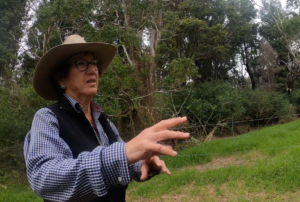
“I want to make this ranch look like Ellensburg.” Lani Cran-Petrie runs Kapapala Ranch on the south flank of the Big Island of Hawai’i with her husband, Bill. This episode with Lani begins a series on ranching in Hawai’i. Lani describes the improbable history of cattle in the middle of the Pacific Ocean, from a king’s gift of livestock to the hide-and-tallow trade through the sugar plantations that shaped which lands ranches kept, the collapse of in-state slaughter in 1992, the shipping containers and airplane crates that now move Hawaiian calves to mainland grass, and a long relationship with Ellensburg, Washington. She also tells the personal story of ranching for 17 years on thirty-day permits on state land, thirteen years of fighting at the state capitol to keep the ranch, ten million gallons of water storage built on faith, and the herd-breaking of “inexperienced” cattle with dogs, exclosures, and an air horn.
The Art of Range is supported by RanchBot Monitoring Solutions.
Host: Tip Hudson
Music: Lewis Roise
Producer: Matt Ziegler, WSU College of Agricultural, Human, and Natural Resources Communications
Mentioned resources
Kapapala Ranch website
National Ranching Heritage Center
The Great Mahele, the land division of 1848
Paniolo Hall of Fame, Lani Cran Petrie induction. Don’t miss the listing of women in the Paniolo Hall of Fame.
Mineral supplementation research project for Hawai’i (SARE-funded)
Tip Hudson: [MUSIC] Welcome to the Art of Range, a podcast focused on range lands and the people who manage them. I’m your host, Tip Hudson, Range and Livestock Specialist with Washington State University Extension. The goal of this podcast is education and conservation through conversation. Find us online at artofrange.com. [MUSIC] This episode with Lani Cran Petrie is the first in a series with Hawaiian ranchers, both on Maui and Hawaii, the name of the big island. Despite a long and colorful history of cattle grazing on the Hawaiian Islands, which goes back before many US states were officially states, even earlier than the Louisiana Purchase, many people don’t know that there are serious cattle operations in Hawaii. The ranches profiled in this series are not tourist attractions, although a couple of them have made efforts to accommodate agritourism. The variety of challenges, the variability of the environment, and the diversity of people is really remarkable and it’s worth your time to learn about. It was more than worth my time to get to know the ranchers who we’ve included in this series. I would like to publicly thank Mark Thorne, the University of Hawaii Extension Range and livestock specialist who helped set up these interviews. I mentioned that the first interview we are releasing is with Lani Cran Petrie. She and her husband, Bill, run the Kapapala Ranch on the south side of the Big Island, just a few miles from Kilauea, the most active volcano and the one that you can watch erupting periodically. As you will hear, this location causes not a few challenges for raising cattle. There are some background noises since this was recorded in person on Lani’s front porch, and she had some business to attend to while we were talking. I hope you enjoy getting to know some Hawaiian ranchers. [MUSIC]
Lani Petrie: This ranch lays between two active volcanoes.
Tip Hudson: It’s between Mauna Loa and Kilauea.
Lani Petrie: Actually on this ranch, all of the lava flows came from Mauna Loa.
Tip Hudson: How old are those?
Lani Petrie: The average age of what we walk on this ranch is only about 5,000-years-old.
Tip Hudson: I see on the map, lava flows that are labeled 1974, 1880.
Lani Petrie: [OVERLAPPING] The most recent on this ranch is 1880. When you’re fresh out of college, you gain a little knowledge, you think you’re going to turn things. I thought I was going to make this place look like Ellensburg, Washington. The years go along and the brush keeps encroaching. Then you realize, well I think God’s plan for this place is bigger than me. Then you start to understand I’m a big advocate of holistic management and followed Allan Savory’s work and his schools. In the later years every time I have a problem I get the book out. This land is so new and it’s being constantly covered not only from the lava flows, the active flows, but we get these massive dust eruptions from Kilauea. Kilauea it’s not a direct threat to us from a lava standpoint. We’re higher, but from the fallout of the plume, we call it vog, volcanic instead of smog. There’s a lot of particulates and sulfur.
Tip Hudson: High sulfur?
Lani Petrie: You know those trains that you see going down the tracks and you can’t count all the cars? In 2018, you could have lined up 100 of those cars payload of 80,000 pounds. That’s what that was putting out every day. The whole island was getting it. You’d think we’d get it the worst. We did. We do. But the lighter stuff really hit the other side of the island. Parker Ranch, especially in that saddle.
Tip Hudson: It goes up and then gets carried.
Lani Petrie: Yeah and those ranches in South Kona really got hit hard. From Pono’s house where you were. I’ve seen the vog so bad that you couldn’t see the ocean from his place. That’s the activity that it’s influencing us, and what we can grow, and what we can do, and what we can’t do. We’ve been here. This ranch was started in 1860, 166-years-old. My family has been here this stint for 49. In the 49 years I’ve been here, the volcano, Kilauea, even Mauna Loa pretty benign. No activity. Well in 2008, that changed. Kilauea became very very active. This recent eruption has gone on for a year and a half now, and it erupts every 11-14 days like clockwork.
Tip Hudson: Wow. I didn’t know that. Eruption as in lava spewing?
Lani Petrie: Right at the crater itself. I have USGS on speed dial. What’s in the plume this week? What we’ve learned is that each eruption or each event has its own signature. There’s a different chemical composition of what’s coming out of that eruption. This current event, it’s an event of Kilauea. I know it’s high in sulfur, of course it’s always sulfur and fluorine. But I think there’s arsenic in this one with being a little bit heavier, it falls out closer. I really need to get in touch with USGS again.
Tip Hudson: That’s in the ash fill or in the gas [OVERLAPPING].
Lani Petrie: That then precipitates the gas. In the mornings here when there’s no wind, it’s just like LA smog. Just this brown layer that just sits right all over us. Going back to maybe the plants and the canopy and what grows here. It’s new land and as new plants and animals, mammals, insects have populated a very isolated state or land. There’s plants that are really adapted to building soil. Those are the plants that I’ve fought my whole life to try and contain and kill and I’m going to get to you. I remember Allan Savory’s been here a couple of times, and my dad asked him, Well, you see Guava around the world, and what do other people do about it? He says, “Gordon, good luck.” But now I understand there’s nothing that starts the water cycle better than that plant.
Tip Hudson: It’s a colonizer species.
Lani Petrie: Christmas berry and guava are two plants that I tend to like now. There’s just so much you can do. I did go to WSU. I started in animal nutrition, but I flunked chemistry. I wasn’t good at chemistry.
Tip Hudson: That’s funny. It’s a weird thing. I almost never listen to these episodes after they come out, but I happened to listen to part of Doug Tolson because I was wanting to hear some of it, and he said that that’s also why he switched from a vet major because he couldn’t pass chemistry.
Lani Petrie: I heard that part. I did listen to some of it this morning. But I couldn’t, I was in tutoring all the time and my adviser looked at me. He says, “You’re getting A’s in business classes in economics. You want to just change majors?” I said, I would. I like the business classes. I graduated there in 1983 and with a bachelor’s in economics. I think we all got a minor over at Moscow, Idaho in Western Swing. I don’t know if it was like that when you were there with the cars.
Tip Hudson: It was. I went to the University of Idaho in Moscow. I work for WSU, but I didn’t go to school there. We were dancing all the time. It was still going.
Lani Petrie: That’s probably why I have a bad knee. Anyway, I love WSU and actually, because I was still in animal nutrition, my first two years, I was fortunate to go live out at the cattle feeding lab. I lived out there and worked for two years, got to meet a lot of the nutritionists. We had some fistulated steers, and we did all kinds of field trials, but I think we’re too young to know or to be digging in too deep. I think college for me, was that I could always find information that I needed somewhere. I did enjoy being around ag students. Here in Hawaii, there’s not a lot of our type of agriculture. But I enjoyed WSU and got out and came home. My parents had just come back to this ranch. My dad was the foreman. I should just back up a little bit, if you don’t mind.
Tip Hudson: [OVERLAPPING] I was going to ask questions about the origins. I’ve actually gotten several bits and pieces of the story of how the cattle industry got started on Hawaii from everybody that I’ve talked to, but I think we’ll likely run this interview either first or second. I’d be interested in your telling of how there came to be Bos taurus cattle in the middle of the Pacific. Well, and how the ranch got started?
Lani Petrie: Well, first off, we were a kingdom, and so the king ruled. The sea captains were bringing livestock. They wanted to provision their ships with things besides dried fish, but the king wouldn’t let anybody harvest those animals. The sandalwood trade was big. It gave the Kingdom something to trade. We were a subsistence civilization. Then all of a sudden, you have ships coming from all over the world wanting to trade. The sandalwood industry boomed in the early 1800s. Then it was dying out. The sandalwood was harder to get less abundant.
Tip Hudson: What was it being used for? Just building material?
Lani Petrie: No. It went to China. Here’s these cattle that have been brought in, and they’re multiplying, and then they’re actually starting to cause a lot of trouble because they’ve been protected.
Tip Hudson: They were a gift to the king.
Lani Petrie: They were a gift to the king. I do the math. One cow can have a calf a year. There’s no way that the islands were completely inundated with livestock by the time you lift the, they call it a kapu or the taboo. But anyway, when they lifted it in the 1840s, I believe 1830s, it was 1840s.
Tip Hudson: Was that King Kamehameha’s son then?
Lani Petrie: That was Kamehameha III.
Tip Hudson: I think he was one of the most challenged kings we ever had. I admired the man because he was just in the middle of a world that was just turning upside down.
Lani Petrie: Not just his world, the entire world.
Tip Hudson: Well.
Lani Petrie: Nearly.
Tip Hudson: The foreigners wanted to own land. They had the great Mahele, where the king actually kept a certain percentage of land and put out, I think about 25% of the kingdom to private ownership. I might be wrong on that number, too. He kept about half for himself. But then there was a lot of elite, the other royalty, that held land. If you look at some of the ranches like Parker Ranch, I believe Haleakala too, don’t quote me, but I’m sure on Parker, they married royal families. They got very early, in the 1800s, and they were able to develop good lands. Getting back to how the cattle industry started. At first, there was really no fresh meat market. If you could get them, they weren’t being raised. They were just being hunted. The hides and tallow business got to be really big here. There’s a lot of remote campsites. There’s one on this ranch where later they actually built a little cabin. But they were harvesting these wild cattle. I hate the word wild. Inexperienced, yes.
Lani Petrie: Were there any other mouse? What other wild game was there on these islands prior to Europeans bringing everything here?
Tip Hudson: The Hawaiians brought pigs.
Lani Petrie: They’ve been there for a long?
Tip Hudson: But the pigs were domestic. I’ve read somewhere or heard somewhere that the pigs went feral when Hawaii got earthworms. As long as they needed man to clean their garden, and they were domestic. They were brought here as domestic animals. But like I said, different insects and plants and things come to Hawaii, and pigs can breed, and they have no predation. That’s the problem with the cattle, too. We can talk about that later. The hide and tallow business starts to boom, and Parker Ranch, I should know this. John Palmer Parker marries a Hawaiian woman and is one of the very first to start a domesticated operation.
Lani Petrie: I think their website might say 1837, which is interesting because Texas became a state in 1845. Their claim is that they were a cattle business before Texas was even arrived at statehood.
Tip Hudson: Well, the first sheep in Oregon came from Hawaii.
Lani Petrie: Really?
Tip Hudson: Yes, they didn’t bring them over the divide. They brought them by ship around. Because we were getting trade from South America, Africa. There was a lot of sheep. What was brought here? The only animal that was brought here prior to the Europeans coming were pigs and dogs. But then, dairy animals, beef, sheep and goats and all these other animals came in as foreign trade was booming. You get Parker starting a domestic herd, and then I’ll let them fill in. But they’re the first ones that brought in trained men, vaqueros that knew how to handle and domesticate and I’d call it herd breaking animals. They were excellent horsemen, and thus the story goes. You’ll see this ranch was started in 1860. There were more and more foreigners. There was reason for fresh meat. There’s actually the slaughterhouse this ranch had, the foundation still down there below the shop. The old timers, my great grandfather was the foreman here in the 1880s. As the story goes, they killed beef three days a week. They had a dairy here, and sugar was just getting started. But this ranch was started by someone that was not in the sugar business. A businessman from Hilo and his partner. The lease was signed in 1860 by Kamehameha IV. They as far as we know, did you meet Christian Ollie?
Lani Petrie: No. He was not able to be present from my visit with Pono. Evidently, I just missed Sabrina at the Waimea coffee shop this morning.
Tip Hudson: Shocked.
Lani Petrie: I met a guy in the parking lot who I got into conversation with, and then he texted me after I left and said that he had just met Sabrina at the coffee shop. But I have not met them.
Tip Hudson: Chris and Ollie are brothers, and they’re great. I might want to even say one more great grandfather was the stepson of the man that started this ranch. Willie Shipman was fluent. His Howley boy, Caucasian, but he spoke fluent. Everybody spoke Hawaiian. This was a bilingual community. Everybody spoke Hawaiian. I find it really interesting that we’ve partnered with Pono Hallo on cattle and everything. We made a little to do on the 150th anniversary and took a picture with Chris just as we were getting back to cattle, and this ranch was started for the purpose of meat. There were actually travelers coming through this district going to the volcano. It was quite an attraction back then. But the easier route was to come by boat to these little harbor inlets, Punalu’u Black Sand Beach down here. That was one, another one further down. Then they’d ride by horseback. This is one of the places that they would stop. Kapapala was known for you were always welcome. Any traveler was welcome to stay. Get a meal and a bed. Then there was another a halfway house stop that people could rest at and then on to the volcano. The Red Shipman family had this ranch for 17 years. As far as we know, they built the main part of this house and some of the ranch headquarters. Probably brought the first magnolia trees to Hawaii.These magnolia trees are old.
Lani Petrie: They are.
Tip Hudson: In 1877, now, there’s the sugar companies getting started. Little corporation, Charles Brewer starting a company. They were going to build a mill in 1877. He knew he was going to need lots of meat to feed his workers, and they knew that they were going to need draft animals, oxen and horses and mules and so he bought the ranch from Shipman and Red. Then C. Brewer owned the ranch and the sugar company for 99 years. You’ll find this parallel I think Honoka’a, I won’t try and name all the ranches, but you’re going to find a parallel of sugar companies that own the cattle ranch and a mill. They might in many cases. Early years, they’d contract out growers to grow sugar. But you got these two industries growing side by side. At this ranch or in this district, there was no need to irrigate sugar, but they needed to flume it to the mills. They built all statewide, the water systems are elaborate. On Kaua’i, Maui, you name it. The engineers that came in here mostly from Scotland. My grandfather was from Scotland. Wonderful engineers, and they developed these fabulous water systems. In our case, the water was engineered by drilling or hand digging tunnels, horizontal shafts, like mining shafts. Well, I shouldn’t talk. Horizontal shafts on an impervious layer of clay. The tunnel that services this ranch is 4,000 linear feet of tributaries. The sugar went hand in hand with the cattle ranch. The cattle needed the sugar for food, for oxen, draft animals. But the ranch was benefiting from the economic boom that was happening in sugar and things like water, which never would have been developed to the degree that they were. This ranch in particular, for 60 years relied on just water ponds, and this land does not hold water very well. I think the Kala were highly tolerant. I think they could live without much water and tank.
Lani Petrie: Without water and tank.
Tip Hudson: But the sugar company, by 1920 had allocated the closest tunnel to this ranch. The first running water was in 1926. Actually this whole district, I’m only going to talk about this one, but this whole district got running water because of the plantations and every ranch in the kingdom at that point, was getting benefits from the plantation, including carpenters and housing and they had skills. They had to bring in a skill set to house these workers. This ranch, actually, at one point, around the turn of the late 1800s, early 1900s had its own carpenter. It’s very own carpenter. It had its own gardener that grew all the vegetables and fruit. There was a lot of fruit trees here. The old pictures that I’ve seen. Actually, this whole front yard was all fruit trees.
Lani Petrie: I suppose a carpenter wouldn’t go down and buy 2*4 at the local.
Tip Hudson: No.
Lani Petrie: The Carpenter was making their own stuff.
Tip Hudson: I have read about the carpenter that was employed here. There’s another cement slab up behind the house that we’re rather sure was his shop. What I’ve read about him and he’s Japanese. I can’t remember his name, but he had a pair of oxen, and he would go up into the forest and he’d cut what he needed, and the oxen would drag it back down here. Then he would do his sawing, whatever he did to plank it. He had a whole wood shop up here. Everywhere, onee of my favorite places is in Lubbock, Texas. The Ranching Heritage Museum in Lubbock. Have you ever been there?
Lani Petrie: No, I have not.
Tip Hudson: My goodness. Talk about salt of the Earth, the people that forged a living out in the middle of nowhere. We’re no different. Getting back to the sugar industry really goes hand in hand with the cattle industry in Hawaii. Hawaii’s population never stopped growing, in spite of sugar. But sugar really made us totally agricultural kingdom. There were hundreds of thousands of acres in the kingdom that were planted to sugar. People needed to be fed. By the turn of the century,1900s, all these islands were sending cattle to the hub. Not entirely everything went to Honolua, but a lot of it went to Honolua. You’ve see the pictures of them dragging cattle off the beach and all that. We had a nice slaughterhouse. This island, even 50 years ago had seven slaughterhouses on it. Today, we have three.
Lani Petrie: Honolulu is growing. Anywhere that ships can come into is growing. It’s becoming a center, a hub. Hilo is growing. Hilo becomes a really booming town with sugar and ships, and so meat with no refrigeration and everything, cattle are just like in the Texas cattle drives, driven to market. In some cases, like at this ranch, they would drive them so you came from Hilo. You could tell where it got really wet in there around Glenwood. They finally were able to get a rail to there. Then this ranch and many of these ranches quit the drives because the cattle drives from this area used to go right towards the Saddle Road. Did you come from Saddle Road?
Tip Hudson: Yeah.
Lani Petrie: From these ranches in Kao, this one, and I’m talking in the 1800s, 1900s, 1920s. The cattle were driven from here, right across, stayed up high, and went to where the Saddle Road is, and then went around Monkea on the east side. Vice versa. There was a time when Parker Ranch owned Kahuku Ranch, both ends of the island, and they were moving cattle back and forth all the time. But this ranch utilized fairly quickly. The meat was going to Hilo, and this ranch, when my dad worked here in the 1950s, was twice as big as it is today, and it actually went all the way down to the Black Sand Punaluʻu, and they ran the cow herds up here in the higher elevations, weaker marginal land. Then the weans went down to the strong country that’s Makai towards the ocean. They were growing 3-4-year-old steers and were driven as far as they could, and then the rails picked them up and took them into Hilo. But then the war came.
Tip Hudson: If I can stop you, when was the last king? When did Hawaii cease to be a kingdom? Was there some transition period when it was no longer a kingdom before it became a US state?
Lani Petrie: Yeah. We were a territory for 60 years. 1893, the kingdom was overthrown and annexed by the United States. We did not become a state. We became a territory.
Tip Hudson: That was a military event, or was that just an occupation?
Lani Petrie: No, I did not turn into a military event. Little skirmishes. The Queen stepped aside. she was actually imprisoned because she had a lot of followers. Actually, one of the prison camps, some of the roads that we use now were built by prisoners. There was a prison camp up by the Volcano National Park, and the Hawaiian word is Namakani Paio, but what it meant was the changing wind. They didn’t put hard criminals there. They put people that were siding with the Hawaiian kingdom, and actually, I just read a book, and you can cut me off or redirect, because I get out on a tangent sometimes. I just read a book on Grove Farm, which is a sugar plantation on Kauai. I learned a little more on the annexation by reading that book because it’s the history of how that sugar company got started and went on. Most of the big landowners and the sugar companies they wanted the kingdom to stay. I was really shocked when I read that George Wilcox was 100% not wanting to be annexed by the United States. The kingdom was fine and functioning well, as far as they were concerned. As history went, the kingdom was overthrown in 1893. It was not a militant event. Thanks to the queen who stepped aside and said, we’ll battle this another way. Anyway, so getting back to cattle, I want to go to the World Wars really shaped. Again, it changed the scope of raising cattle in Hawaii. World War I, not so much because the internal combustion engine wasn’t being widely used. It was invented. But by World War II, now we’re in a technological shift. Ranches could use jeeps, and old tanks were not.
Tip Hudson: Armored carriers and stuff.
Lani Petrie: But the World War II really changed our state, in my opinion, because of the internal combustion engine. What happened was the sugar plantations didn’t have to rely anymore on fluming sugar. Now they could start to cultivate further and further up the mountain. Lands were being withdrawn from all the ranches, Hamakua coast. Any place that could grow sugar, the ranches were receding. This one, from the 1940s to the 1960s, they had taken every piece of land that had soil on it. We talked about the lava flows earlier. But there are older formations that the lava didn’t cover. Right here at headquarters, and a great place to look is just past the shop. There’s a shelf of lava that came down. I don’t know when, but there’s 60 feet of soil underneath that. Where was I going with this?
Tip Hudson: Sugar was taken over everything, so cattle.
Lani Petrie: On this ranch, because of this patchwork of pockets of soil, they own the ranch, they own the sugar company. They just started, 100 acres over there, 200 acres over there, and somebody fenced it, and the ranch kept running. But the big change that World War II brought was refrigeration. That’s when we started seeing swinging carcasses coming from the mainland. They weren’t grass-finished. They were some of the first fed cattle.
Tip Hudson: They came on a rail-refrigerated as whole carcasses.
Lani Petrie: Halves.
Tip Hudson: Halves.
Lani Petrie: That was the big shift that technology and what happened at that point in time. I think you see it probably in ranching industry, in other parts of the country.
Tip Hudson: Where that doesn’t exist, you see it being done the old way, like in North Australia. They just stick everything live on a ship and transport it to a market somewhere else.
Lani Petrie: This is another fact I didn’t know. I might be wrong. You might want to find a better quote than me. But they started feeding cattle to make something that went in bullets. The white fat off of a fed beef was superior to fat that came off of a grass-finished animal.That’s what spearheaded some of the feeding that got started. Then, of course, the consistency and the taste, the flavor. Here’s the Hawaiian cattle industry that’s relied on grass-finished beef, four-year-old steers. I don’t think it was quite the dining experience that we’re used to now. But that’s what people ate, and they knew how to cook.
Tip Hudson: It was fed on grass. It wasn’t exactly finished on grass.
Lani Petrie: Here comes container loads of refrigerated carcasses into Honolulu. It didn’t take long for people to want that. What did our cattle industry do? Again, we have to hats off to Parker Ranch because Parker Ranch was so big, and they needed things to happen quicker and faster than anybody else. But there was a meat company in Honolulu that they had shares in, and then there’s Pono’s family that owned another meat company, and they had their shareholders. Those two meat companies and those ranches were at odds with each other. They didn’t sit in the same row. Today, we all sit in the same room. But they all realized that as an industry, if we didn’t start feeding cattle, there wasn’t going to be a consumer to eat a stitch of our meat. They got their heads together, and I don’t know enough about that history. Punaluʻu probably does. They got their heads together, and they built a 15,000-head feed yard on Punaluʻu out in a drier area, but it still wasn’t the best place to feed cattle. Hot and humid. Everything here is humid.
Tip Hudson: You’ve got to find feed.
Lani Petrie: They started bringing in feed, and they got refined at it. They started bringing in barge loads of feed, and that’s probably why they built that feed yard there, because there was a little harbor, and I think the military built that harbor, but it was very close to where they built the feed yard. Barges could come in and get unloaded in, I don’t know, a couple of miles to the feed yard, and that’s how they had to move the feed. It made sense. From the late ’50s to 1990, almost all the cattle raised in the state went through that yard and either went to the Kahua plant or the Hawaii meat plant. Right around the ’90s, Hawaii Meats plant, Honolulu was growing into it, and so it got condemned. It had so many years, and it was going to have to close. Parker Ranch, being the biggest stockholder there, they did the math, and they said, we’re not going to rebuild. When a ranch that size goes, we’re not going to do this anymore, and started shipping all their cattle in foreign boats to Canada. Up until 1991, because Parker started shipping in 1992, all the cattle that were raised here were consumed here in ’91, and ‘ 92, 90% of the cattle were being exported. That’s how fast it happened.
Tip Hudson: Holy cow.
Lani Petrie: The cattle industry is resilient. Many people tried the cattle boat or tagged along. I don’t know if Parker took any outside. But to go to a foreign country was no small undertaking. There was one cattle buyer that pulled it off. He did a couple ships to Mexico and some to Canada, but the testing to go on that foreign ship, in my opinion, only Parker Ranch could do it and do it well. They did it. The rest of us smaller ranchers were scurrying around. There’s another guy, a very colorful man by the name of Elmer Rabin, he was a cattle buyer from the time he was 12-years-old. His home was California, but he bought cattle all over the West. He was ill. I think it was in his late 60s, and the doctor sent him to Hawaii because he was going to die, and he had emphysema and all this stuff. But he got to Hawaii and took one look at all the cattle here. He bought cattle the first day he got here. I think he lived another 20-something years. He just taught the Hawaiians that your cattle are worth a hell of a lot of money on the mainland. Get these cattle to feed. Very quickly in 1992, double-decker trailers were being loaded with cattle and jerry-rigged with hoses to water the cattle.
Tip Hudson: They just rolled the trailers onto ships?
Lani Petrie: At that time, there was still what they call the row-row vessels.
Lani Petrie: But Pono was starting to he did some work with one of the other cattle buyers and built one of the first prototypes of a lift on container. I mean, it worked. I cut windows in the side of the container and built self feeders. A water system and so Pete Craig, I think he still buys cattle and Pono and Sumner. They were the first ones that really started to refine the lift on containerized movement. But the investment was a lot smaller to do that. In our case, my dad and one other a couple of the ranchers had formed a co op, a rancher owned co op. There were nine members. They really weren’t doing much, my dad was frustrated because the big guys, the other ranches, they didn’t want to participate. But things were happening here at the ranch. By then, we were a state. State doubled our rent because we got a long term lease on marginal land. My parents couldn’t afford me on the payroll nor this one hired man, so I had to get a job somewhere else. I rallied the troops and shook the tree and raised enough money to build eight of those containers and actually, Merritt equipment, Everett Merritt was the first one that built our containers and we built them out of steel. I mean, we were in business as soon as they hit the deck, and actually the co op members tripled in like three months of those containers getting here and that co op is still in business, 40 years in business and still shipping cattle. But I think those are the major events. I think World War II really I mean, the cow industry had to react because everybody wants to eat grain finished beef and the second big thing was that Hawaii meat Company was not going to rebuild that slaughterhouse and they had an action plan already. Like I said, the likes of this ranch could hardly put together all that it took to even be a part of one of those shipments. The testing was so stiff, so anyway.
Tip Hudson: That went through I think Kono blew by it and you mentioned that the ships had to go to Canada. That was because of the Jones Act that established that only American ships could travel between American ports and once it was a US state, if they wanted to travel on a foreign ship, it had to go to harbor in Canada and travel into the United States.
Lani Petrie: Yeah, even some of these cruise ships today have to make a stop somewhere else.
Tip Hudson: Like go to Vancouver or something?
Lani Petrie: Yeah or down to Mexico or something. The Jones Act, I don’t want to get into that story. I fought that one for long enough, but it’s a maritime law that’s been on the books since the 1930s. But I’m questioning more and more the validity of it when you see all these because it applies to airplanes too and what are the jets that are being made in France now? The Airbus. Airbus is in France and somehow they seem to be getting around the Jones Act, but I haven’t really paid that much attention. But every time I get in an airbus, I’m like, hey, about the Jones Act.
Tip Hudson: Yeah.
Lani Petrie: Anyway, and that takes us to flying cattle. This little cooperative that my dad and the Schultzes and a few other ranches got started, when it was just them, we were the first organized group of ranchers to put cattle on it was a DC6 and we lost our shirts, not on the ride, but we had consigned them to a sail yard. They didn’t have time to, you know, get any shrink back, and it was a long story, but the first nine rancher members of this Koi cattle producers coop were like, If it can be done, we’ll try it. Yeah, my now, it’s 40 years ago. And so airplanes have serviced Hawaii. You know, first was the DC. My dad recalls loading cattle in a DC three, moving them from Maui to this island. As an island state or being out in the middle of the Pacific, we’ve always had to transport, always and today, there’s a company, Pacific Airlift. That’s a livestock. Their primary business is moving livestock. They contract the plane. They contract the air what do they call it ground handling equipment and all that. But many of us have the opportunity to put cattle on that airplane 747.
Tip Hudson: These collapsible crates that Runo was talking about.
Lani Petrie: Yeah. Have you seen pictures of them?
Tip Hudson: No.
Lani Petrie: I got pictures. I can send to you.
Tip Hudson: That’s cheaper than going by ship or competitive.
Lani Petrie: It’s cheaper right now. Comparing apples and oranges. Well, I wouldn’t say that.
Tip Hudson: No.
Lani Petrie: Because the container I shipping, those cattle get in and they’ve got feed and water immediately. I’m sure they’re going to scramble around the noise, the aluminum deck. Usually takes some a date and acclimate to it. But if they’re hungry and they’re used to being, you know, we put a lot of time into bunk breaking our cattle. We’ve had cow so to load the front compartment, you have to go past the feed bin through a little gate system where they flop the water trough. I got pictures of that too. If you got your cow a pretty bunk broke, it’s hard to get them pass through that little. They stop right there and they start eating. I just shipped cattle in May. They went all the way to Texas or to Gib in Oklahoma. My shrink from scale weight in Hilo to scale weight in Oklahoma was 7% loss.
Tip Hudson: Wow. Yeah.
Lani Petrie: Those cattle are doing okay.
Tip Hudson: Yeah.
Lani Petrie: Airport? Airplane? Same thing. Now, I ship cattle from Kono, airplane, and they go straight. From the airplane, they get right in the trucks, and they go straight to Texas. So those cattle don’t get a drink of water for it was 30, 32, 34 hours and the shrink on that is bad. Mm hm. And I didn’t see my own cattle come in off the airplane, but I was there. I try to go see our cattle every six months, if I can. And I was there when a group of cattle had just come in at four in the morning and off loaded. They were rough and so I think as an industry, we need to address that. Whether they’re going to get off that airplane and go to Idaho, they need to stop and get a drink of water. Rest. I think we not, I think, we’re working with Pacific Airlift right now that there’d be certain staging areas that we could get them off the airplane. Let them overnight 24 hours, at least, get them hydrated and then get them in the trucks and on the way. Yeah, speaking of, we just shipped last week, Tuesday, and I’m a little concerned with the heat. I know better. Our climate here is so benign. It’s at this ranch, it never gets in the 90s, maybe maybe seven days out of the year. Then it’s only there for maybe four to six hours. The daytime temperature runs in the low 80s.
Tip Hudson: They don’t experience much heat stress or cold stress?
Lani Petrie: I got a call from the guy in California. Let me just back up. We load those cow tainers because of the barge schedule, we like to get on the other side of the island, so we’ll load trucks here. We’ll bring the cattle in on Sunday, get all the sorting, and we’ve been loading not by sex so much anymore, but by weight so eight days that they’re in confined quarters in those cow tainers you don’t have four weights with some six weights. Again, Parker Ranch, bless their heart. They let us use their facility at one of their corrals. We’ll bring the cattle in on Sunday and get them sorted, put them on feed that night. Then they’re trucked Monday morning to Parker’s facility. We overnight them there. They’re on feed in water. Then we load the cow tainers Tuesday morning, and they go to the pier and they get on barges. Then the barge takes them to Honolulu. There’s no attendant. There’s no livestock attendant on the barge. But the cattle are watered. Their tanks are filled while they’re on the pier at Kauai high because it’s hot down there and at this time of year, in fact, we loaded light just because it was hot.
Tip Hudson: This is the one at the bottom of South Kohala up there. On the bottom of the slope from Pono.
Lani Petrie: Yeah. The barge takes them it’s a 24 hour trip there from there to Honolulu and they will run out of water in that 24 hour trip and the stock tenders usually can get those containers off Wednesday afternoon and that’s the big push is to get water to those cattle quick. Then those cattle sit there in the cow tainers. They’re not unloaded. The stock tender is there with them. He doesn’t live there, but get him a motel, but he tends to them during the day and at night if he has to and then the ship, the long haul vessel leaves to Oakland. It left Friday. From Sunday to Friday, they’re still in those containers, and now they got a five day trip across the Pacific. They just offloaded him yesterday Wednesday in Los Banos, California, where it is. That’s why I got a call this morning from the staging owner. He says, it’s 102 and your cat got their tongues hanging out. He goes, there’s nothing I can do about it. I said, I understand. He says, we got sprinklers on them. You might want to alert the people in Texas. I said, I will. I said, but that’s probably just as hot there anyway, but they do a nice job for us. They handle cattle from all over.
Tip Hudson: You say our cattle. It sounds like you’re retaining ownership then through finishing.
Lani Petrie: Yeah. We did that. Well, in the 90s, when we built these containers, just getting them to the mainland wasn’t the answer and a few of us this small rancher co op, a few of us went on a trip to the mainland to scout out who could handle cattle for us because we knew that they needed to get on their feet, be fed. I think at that time, many of us were thinking we could go to a sail yard or turn them over pretty quick and that’s when we met John Wilson Wilson Cattle Company. I think one of the big things is that nobody and we went from Amarillo to yards in Arizona to Colorado and couldn’t find any, they’d finance cattle in the feed lot. But out on pasture, nobody was willing to jump up and finance cattle and at that time, anyway and we met John Wilson up there in North Powder, and he had a lot of family deeded land and a lot of lease land. He said, I’m pretty sure my banker will finance your cattle out on my grass and that’s how we went to him. Because we also knew that you had to have cash to get these cattle moving and if you were a well established ranch that had good working capital and owned your land and didn’t have to use the bank too much. It wasn’t a problem, but for ranchers like us, it was a problem. Being able to finance cattle while they grew and how we quickly found out, you know, our Hawaiian grasses you’d be lucky to get a pound in this part of the island, lucky to get a pound a day gain on your best pasture. We’d never seen two pounds, 2.2 pounds a day gain on grass. We were all smiling and happy to own these cattle, and we did business up there. I’m talking about our ranch, Kapapala did business with them, and fed cattle with Beef Northwest for years.
Lani Petrie: Then Wilson’s and Beef Northwest shuffle a good majority of the cattle to country natural beef. Are you familiar with them?
Tip Hudson: Yeah.
Lani Petrie: Our cattle from this ranch was trying to put a square peg in a round hole, and it was the way that we were going to market cattle that Wilson’s wanted us to market cattle. When I say us, the ranchers in Hawaii Cattle Producers Cooperative. By now, the coop has probably got 40-something members, but we were treated as one member at Country Natural Beef. It was like, get on that bus. Our cattle didn’t fit that. Let me talk a little bit about the ranch, and it’ll relate back to the sugar company and how they kept pulling the deep-pocket soil away and left this ranch at Kapapala with all the marginal rocky land and brush, that canopy stuff. I have a backup. There’s Sabre that owned this ranch for 99 years. Nobody’s to blame. Now that I’m older, I can understand. The landscape that we deal with as we walk through life is a shadow cast on what the economic situation was before us. This ranch ended up with all this marginal land, and I just feel for the ranch managers and the men that worked here in the ’70s because they were weaning 300-pound calves. Now, what does that do to your cost of production? Then the cows aren’t breeding back every year. What does that do? The fences fall down, and there’s no money to repair them. Now, the sugar company has pulled all the good land away. I love bean counters. I do. I rely on my accountants. But I can just hear the corporate meetings going cut that ranch off, get it sold. It’s not making money. Not realizing why it wasn’t making money, but in hindsight, I can see why. This ranch was sold in 1975 to Parker Ranch. Now, this relates back to that feed ard and the two competing meat companies on Oahu. Hawaii Meat wanted to make sure that they got as many cattle through that plant as they could. Kahua Pono’s family and the shareholders in that the own ranches, everybody’s competing for cattle. The feed yard was big enough. But now, which plant were those cattle going to go to? I can see why Parker Ranch made a bold move. This was called Hawaiian Ranch. It was Sea Mountain. It doesn’t matter. Hawaiian Ranch is because it was Hawaiian ranches. There were three ranches, Kaho, Kapapala, and Kaʻaluʻalu. Each one of them had different land tenureship. Kaho was owned by a very prominent princess. In fact, if you’ve been around here a while, the Kamehameha Schools it used to be called Bishop Estate, but now all their lands are called Kamehameha Schools. The princess had no children, and she started a trust that has withstood the test of time and all the tax. It’s tax-free. They don’t pay any taxes. But all of the money goes to educate Hine people. Anyway, so that land tenure was solid. Kaʻaluʻalu Ranch was a mixture of the princess’s land, Kamehameha School’s land. Sabre bought a lot of their corporation bought a lot of land and some state land. This parcel was 100% state land.
Tip Hudson: On a long-term lease?
Lani Petrie: No. Expired leases because of all of the political upheaval. I’d say by the ’70s, the government was afraid to tie up the state lands. Cattle were never looked as a paying, tourism booming and land values, and same thing, the bean counters at the state auditors, and they’re looking at their land values and what’s generating income. So much of the state, or what was held by the king, was really the black sheep of land management. It was poorly managed land. Let’s start ’75. Parker makes a bold move. I don’t know how many thousands of cattle they bought in one transaction, and they moved here. They sent guys from Waymea. They employed guys from Hawaiian Ranch. They took over this headquarters, and they ran all three ranches. Of course, all the cattle went to Hoi Meat slaughterhouse. But it didn’t take long for the foreman here. His name was Charlie Kimora, very astute cattleman. His family has worked for Parker Ranch. I think there’s still Kimoras that worked for Parker Ranch. It didn’t take him long to tell the bosses at Parker Ranch, you need to carve off these couple of polo piece and get rid of it. He said there’s no corrals, there’s no water system. They did. They put it up for sale in 1977. My dad had worked here in the ’50s, and he knew the ranch pretty well. Then, of course, my mom’s family being from here, she’s like, Gordon, we should really take it on. My dad was like, that’s too big. I don’t want that place. But he come out of a partnership that didn’t pan out. At 50, he looked at my mom. He says I’m unemployable at my age. Nobody’s going to hire me. I think that’s the best thing we can do is take that on. I’m telling you, I was 17-years-old when we came here, I was raised like a princess at a ranch on Oahu. My dad has always been in ranching. He got out of high school. His first summer job was for Willie Shipman’s son. The Shipman family stayed in ranching. My dad’s first summer job at 16-years-old, he was working for Shipman’s up on Moniquea. He loved ranching, and he’s never done anything else. We went from ranch to ranch as him being employed. But where I was raised was on the north end of Oahu, and it was virtually unpopulated. It was beautiful. The ranch ran up into the mountains, and then there was the really productive flat lands, but it was all privately owned. It was owned by the Dillinghams. Any land in Hawaii that’s been privately owned for a century, or I put it this way. The Dillinghams built railroads, and they operated railroads. That gave them the cash to go buy land. They owned it out. They hired my dad who had tons of experience, and he went there and built them a nice little ranch. I was raised there. Trailing those cattle in and out of the mountains, it was nothing. The cattle were trained well, and my dad went to University of Arizona after the war. Got a job in Bull Basin. Daniel Allen was the name of the rancher, and my dad said, now, that’s where I learned how to be a rancher. Until then, all I did was cowboy. Rope and Chase. Chasing rope, He says, working for Daniel Allen in Flagstaff up in that area, Northern Arizona. He says we took 300 cows, trailed them for two days. It was me and Daniel and one hired guy who was riding a colt. The wife drove a station wagon with dried beans and canned goods. He goes, the station wagon in the back, bringing up the drag, and we headed for the hills, got the cattle settled, and they gave my dad some beans and some bacon and said, you stay here for the summer and keep these cattle on fresh grass. That changed my dad. He came back to Hawaii. He didn’t want to. He wanted to stay up there. But his parents’ family was still here. Anyway, he came back here and went to work for shipment again, and nothing had changed. When he got to work for the Dillinghams, he just went, he ran it like it was his own. We trailed cattle in and out of those canyons, and I can just imagine Daniel Allen riding along with us. Then we came here. I’m 17. We rode for two days and didn’t see a cow. We were staying with my grandparents, just outside of Hilo. We rode for two days, and Monday morning, my dad calls up Parker Ranch manager and says, we’ll take it. I’m like, what? Him and my mom would talk in the bedroom. My bedtime was still, you got to go to bed. He hangs up, and I’m like, what are you thinking? We never saw any cattle. You don’t even know what they look like. There’s no fences, and thinking that the only ranch was the kind that I grew up on. My dad, he was pretty colorful. He said, Well, did you count how many times the Parker Ranch water truck ran? How many loads of water they were taking? I said, I guess I missed that part. He says remember when we stopped the horses, we ate lunch, and there was a water trough there. I said, yeah. He goes, did you see the trails and how wide they were coming in there? I said, I guess I missed that part, too. He looked at me. He says, Parker’s going to sell us 2,000 cow. There’s four here. But it was pretty wild getting him. The first few years and Greg Freel, a dear friend of mine, I’m mad at him in a fun way because he got to work with my dad side by side.
Tip Hudson: He mentioned that.
Lani Petrie: I was at WSU.
Tip Hudson: While he was here.
Lani Petrie: While he was here. My dad’s motto was, if it’s broken, fix it. We’ve got weaned off of mother’s milk and handed a pipe wrench. Even the kids could twist pipe. We fixed pipe 3-4 days a week and got the old water system going and just patched it together. But it’s always been a marginal place. Of course, with the vegetation and the animals, the cattle having no natural predators, they don’t need man. You get off in the bushes and, so you can see how the cattle would get feral very quickly. Here, it started in the ’60s. My dad worked here until 1955, and he was shocked to come back in the early ’70s and go, whoa. But then, going back to that sulfur bank that we got down there? You can’t build a fence and have it last. What Sabre did in the 1950s to really try and make this ranch with paddocks and herds and you move these cattle. It didn’t take Kilauea a decade to destroy all the fences. Again, in hindsight, I got out of college, and I’m like, we’re going to rebuild this place. You bet. My dad took over this lease. It was a 30-day revocable permit. Never thinking that he couldn’t get this property. At that time, everything went to public auction. He never figured that he wouldn’t be able to get a long-term lease. Parker Ranch wanted A here so bad and we couldn’t borrow the money to buy those 2,000 cows.
Lani Petrie: We didn’t have the equity. PCA, at that time, was Production Credit Association, with Richard Smart’s signature on the note, that’s how we bought this ranch. Leverage to the hilt. Greg got a lot of experience working with my dad, because my dad he was a contract guy that used to rope cattle for shipment before he married my mom. Anyway, trapping, roping. But my dad knew that the only way you run a ranch economically is to have pink cattle, or manageable cattle. You don’t have to always stand around and get in your face. That’s how my mom and dad swung it financially with Richard Smart’s signature. We floated the loan, and for 17 years, my dad ran on a 30-day revocable permit. We couldn’t do anything.
Tip Hudson: No, we make fun of one-year leases because you can’t invest anything, but I’ve never even heard of a 30-day.
Lani Petrie: For 17 years. But as my dad looked at my mom, when things got rough, he said, we don’t have anywhere else to go. Just to comment on that loan that Richard Smart signed. My dad need Richard Smart’s signature within 18 months. That’s how many cattle were here. He was taking so many cattle to the Hilo slaughterhouse that they finally just gave him the key to the pens. Didn’t matter. He’d bring them in anytime. I came home in the summers, and I went to WSU for two years, and I came home for two years. I had it with animal nutrition. I’m going to cowboy. I fix this ranch. After two years of working here, one of my aunts looked at me, and she says one of the few things you can lose in life is a college degree. I went back, finished school. But going back to how keen he was in just putting things back together and making a ranch. We started selling cattle to Elmer Rabin, pretty new into this because we had light calves. A 400-pound wean calf was a big calf on reg. Actually, if you’ve got to go, you just tell me I have to sidetrack for one minute.
Tip Hudson: Go ahead.
Lani Petrie: Dr. Miles was my Cattle Production 301 professor. There was me and this other kid from Eastern Washington. We came from ranches where you made a living with 300-pound calves. We didn’t do well in the class because you were graded on this project. My project was showing how we could make a living with 300-pound calves.
Tip Hudson: Instead of 800.
Lani Petrie: Cows that didn’t have a calf every year because my dad was doing it. I wasn’t one of the popular ones in that class or by the professor, but I passed it. But my dad made this work, and my mom worked for USDA. But she was always a government employee. When we were on Wahoo, she worked for the military. But she’s the one that brought in the cash flow to put the kids through college. Every time the ranch made a little bit of money, we bought more pipe to fix this or build a water tank. When we came here in ’77, there was one water tank that would hold water, and it was 7,000 gallons. That’s the one Parker was hauling too. Then from there, they would pump. Today, we have over 10 million gallons of water stored, and 110 miles of pipe that’s 75% of it’s been replaced.
Tip Hudson: Still long lease ground?
Lani Petrie: When I had to leave because they doubled our rent, there was actually a law passed that if you had been on state land operating as an agricultural enterprise on state land for more than 10 years, you were entitled to negotiate a lease. It didn’t have to go in public auction. They negotiated the lease, and they doubled the rent that’s what threw a monkey wrench in a 35-year lease. The first 10 of it was just borrowing money to pay the stake. Anyway. That lease was just on the marginal land. Go back to the plantation now, because the plantation spun off the ranch to Parker. Then Parker spun it to my dad. My dad had nowhere else to go but to make it work. Now, sugar company sees the writing on the wall. Let’s see. The first sugar companies were starting to close, even as early as 1960s. This one the bean counters were counting, and sure enough, they announced that they would be closing in 1997. My dad, he would have been in his 60s, and he’s like, yes. He’s like, we’re going to put this ranch back together. The state still doesn’t like ranchers because they don’t pay enough lease rent, and they’re always crying that there’s cattle prices, and everybody was looking to the tree industry as the new golden nugget. Here comes these Mac trees? No. These eucalyptus trees. Parker put in a bunch. The Kamehameha Schools put in a bunch because sugar was going to be gone. The land needed to be kept in agriculture. Otherwise, the land taxes would go to the highest and best use. Here’s the state. Sugar Company closes in ’97. My dad’s down there. He’s knocking on the door at the state. I want to lease these lands. They’re like, cran. They did that to all the ranchers. Then we’re looking for other things, like these big timber guys that were coming in from Australia, New Zealand, South Africa. This is what we do there. Kamehameha Schools tied up their land real quick in Eucalyptus. Sibrur sold their land. They were out of agriculture. Here’s the state wondering, what are we going to do? They finally did start to put these parcels out for lease for 30-day revocable permits. They were still hard to get. You had to go before the land board with a business plan. Even though we were completely around lease our marginal lease land completely surrounded that 200 acres of land. Then, slowly by slowly, we got the first 30-day revocable permit in plantation, closed in ’97. We got it in 2001. But then you’re back to that cash flow thing. How do you put in all the fences and infrastructure on 30-day revocable land? But fortunately, I had gotten to know Pono real well when I was managing Hawaii Cattle Producers Coop and their members. He was a board member on and off and got to know Pono real well. My dad was getting older, and they shut down a meat company that we were running. My husband’s a meat cutter. We were running a cow plant in Kona. It was timely for me just to not manage the coop anymore. My husband and I come back to the ranch. Here we got this really good land on a 30-day revocable permit. I knew if we didn’t tie it up quickly, our neighbors were going to come knocking at the state’s door. I talked to Pono, and he said, sure, we can partner. he says, I’ll stock you. I’ll stock the ranch as what you need. He’s such a good man to do business with, so easy. We share cropped the calves. But they all went to him. But he gave us half the value. The sharecropping was half the value of the calves. He brought good cattle. They’re the best man’s ranch easily in this state, but I say a lot of the country. Pono does things. He’d be the first man on the moon if he’d been born in a different era. But anyway, he’s the one that helped us by working with us. We made him a good return on his money. We kept their cattle for 17 years and bought cattle and bought another herd with him. That wasn’t just his cattle.We actually partnered on some heifers, and our share of the buy-in was the gain, like I said, he said, one-page agreement. Just keep it to one page, and we’re good. We did beautiful business together. That’s how, and to this day, I still thank Chris and Sabrina and Pono that if it weren’t for them, this would have been a slow, tedious process because being able to leverage money. They turned this ranch around in 2000 with their help. My dad’s smart about knowing that, never mind if it’s only 300 acres down there. Go fence it. It’s worth it. There’s a pocket of soil over here, and where you came up the driveway, we got to take that 500 herd cows, got to go through this thicket over here and around the bushes and get to the next pocket. There’s about 12,000 acres on this side of the ranch. That we have to maneuver the cattle, it’s all fence now. They might go through an area that’s 300 acres of big heavy brush, but they come out the other side. There’s those cattle, I call them the farm herds. They see people all the time. Genetically, they’re predisposed to being very gentle, and those cattle you call them and they come, as opposed to all that marginal land, which we operate. Now, we run a much smaller cow out there. It’s not like we had any choice except to harvest the bulls that we didn’t want. That herd, I call them [inaudible 01:29:32] . They have 22,000 acres. That’s their home. We’ve used traps, and I don’t like them because a lactating cow comes and gets a drink and leaves her calf outside. As we’ve been able to be more financially stable and acquire these better lands, we’re using exclosures. I’ll have the boys just save me a paddock. Then the Montbeliarde cattle, I hate calling them feral or wild. They’re inexperienced. We use the ex-closure, and we get a memo out. We put mineral and start turning water off, and then those cattle start coming in. But the gates open for a week. They go back, and they get their calves. Then if you’re lucky enough, you’ll get a cow in heat, and then she’ll bring in a bunch of jack bulls with her. We’ll leave the gate open. It just depends how much feed or how we can’t do that in rainy spells, because shutting water off doesn’t work. Then we got these cattle in a 70 or 100-acre field, and then we can expose them to the dogs, a little bit of predation and they learn to herd, and it’s pretty amazing how fast that once the Montbeliardes get exposed to a stock dog, you just see the DNA start to go around in their head. It’s not like the dog needs to do anything but just do this. That animal goes, what’s that? They’ll take one step back. Boom. You’re mine. Then the key with them is just don’t expose them. Give them more.
Tip Hudson: Space.
Lani Petrie: Space.
Lani Petrie: I like working dogs. I can stay over here and my dogs can go out their quarter mile and handle things much better than I could ever on a horse, or definitely not on a quad. Slowly by slowly, so that marginal land, the last 10 years, I’d say, we didn’t do it on purpose. There was a law passed 23 years ago that all these state lands that were agriculture needed to be transferred from the Department of Land and Natural Resources to the Department of Agriculture, State Departments. The DNR had gotten so infiltrated by, I don’t like to even call them conservation-minded people because I feel I am. But you know what I’m talking about.
Tip Hudson: More of a preservationist.
Lani Petrie: Preservationist. Now they see all these ranch lands. Now, mind you, all these ranchers have been spending a lot of money keeping their lands somewhat open from woody encroachment. The last 20 years, me and several other ranches that are 100% on state land have been fighting at the legislature to get that law enacted and get these lands to DOA. But there was one little glitch in the law that said both agencies have to agree. Twenty-three years ago, they did agree. There was people in the DLNR that wanted this to happen. But then, as more of the preservationists started to become staff, no, we can’t. For the last 13 years, I have spent more time at the Capitol than on my own ranch, because we were going to lose it. Even up to 2022, I was at a meeting at the Capitol, and it was a private meeting with the chairman of the House Land and Water Committee. He didn’t like me, anyway, so it was easy for him to tell me. He says, Lani, the DLNR is going to take the ranch. They’re going to take it. I said, that’s why I’ve spent five years, 10 years down here at the Capitol, and you’re the land and water, Chairman. How do you feel about it? He says, I support the DNR. I cried on the airplane all the way home. I told my husband, you know what? All of this is for nothing. We’ve built all this water. They’re going to take it. We’re here. Thank God, we got a new governor in 2023. We’ve been talking too much history. 2023, we got a new governor. He’d been met before any of us voted for him by the Farm Bureau, who’s very active in this state and very much participates with the Cattlemen’s council, and that’s scary for a politician, but he promised that he would get those ag lands transferred per the bill and get it done. In 90 days after him taking office, we got our phone call. He made the promise within 100 days, you’ll see action if I become the governor. I think it was day 95 or six. We got a phone call from the Department of Land and Natural Resources telling us our lease was going.
Tip Hudson: Wow.
Lani Petrie: All of these pockets of soil, the 30-day revocable deferment land, would be going. If itwasn’t for this governor, my husband and I would not have this ranch. It was down to splitting hairs. Wow.
Lani Petrie: We had already spent a lot of money because we were actually led to believe in 2009, we got a letter from the DOA saying that we would be your new land agent and that, within six months, all of it the revocable permits, and they named them all, and the general lease we’d be your new landlord, what letter said. We went nuts. We built a five-million-gallon reservoir and we put in $1 million water system in just a couple of years. We didn’t have to rely on that tunnel anymore, because the tunnel is at 3,700 foot elevation. We still had to run it as far out on the contour as we could and then pump it. But where we built this reservoir now, we turned the pumps off in 2015 because the water comes gravity flow. We can put water anywhere now. We were just about to have to give that all up in 2022.
Tip Hudson: The DNR would have kept made it go back lands, they sometimes call it. Just let it do nothing.
Lani Petrie: Do nothing. It would have opened it up for public access and hunting. There would be trash everywhere. As it is now, because there’s forest reserves above us, we have a managed gate system. It’s pretty sophisticated, actually.
Tip Hudson: I meant to tell you that gate was not locked when I arrived and I can lock it when I leave.
Lani Petrie: It’s okay. The boys were hauling some cattle. I said, hey, leave the gate open. Unlocked. Anyway, it’s been nip and tuck on state land. depends who’s in office as to what’s going to happen. I think it’s in the works now. They’ve actually done the surveying. We had to give up 7,000 acres, and it’s more marginal land than the marginal, but unfortunately, it has our water system on it, which they’ve subdivided out. You got a lot of red tape, but I do believe by early next year, we will have a 65-year lease on all of it, and that’s pretty nice to know. My husband and I are 67. That’s pretty nice to know that we don’t need to go to Las Vegas. We gamble enough here. [LAUGHTER]
Tip Hudson: Way higher stakes. Decades of fine instead of a few days.
Lani Petrie: Decades of keeping your heart in your mouth.
Tip Hudson: Oh, my goodness.
Lani Petrie: In the early ’80s, when the prime went to 22%, and my mom and dad dug a hole so deep, it took all of us close to 35 years to get it paid off. I told my parents at one point, I got out of college, and we’re still just busting our tails and setting traps. But my dad was very methodical where there was a fence that could be fixed, we’d go out and fix the fence, the old paddocks. Then he’d go in and expose those cattle there to dogs. Usually we could drive, maybe 30-40% of them out on the first time that we tried. He’d leave a gate open. He’d teach him what he wanted him to do. Then just show up with horses one day. then he’d let those cattle come back and then close the gate because when they come back, they’d bring more. He’d heard break cattle that way, and then it got to the point where there’s just that 30%, they’re just not going. They were born and raised under that tree, and that’s where they’re going to stay. Then he’d got him and Greg, me too in the summers we had all kinds of traps and trap cattle. But then he’d take those heifer replacements and we’d take them up to the open end of the ranch and we’d treat them like cattle herd break them, bonk break them, teach them to be handled. I’ll never forget. I’d come home from college and Greg and my dad they’d amassed about 300 heifers. They’re all nice and it’s big open country up there. My dad says we’re going to drive them home. That’s 15 miles down here, which is no big deal, if you have the right cattle and the right terrain and Greg looked at me when my dad announced that he goes because once you get out of that open country, and you got to start to wind down through all this brush.
Tip Hudson: It’d be hard to hang onto him.
Lani Petrie: Took us two days. We rested the halfway. Let them graze along where we could and gathered them up. Anyway, we made it down here with 296. It’s great. Greg and I thought we were the real deal. Anyway, that’s how this ranch has evolved. But getting back to the Montbeliarde, and I love that country because it’s always full of surprises. But I’m still young enough and I really want to get out and teach those cattle with exclosures. On this end of the ranch, I use air horn, like one of those that they use in the harbors a little aerosol can he sound. But it’s easy, and you can carry it anywhere.
Tip Hudson: The sound carries through the. [OVERLAPPING]
Lani Petrie: I love the sound of a train horn, and I bought me one to go on my bike, but you can’t go where the cattle go. I got me that little air horn. When we use the exclosures now we get the message out. Turn the water off. That’s the first sign in the memo. Then we’ll even put some out on the cattle trails a couple miles away and blow that horn that the gates open. We’re getting some of those cattle trained, that hey. Then they bring all their buddies, and I think in the last eight weeks, we’ve sent 40 jack bulls. Some of them are seven or eight years old. But that’s how we clean up that I haven’t paid attention to it. Like I said, we were going to lose this place. Now there’s a reservoir of Montbeliardes. That’s going to be a breed when I die you can go back to Montbeliardes.
Tip Hudson: Being in your textbook.
Lani Petrie: But anyway, just use those cows to keep bringing in all those cattle that their DNA tells them what to do. We just have to be smart enough and use our head to encourage the right behavior. I enjoy my life. I enjoy this place. Every time I go out to Parker Ranch and I see one guy on a four-wheeler bringing in 1,000 yearlings, I’m just like, man. But this place is a challenge. We love it. I guess at my age, I’m really happy. I think I’ll be able to leave a legacy that has a term that will outlive anybody that’s alive today, except maybe some of these kids running around, enough water for twice as many cattle and no dead. I told my husband, I can hang my hat on that. That’s how I hurt myself cause actually, I was handling those bulls and actually, the cows were worse. But anyway, I had some really fresh Montbeliarde cattle, and I was okay with them in the crowding pen till I got down to the ones that were just totally confused. They’ve never been in a pen. I stepped out of the pen and just worked them from the outside. I got that one snotty bull. I got him to follow this cow up the long shot, because we have a guy on a parting gate there, which doesn’t mean much with these cicas when they come to on top of each other. Anyway, I got that bull, and I went, Holy ****. He is not coming back in this crowding pen because once you have a Mexican standoff in there, even my dogs, it’s just they’re just crazy. I jumped in its guardrail, and it’s high. I got over, and all I could think was get the gate closed. When I came down hard, I knew I had hurt something. I got the gate closed. We got him in the pin. He’s somebody’s hamburger now. But I love the challenge. She blew the horn. It’s time to come in, but when they come in, they’ll bring all these other cow. I got a call the other day. Because of the public access, people see all of these feral cattle out there, and they’re like would you like to entertain a contract? I know some guys that can go clean up those cattle.
Lani Petrie: What? With a horse and a rope? They’re really good. I said, the first ones are easy to catch, but the ones that get away, you’ll never see them again. No, thank you. We did that for years, but that was always the last resort. My dad and some of the guys that were really good at it, I wasn’t. I was the one to take my dogs in and flush them out. I didn’t like roping cattle. I don’t like it. I told this guy on the phone, I said, why would I need your help? My cows are bringing these bulls in. I didn’t tell them how many I marketed in the last few weeks, but I said, I just haven’t gotten that far yet. Don’t worry about it. Don’t worry about me. Worry about yourself. I do enjoy taking something and making it better. I think my dad, that’s his DNA.
Tip Hudson: [OVERLAPPING] That’s good work.
Lani Petrie: I hope you see how the landscape from the economics of the Kingdom of Kauai really started to shape, what lands went to who and how you can see the royal families, like Princess Bernice Pauahi, and how some of these families, the Baldwins and the Robinsons on Kauai ended up owning land back in the 1800s. They’re the foundation ranches. We’re the wild bunch, even though this ranch was started a long time ago. I wonder what it would be like if it was still a kingdom. It’d be something, wouldn’t it?
Tip Hudson: You’ve described well how unique the geological and atmospheric conditions here are and how they cause challenges for animal health and nutrition. You mentioned that you recently began using a new mineral package for cattle. How did that come about?
Lani Petrie: We’ve never been able to really afford putting mineral out all they can eat in that, it’s not open, free range area, the 22,000 acres. Then Mark got a grant with the Western SARE group and did a field trial on minerals, free choice. For two years, we worked with Mark. We took four samples and we’re weighing out how much of each mineral that they were eating. We didn’t start with any high dollar products. We were using dolomite fertilizer for magnesium and calcium. We were using copper sulfate for copper and just trace mineral salt from tractor supply, and we learned a lot. We learned that sometimes when the volcano got pretty active, we really needed to get more copper in these cattle, and the mineral mixes were just pretty standardized. Long story short, after this two-year deal, I like the fact that we were mixing mineral even with labor and bagging it. At first, we just boxed it for $750 a ton. That was that was about close to 10 years ago, mineral was $1,400 a ton. I was like, even Pono’s cattle got that. The cattle we partnered on with Pono, they got that mineral, but the rest of the ranch did not. When I saw my lights came on with this $750 a ton, holy cow. All of a sudden, we were able to get these cattle with a lot of mineral. I knew it wasn’t the best, but we could see already the copper. We’re only putting, I don’t know, half a cup in about 125 pound batch. Within months, we were seeing a difference in the cattle just with this little formulation that Mark and this project came up with, but I’m the one that ran with it because I couldn’t afford $1,400 pound mineral. The cattle market is what it is today and then, of course, the mineral salesman comes. I’m not a nutritionist, but I know enough about it to know that there’s better formulations, and they’re doing a better job of using things that can combat the antagonists in the [inaudible 01:52:41] and we know the antagonists that we’re dealing with, and that’s copper deficiency because sulfur ties everything up. Nice young man. He works for Performix. He sells mineral to Parker and [inaudible 01:53:01] . You’re from Washington. You know Joe Russo?
Tip Hudson: I know Evan. I don’t think we met.
Lani Petrie: In 2008, my son happened to be dating his daughter. Thank God. I think they were at Washington State. Here we’re in this crisis. The volcanoes are going off. We got nice big, healthy calves that can’t get up off the ground. What in the hell is going on? Calling up Mark, I’m calling up the vets. I had a staff of about 10 professionals, and we were testing. Mark’s the one says, watch out for fluorine. Those volcanoes can be notorious for fluorine. I’m like, ****. We put some animals down because you got to take bone, and it’s best if you take rib bone, so we did. We sacrificed some animals. Sure enough, but we had mouth over 1,000 animals. We run goats, too. We run neat goats. That event lasted for two years. In that two-year window, we did all the checking in late 2008, early 2009, their mouth were compromised. If they had permanent teeth already, it was okay. Not bad. But all these growing replacement heifers, no teeth.
Tip Hudson: From the fluorine.
Lani Petrie: From the fluorine. That one’s not an easy one to combat because fluorine and calcium are side by side on the periodic table, and the body metabolizes and goes, got you. They’re taking fluorine and not calcium. We’re going through all this crisis and Janine, his girlfriend, she says, “You need to meet my dad.” Cute little girl. She’s tall Italian. She was a pretty girl. She goes, “You need to meet my dad.” I said, sure. She goes, “He’s a nutritionist and he works for Agri Beef, and he does this.” I met him over the phone first, told him what was going on. He got his masters when Mount St. Helens was going off. He’s the one that started to put the pieces together. The big one for me, and I take my hat off. Joe, works for Performix. He’s one of the owners. I’m not sure if he’s a shareholder. He’s lucky because I’m buying mineral from him because I like Joe, but I like the mineral mix, and the cattle market’s good. Joe started to listen to me on the phone, and I’m describing to him what we couldn’t understand. One day you’d go out, I call them the pedigree cows, and they’re just fine, laying there, they get up, move, they graze. One day, you go out and they are just spinning around that pasture, just stampeding. What in the heck? One day, we had him in the corral. This cow puts me over the fence. What’s happening? I’m describing this to Joe, and he goes, “I can’t believe it.” He goes, “I think what you’re describing is a magnesium deficiency,” because I told him all the other things that were happening. Insects, we ran into a bunch of dragonflies. Thousands of them just spinning. He says, if you got a fluorine toxicity problem, you’re going to have a magnesium problem. The fluorine’s going to bind that magnesium. I’m like, huh? He goes, you started working on some mineral mixes, but he says, get some epsom salts, and so we did. In that two year, once we got to know Joe, understood what was happening with the fluorine, every one of us kept a bag of epsom and salts in our vehicle because you come down to a downed animal, just get a water bottle, shake some dose with magnesium. Twenty minutes later, they’re staggering and they’re getting back on their feet. That volcano, we’ve learned a lot in the last since 2008, and we’ve learned a lot from people like Mark and Joe, just the call and making sure that what they’ve just formulated for me is the right thing. They’re not cutting down my order. Would you like to go look around? We can keep talking.
Tip Hudson: I do. I’d love to if you got a minute. I’ll close this off and then we can quit this part.
Lani Petrie: We can go look at some cows. They’re not too far away. You don’t mind opening the gates.
Tip Hudson: I can do that.
Lani Petrie: I’ll drive. I think we’ve got one group of goats right down here. Did you see them when you drove in?
Tip Hudson: Yes. I saw the goats and I saw them netting down there.
Lani Petrie: We run about 1,500 goats. We have men from Peru under the H-2Alabor program, and we’re not trying to do brush on 30,000 acres anymore. Now we’re just trying to keep the good land good. You can’t use mechanical in this. I won’t say can’t, you got to be real careful because the ones with the deep roots, they love to be mowed down. They will root sprout. They will come back 1,000 to 1. We find goats take longer. They’re expensive. It’s not an enterprise for us. It’s a line item on our P&L. It’s rather than spending so much on chemicals. We feel they do a great job. We’ve run goats for about 45 years, little at a time. This isn’t goat country, and I actually brought in some bucks from Uvalde, Texas. Get these goats bigger so that they can eat higher in the trees. Typical. Of course, they all died. They got here, and then what’s a parasite? When I met Doug Tolleson, how do you say that, Tolleson?
Tip Hudson: Tolleson.
Lani Petrie: Tolleson. I’m like, you got to show me how those guys do it in Texas. I want to learn. Sure enough, I went down there. I met, what was his name? Nice young extension agent. Sonora was where we stayed. Where’s the seal yard? San Angelo. I’ll think of his name, nice young guy. He looked at me, he goes, big mistake to move bucks out of Texas and take them to Hawaii. He says, parasites get them? I said, yeah. I stick to what’s working here, and we’re pulling bucks from our own does. Although we ran Kiko goats, not that I was all that involved in it. I was in school, I was running the co-op. The Kiko goats are out of South Africa, but they’re all white. We have a great ethnic market here. The Filipinos were like, that’s sheep. I’m like, no, that’s goat. No, sheep. They wouldn’t buy them. No. I said, look at the tail. That’s a goat, not a sheep. Finally, it took a long time for them to buy a white goat. But the Kikos were very hardy. Right now, I’m President of Cattlemen’s Council, and it takes up a lot of time. I got three-and-a-half more months, so I’m hoping to really get back and enjoy the ranch. But we can go look at some goats and tell you all the mistakes we’ve made.
Tip Hudson: No, that’s great. Thank you for giving me so much of your time. Wow. This is a beautiful place.
Lani Petrie: Go see some of it.
Tip Hudson: Thank you for listening to the Art of Range podcast. Links to websites or documents mentioned in each episode are available at artofrange.com. Be sure to subscribe to the show through Apple Podcasts, Podbean, Spotify, Stitcher, or your favorite podcasting app so that each new episode will automatically show up in your podcast feed. Just search for Art of Range. If you are not a social media addict, don’t start now. If you are, please like or otherwise follow the Art of Range on Facebook, LinkedIn, and X, formarly Twitter. We value listener feedback. If you have questions or comments for us to address in a future episode or just want to let me know you’re listening, send an email to show@artofrange.com. For more direct communication from me, sign up for a regular email from the podcast on the homepage at artofrange.com. This podcast is produced by CAHNRS Communications in the College of Agricultural Human and Natural Resource Sciences at Washington State University. The project is supported by the University of Arizona and funded by sponsors. If you’re interested in being a sponsor, send an email to show@artofrange.com. The views, thoughts, and opinions expressed by guests of this podcast are their own and does not imply Washington State University’s endorsement.