Haleakalā is the dormant volcano on Maui. Haleakalā Ranch occupies the northwestern flank of the volcano, streching down to the ocean. Greg Friel has managed Haleakalā Ranch for more than 30 years. In this episode he and Jordan Jokiel, who leads the ranch’s weed control, forestry, and conservation work, talk about managing around a very large Axis deer herd, accomplish conservation goals, and manage fire risk. They explain why they now see managed grazing as a key tool for reducing fine fuels near communities. Greg also talks about his path from a city kid on Oahu who wanted to be a cowboy to managing a family-owned ranch founded in 1888.
The Art of Range is supported by RanchBot Monitoring Solutions.
Host: Tip Hudson, Washington State University Extension
Producer: Matt Ziegler, WSU College of Agricultural, Human, and Natural Resources Communications
Music by Lewis Roise
Mentioned resources
Haleakalā Ranch: haleakalaranch.com history page. The ranch website covers the 1888 founding and the 1927 land exchange that created the national park. It also notes the ranch helped establish the East Maui Watershed Partnership in 1991. haleakalaranch
Maui Nui Venison: Deer meat products are sold at mauinuivenison.com. The Wikipedia page covers how the company harvests invasive axis deer to balance the population and sells the meat, using a night harvesting and field processing system. noshWikipedia
East Maui Watershed Partnership: eastmauiwatershed.org. The ranch is a member of the Leeward Haleakalā Watershed Restoration Partnership (LHWRP): eastmauiwatershed
Ranchbot: ranch-bot.com. Their newer water trough monitor runs on satellite connectivity.
AoR episode 188 with Lani Cran-Petrie, Kapapala Ranch: Episode 188.
Tip Hudson: Welcome to the Art of Range, a podcast focused on rangelands and the people who manage them. I’m your host, Tip Hudson, range and livestock specialist with Washington State University Extension. The goal of this podcast is education and conservation through conversation. Find us online at artofrange.com. Welcome back to the Art of Range. My guests today are Greg Friel and Jordan Jokiel with the Haleakalā Ranch on Maui. I’m thrilled to be visiting with these guys today in person on Maui. It’s a beautiful ranch. Greg and Jordan, welcome.
Greg Friel: Nice to be here visit with you. Haleakalā Ranch was originally started in 1888. The first purchase was these lands that are right here around the headquarters going on up to the summit of the mountain. Like I mentioned earlier, the ranch originally owned what is now Haleakala National Park. Sometimes in the early 1900s, the federal government purchased that from the ranch.
Tip Hudson: I think 1927 is what I found on the ranch website.
Greg Friel: They purchased that from the ranch, and the ranch ended up purchasing some lands down in Lower Komola Kehey Country, which is from where the ranch sits here, the headquarters is at right about 2,000 feet elevation with about 35-38 inch annual rainfall. That Komola country is from 2,000 feet down to sea level. That portion has about a nine, on the lower end of it around closer to sea level, it’s maybe 6-13, 14 inch up at 2,000, 3,000 foot elevation. There, a lot of the time, it is stronger feet, a lot stronger than this mountain. It’s hard grass that really makes a difference. It’s down there, it would be what we call buffel which was an African grass that was brought in sometime and green panic, guinea grasses. You know what the name would be, Jordan?
Jordan Jokiel: The genus is Leucaena. It’s in the Pea family. I don’t know where it came from originally or when it was brought in.
Greg Friel: But it’s a legume. It’s a good forage. Animals do too much of it. There can be some problems, horses will lose their tails, their main will thin out. But it’s a great feed. Then other than that, there’s some vine-type legumes that do well with those forages down there, whether they’re glycine, desmodium, whatnot.
Tip Hudson: Just to clarify, where you’re ranching the side of a volcano. Is it considered a dormant volcano? Is it called Haleakala name of the mountain?
Greg Friel: The mountain itself is Haleakala, which means a house of the sun. It’s dormant, but that last eruption was.
Jordan Jokiel: Dormant is a relative term.
Greg Friel: Geologic time, it’s not very long ago. I want to say 1700s was the last eruption, and relatively it’s not that long ago.
Tip Hudson: We think that the volcanoes on the Northwest Pacific Gram are dormant. But of course, Mount St. Helens blue within living memory.
Greg Friel: That was a violent, explosive type of eruption. That’s the thing we’re lucky with in Hawaii is our volcanoes just don’t seem to be that well. In recent history, the eruptions have all been pretty mild where you can go out there and watch them and what have you. In 1940s, they did start coming down off of Mauna Loa that got not too far from Hilo Town, but it did stop.
Tip Hudson: I remember that. I think I heard a geologist say one time that the magma, just the nature of the rock is thinner here. It trickles out mostly. Instead of the over on the continent, it’s more like oatmeal, where the bubble builds and builds and builds and it’s viscous enough that it eventually just blows and it’s a big explosion.
Greg Friel: I know this there’s, I think been how many episodes of this eruption now?
Jordan Jokiel: They’re up to a couple dozen, I think, Kilauea.
Greg Friel: Kilauea been erupting I think, I want to say at least 30 episodes so far. They call them episodes because it’ll go off for a few days and then stop, and then a couple of weeks later, start up again. But I know there’s been a lot of ash and what have you been thrown up. My friends still ranches there now just south of the National Park. They boundary with the National Park. The headquarters is 12-15 miles from the actual eruption. She’s catching all this ash cinder. We call it pales.
Jordan Jokiel: That’s the Tephra?
Greg Friel: It just get carried with the wind and sending pictures of the ranch camp and instead of the corrugated iron roof being green, it’s just brown and black because it’s just covered in that stuff.
Tip Hudson: I had a colleague who was over at Kapapala back in February, and I think he showed me a picture. I think it was from this February. There was an active eruption and they were having Tephra falling while he was there this February. I’m going to visit with Loni later on.
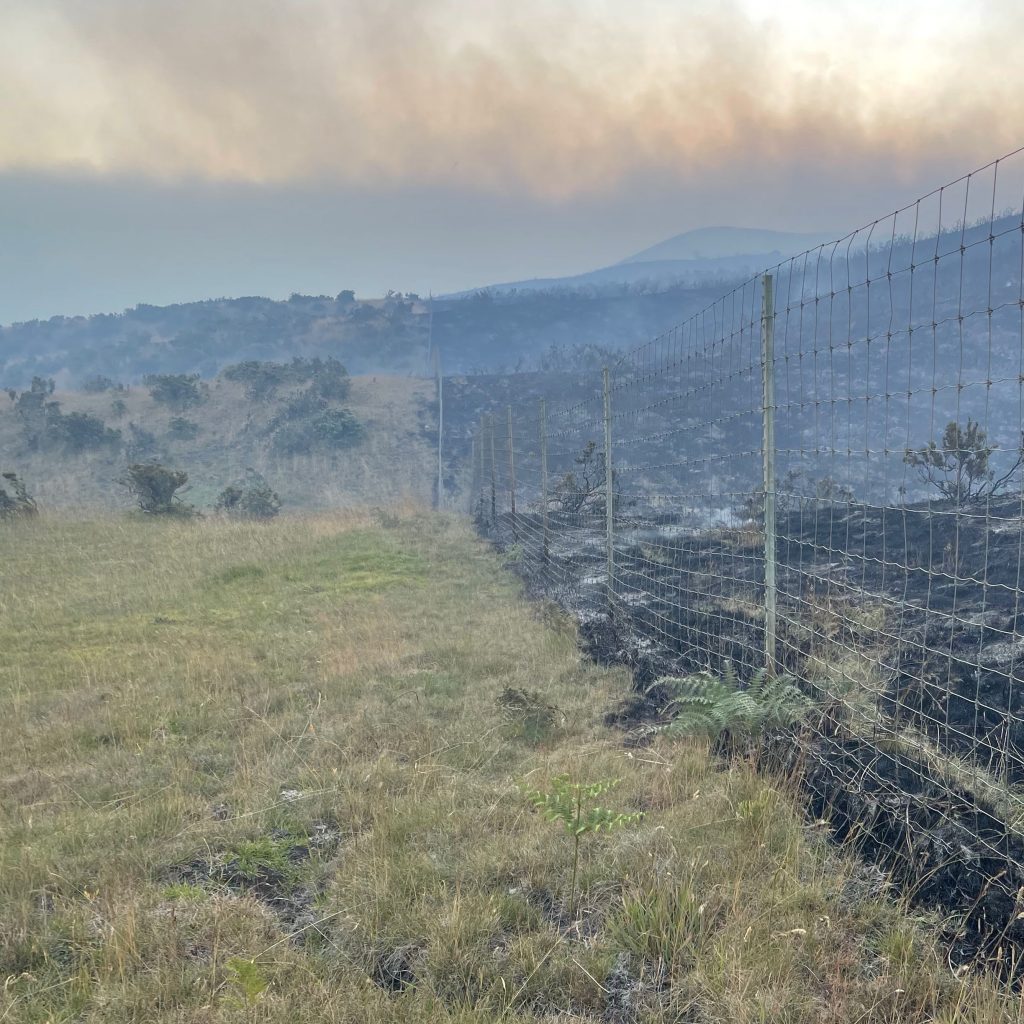
Greg Friel: That’s great. But that lower country, that’s the type of rainfall, the type of forages we deal with. Then from here on up 2,000 feet up to we’ll graze about 7,000. Well, now we’ll graze to about 6,000. We’ve fenced off the top section and put it into a natural reserve to regenerate the native plants that were there. We did have a problem there. Maybe Jordan might want to talk to that in a few minutes, but there was a fire that came through there that destroyed a lot of that. But the interesting thing that came out of that fire was that it took off. The fire started in the middle of the reserve from down power line. That fire was just raging out of control, no access to it until it got down to our fence line where we started grazing and the fire stopped right at the graze line. If the manufacturer of that fence material ever got that into his marketing people, he could sell it as fence proof, fireproof fencing. But you can see how.
Tip Hudson: But it was the pasture though.
Greg Friel: All of a sudden, you go from unmanaged land to managed grazed land, and there was no water put on that whatsoever. It just came down to there and slowed down and stopped.
Tip Hudson: I think most people think of these islands as being it’s tropical forest and it sounds like it’s wet. But what does the annual season look like? Like in the inner Mountain West, we have mostly a wintertime precipitation pattern. It’s dry all summer. All the forage grows and 100 day window in the late spring, and then you’re working off that the rest of the year. This is a different environment, but it’s not like it rains an inch every day.
Greg Friel: No. Here, we’re at 2,000 feet, and the headquarters is about 35 inch annual rainfall. But you get up to 6,000 feet where our intake is it catches where we pick up surface water for our stock water up at 6,000 feet. You’re looking at upwards of 70 ” annually. It varies quickly as you move south away, that eastern is what we call the windward side, and that’s where the catches the rainfall predominantly. As you move south, it’ll quickly drop down to probably 40 ” in pastures we call Ruapehu which is our southernmost up at that 6,000 foot elevation. But then at that point, you’re dealing with during the winter, so all the rain comes at one time across the island. That normally used to be November through about April, May. Now not as normal, not as regular, I would say the past 15 years, I’ve been here 30 years, and I want to say at least half of them have been drought. Trouble is some of those routes ran seven years long. One was five years long, and it makes it difficult. Then what’s really hit us badly in the past 10 years is there’s axis deer on this island that were released by the state in mid 1950s.
Tip Hudson: Where did they come from?
Greg Friel: India.
Jordan Jokiel: Axis, A-X-I-S.
Greg Friel: Yes. There’s no predators here. When I first got here in 1994, if you wanted to go hunting deer, you could hunt all day and not see them, even till today. If I leave my house, I’ll see deer. If I stay in the house, I won’t. If I look out the window, I still might see deer. I’ve killed him in my front yard and I live half a mile from here.
Tip Hudson: There’s enough of them that they’re eating your feed.
Greg Friel: They’re unmanaged ungulate that our 48 inch net fencing won’t restrain them. They’ll just hop over it. Worse if it’s 12 inch squares, which are great for cattle, but they’ll hop right through them. The dolls will just jump right through them. The bucks will jump over them. There was a survey done here the end of 2021, beginning of 2022. On the ranch, there were 9,000 deer. We attribute it to be about 5:1 animal units. Five deer to one animal unit. You figure 9,000 deer puts you at 1,800 animal units. That’s just about what we have to [OVERLAPPING] Now we’re building back now. We’re up to 1,100 cows. We were down as far as 750 from 2,200.
Tip Hudson: On 30,000 acres?
Greg Friel: Yeah. It’s just having an unmanaged animal like that is just devastating. The quality of pasture has gone down. The cattle might not be in an area for six months, but the deer are there whenever they want to be. There was a lot of deterioration in our pastures. Over the past six years, we started fencing our boundaries. It’s slow because it’s so expensive. Right now, presently, it’s about $35 a linear foot labor and material. Mm hmm. The reason why the labor’s so high on that in that lower country, it’s real rocky and so just hard [OVERLAPPING] you’re there with jackhammers and hydraulic pounders and whatnot, and it’s just.
Tip Hudson: Wow. Is the state trying to do anything about the deer?
Greg Friel: They have started started to fence, do some fencing, trying to control the migration. Honestly, they started too late. We tried to get these Axis Deer Task Force started, I want to say 20 plus years ago. Agriculture was having problems already, the ranchers, the farmers.
Greg Friel: But there was no worry on the other side. Unless you were in agriculture, it wasn’t deemed the problem. But all of a sudden they started getting into the Wailea resort area. It’s pretty important when their greens and their sand traps have hoof prints through them and whatnot. Then all of a sudden, things start to become a problem. It’s all relative to who it’s impacting before it is deemed a problem. One thing Jordan and I were just talking about this morning was on the ranches, because we were privately owned and not leased land from the state, we do long term planning, whether it’s 50, 75 years out. But when you’re dealing with a state or other people, anybody involved with the government, long term planning is the next election. Even if there is a plan set up when the department head changes or the mayor changes or the governor changes, that plan can die right there because it’s not their priority. It makes it difficult for us dealing with others. Like I said, we started fencing. We’ve put in, I think you said, 40 miles of fence so far. We’ve got our numbers down to, well, in the areas that are completely fenced, we got them down to under a couple thousand. There used to be 6,000 that ran in that area. But now there’s no ingress or egress anymore. What’s fenced in, we do control work on. I want to say 2024, there’s a combination of hunting pressure that took out 30,000 deer off this ranch only. It was between KIA, Maui Nui Venison company, who has a commercial federally inspected for human consumption, hunting and processing plant. They go out night harvest with infrared scopes and cameras and binoculars and whatnot. They have a veterinarian with them, the federal Veterinarian to inspect the animal. Well, they have to okay. He’ll look through that infrared and look and say, this herd is healthy. You can take what you can out of this herd. Then the next morning, the USDA veterinarian is there when they’re bringing all the carcasses in and as they’re delivered to the processing area and they inspect everything else. They’re USDA inspected, and they sell for human consumption. The ranch has the employees and a few friends that we go out monthly and do five days a month. We do control work. That is strictly for the guys to take home or if it’s a bumper crop that month, then we’ll sell a bunch off for pet food. But I want to say it was 2024, though, there was 30,000 animals. The survey says we’ve got 8,000, 9,000 on the property at that time. But the neighbors might have another 10,000, 15000. The other neighbor might have another 10,000, 15000, and they just drift back and forth and whoever puts the most pressure.
Tip Hudson: Fencing it just keeps the problem here instead of on you.
Greg Friel: That’s what we’ve been told by the county council but you’re just making a problem for those people. Well, you know what? My job is to take care of Haleakalā Ranch and our lands. Everybody who’s below us benefits. He says, our neighbors can take care of themselves. That’s not my job. They don’t like it, but it’s the truth.
Tip Hudson: Do you have government [OVERLAPPING] other private ranches.
Greg Friel: On one of the sides, it is government land. To the south, we have Ulupalakua who also utilizes Maui Nui Venison. But like I said, it’s not my problem. My problem is to deal with our ranch. We’ve got our lands to take care of. Then with all of the overgrazing caused by the deer, it makes Jordan’s job a lot worse because now he’s got all these invasive weeds that are coming in. Maybe we can spin off.
Tip Hudson: That’s a good idea. What do you get for weeds in response to the grazing pressure caused by the deer.
Jordan Jokiel: Bare ground is one of our greatest enemies maybe any land owner, but certainly in Hawaii, when you’re managing land at scale, like we are at Haleakalā Ranch because when you get bare ground, you get basically it’s the perfect environment for other weeds to vector into. They can wind blow in or they can just be dispersed by birds or on vehicles. When those things take root, especially in weeds thrive in those disturbed pioneer environments, and when they get established and they proliferate, if they’re not palatable to livestock, there’s really no easy or practical means to manage them at scale. It gets very challenging. You got to execute a mechanical and oftentimes chemical control program, which is not easy to do.
Tip Hudson: And expensive.
Jordan Jokiel: And expensive. The best thing to do is to avoid having bare ground to begin with and having a wise grazing practice in place to begin with. But again, like Greg was saying, it’s so hard to manage. You can’t manage a grazing program if you have an unmanaged browser like axis deer on the land. That’s really our highest animal invasive species challenges managing deer because there’s so many and they have such an impact. The deer, they directly take feed and forage, which is a huge problem for production, but also they change the ecosystem. They change the vegetation regime from palatable, desirable forages to non palatable fire prone species. If you can’t manage them through grazing at scale, and they proliferate and a wildfire comes in, and we do seem to be living in more of a fire prone world. It just becomes this, what do you call it? It’s a direct feedback.
Tip Hudson: Feedback loop.
Jordan Jokiel: Where you get bare ground, you get fire prone weeds and you get more fire, and then you get more disturbance, which further facilitates more of these fire prone weeds that aren’t palatable. It’s really a challenge. You got to start really by just protecting your land from continual ingress of deer and then really have a methodical and safe animal control program that has a goal of reducing these animals to some level that they’re not just compromising both the livestock enterprise and the landscape at scale. It’s quite a bit of work to do.
Tip Hudson: What would your grazing rotation or management or season look like if you weren’t trying to work around the deer?
Jordan Jokiel: I think that’s a much better question for Greg, but I think I’ve heard him say it’s really hard to put together a grazing plan with deer in the equation because you can’t control that variable. We go out every year. I’m more of an observer on this, but we go out with consultants and people who are really good and we walk the land and try to come up with how many grazing days we can have in a given paddock, but you can’t really do that with any amount of confidence if you have deer as a wildcard that could come in and decimate all your feed when you’re not looking and you can’t really plan to it. The details of that is really something for Greg. But in general, you can’t plan for grazing if you have 10,000 deer in your pastures. It is challenging, again, for other enterprises on the ranch like weed control and we have conservation projects non commercial native forest watershed protection projects that are compromised by deer, pigs, goats, wild feral. We have developing commercial native hardwood enterprise, which involves expensive fencing to protect those assets when they go on the ground. We’ve been able to integrate this stuff with the livestock program. But again, if we didn’t have deer, it would just change everything. It would make things so much easier on us. We’re working hard. That really is one of our highest priorities to manage.
Tip Hudson: What you just said cued up three different questions in my mind. You can take them in whatever order. What are the plants that you’re working with in the forest preserve areas where you’re trying to sounds like bring back some native plants? My other questions about fuel. Greg mentioned a while back that the ranch is obligated to control, is it control fire? Do you do fire control on the ranch or you have to control fuel? What does that look like and how does it compare with the state ground?
Jordan Jokiel: It’s hard for me to compare anything to state ground, but we have related to wildfire, there’s preventing wildfire to begin with. There’s a number of things that we do. We put in firebreaks. We’ve put in conventional, just mechanical firebreaks, but now we’re moving towards creating grazing corridors. Again, Greg can speak to this much better than I can. But instead of just always having to mow or bulldoze and then spray to keep fuels low adjacent, especially to communities. We’re creating grazing corridors to keep that feed low, and then essentially, we’re able to convert wildland fuel loads, vegetation to marketable protein, which is really nice. We keep our cowboys on the land. That’s our preferred strategy where we can do it. We can’t do that everywhere. But then also a really aggressive wildland fuels management program. We have I think on the mountains, so above 2,500, above 3,000 feet above sea level, there’s a number of invasive species that are problematic. The highest priority is a plant called Gorse. It’s also a legume. It’s a nitrogen fixer. It’s a really successful invasive species. It’s native to Northwestern Europe and the British Isles and it just creates monotypic stands of very oily, waxy. It doesn’t even have leaves. It’s just totally armored by thorns. It’s non palatable. Once it reaches just at six months old, it’s no longer palatable to livestock. It gets lignified, and the whole thing is armored with thorns. One of our greatest challenges is really trying to manage that at scale. It can be monotypic across thousands of acres.
Tip Hudson: Does it burn well because it has that oil in the foliage?
Jordan Jokiel: It burns really hot. Again, it’s that feed loop where it establishes, it proliferates, it burns, and then that fire footprint spreads disturbance area, a perfect environment for Gorse to again establish and proliferate. It just feeds onto itself, and it spreads. It’s just like this living system, this almost amoeba that grows. I always call it, so Gorse is the biggest thing up on the mountain that we manage. I call it like nature’s masterpiece because it has a very high seed set. It can set seeds well within under a year. It can already be viable and reproducing the seeds are viable in the soil in some places, it’s been tested for centuries for an incredibly long time. The seed fecundity is really high. Most of the seeds recruit. It has a very high seed sat. It flowers and seeds year round. There are times when it pulses when there’s more flowering events, so it’s really tough. It’s hard to move through. It’s hard to control. It’s a really tough thing to manage. But we also have non native timber. We have different species of acacia. We have pine trees, so we try to focus on those that are really aggressive in that or wind blown or dispersed. They disperse easily over large areas. But those are really big problem too. They’re huge fire issues. We have programs to manage those. We partner as much as we can with other agencies like USDA, with the state, with the county of Maui, more recently with the federal government and the Department of Defense, which I guess now is the Department of War. But they have an interest. All of us have a collective interest in managing wildfire. We try to take advantage of funding support and other support because it’s all in our common interest to manage wildfire. We’ve had a lot of fires in the last just even a handful of years. The day Lahaina burned, there was actually four fires. That was three years ago, almost to the day from today. There was four fires that day. Two of those were on Haleakalā Ranch, and the third one was adjacent to Haleakalā Ranch. There’s real fire threats, even up here on the mountain.
Tip Hudson: Does how does the Well, and you find that the grazed edge made a significant difference? To what extent has the state acknowledged that? Is there any appetite for doing controlled grazing for fuel control, not on privately owned lands?
Jordan Jokiel: There is, so it’s a really good question, and I think that’s definitely becoming I feel like I’m talking about it every day, like, with other people and other partners, like, literally every day- those two conversations we had with funders yesterday about that. I think the state is recognizing it because they sometimes are coming out and fighting fires with us very often, actually, when it’s adjacent to state land, and they see the value of grazing. It depends on the manager. You know, we’re lucky here. We have a manager here on Maui that really understands the value of grazing. I mean, they have their political constraints because they’re a state agency. We have fewer of those constraints. You know, we can identify a good solution to a problem. Just implement it. Then implement it. The state, and again, there are good managers with the state, but it’s just a harder, it’s a bigger shift to turn. But that conversation is definitely getting some traction with our state partners, with our county partners, and we’re getting funding for that. I mean, when it comes down to it. It doesn’t solve everything, crazing. But, like, what else? What solutions do people have when you have like 15 or 20,000 acres of land that’s adjacent to a community? If you do nothing, all Mechanical control and bare ground. Yeah, we do it. You can’t do that. No, you can’t pave it. You can’t just put organic gardens on 20,000 acres overnight. That’s not Right. There has to be some realistic, pragmatic solutions, and grazing is one of those things that I think is gaining. For me, it was almost an epiphany when Greg and I went up to go look at this fire, the Crater Road fire just two years ago; we watched that fire burn all night through this conservation project. That was managed for conservation. I mean, that was something that the ranch managed to, and, I mean, it’s an important thing that we do. But I had never seen it burn so hot and so fast because that ecosystem type is much like, I guess, what you’d on the mainland call chaparral. It burns hot, and it burns fast. Up until then, I had only seen fires on the ranch that burned fast, and there were grass fires. Right. But they didn’t burn nearly as hot. This fire burned fast, and it burned hot. High flame height.
Tip Hudson: It had a fast rate of spread.
Jordan Jokiel: It took 25 years of work, and it burned it to the ground 600 acres overnight- and it stopped. Like, Greg and I went up at first light up to the fence to go fight the fire. We both looked, and the fire had- I didn’t put it out, but it went from a raging fire you probably couldn’t outrun to something that crept so slowly. It essentially stopped, and it was defensible, and we could drop water on it because then it was daytime and we could use hand tools, and that really opened my eyes to the value of grazing land as a well-managed pasture, short-statured pasture, and the value, the contribution that makes to managing wildfire at scale. That definitely is getting traction because you don’t just get that wildfire value. You get food production out of that. You get open space out of that with a well-managed rangeland. All of these other what we call ecosystem services all came into play in that one photo for me. Where the fire burned right up to this fence. I mean, there is a place, and we are going to try to reestablish a conservation project in the area that burned, but I think we’re going to try to integrate grazing into that somehow, whereas we had excluded it for 25 years. I don’t know what it looks like. I don’t think Greg knows what that looks like yet, but it breaks your heart to work this hard. Lose everything overnight. That was 25 years of work. We lost 600 acres overnight.
Tip Hudson: You feel like you could manage grazing in a way to be compatible with those conservation goals and the plants that you’re trying to reestablish in that area?
Jordan Jokiel: I think we are doing that in places, and I think this up here, it’s called the Po paw Reserve, is a challenge. It’s going to be challenging to do it. But I think you can. It’s just not going to be what I would have envisioned before working here as a perfect conservation project. I’ll go out on a limb, and I think it’s not going to be exactly what Greg or Livesto person would say, This is an ideal pasture. It’s going to be some hybrid in there, but I think that’s maybe what we need to start looking for: this middle common ground in areas that are grasslands where there’s conservation value we can manage, but also agricultural production value. Then adjacent to that is Halaka National Park, where there’s no grazing, and that’s the place where you can have biodiversity as your primary goal. But you can have these intermediate landscapes that are common to both of those enterprises.
Tip Hudson: Forgive me if it’s too soon to ask about it, but with the Lina fire that was tremendously destructive in terms of infrastructure, and I don’t even recall what loss of life, if any, but 100 people? Oh, my goodness. To what extent is it possible that a situation like that could be different if you were managing the areas on the edge of that suburban landscape with grazing? I guess what I’m thinking is, some of these places that are like Chaparral, to what extent can grazing make a difference in that? Like with sagebrush. We say if it’s more than 20 to 30%, there’s enough sagebrush that if it burns, it’s going to be a stand-replacing, crown fire. Grazing probably has the most benefit in, well, similar to what you said a minute ago, it changes the patchiness of the fire. It changes the speed of the fire, flame height. The whole world heard about Laana because it was so destructive. To what extent could that be different?
Jordan Jokiel: Well, I can’t; I don’t know that landscape, like I know Haleakalā Ranch. I think there’s a common denominator, and I want to be respectful and considerate of Lana because that was Tragic. There’s a mutually agreed-upon understanding that fuels have to be reduced around communities like that and communities like Kola and others. You know, what is the best tool for La Hana and what is the best tool for Ke Hay? Those can vary. I don’t know what. But I do think that grazing is something in the right setting that should be considered. If it’s something that’s done at scale, if it’s something where you have a good livestock manager. There are always people; I mean, there are nuisance issues with grazing, right. But those are all given the take, you know? Like, we have Halaka Ranches adjacent to communities, and, I mean, I think so even if their dogs bark because we have cattle next door, like, one of the things that’s important to keep in mind is there’s a reduced fuel load along that boundary because we have a well-managed herd. There’s a lot to that, and I can’t speak. I personally, at least, can’t speak specifically to the Laana setting, other than, yeah, I think it’s clearly recognized that fuel has got to be reduced. In addition to other things like having water readily available, having some management presence on those adjacent lands was not just fallow. Whatever the enterprise might be. I mean, I don’t know.
Tip Hudson: It’s one of the pieces of a multifaceted solution, or at least moving in the direction of a solution. Right.
Jordan Jokiel: For me, it’s just a tool that is so clear to me when it is. In our settings here on Holk Ranch, it’s really clear that it is; again, it doesn’t solve everything, and there are no guarantees of it, but it is a really good tool to manage wildfire at scale. I mean, the photos that we showed you, and just our experience with it. You know, that was from a 2024 fire. The 2023 fire, if you look, you turned that photo over; that’s from the day the line of fire burned. That ripped through a gulch that was heavily timbered, called Kiilu Gulch. But for the most part, and that was a crown fire, it burned really hot. There were embers that flew into the pasture. But when they got into the pasture, they burned because it was hurricane-force winds. It was like a fellow, but it really slowed down. You can see how, in that photo, the fire, for the most part, the hottest part of the fire was contained to the gulch. It did creep out of that. But it crept. It didn’t move with the same speed or with the same intensity as it did when it was in that heavy timber. We were able to drive into the pasture and get right up to that leading edge of the fire and do our best with backpack spars because we didn’t support. Yeah, we could fall back because we weren’t outflanked by it.
Tip Hudson: What would you say, if you have any idea, would have been the historic fire return interval? On this landscape, on the flanks of the mountain.
Greg Friel: I got here in 1994, and that’s the first fire I’ve seen on this upper part [OVERLAPPING] of the 2023 fire was the first one you saw since coming in 1994.
Tip Hudson: Wow.
Greg Friel: In that lower country, those are drier-type conditions. I got here December 1, December 31; I was on my first fire, and it was they’re always man-made. There were aerial rockets that some kids shot off flew across a four-lane highway, landed on the median, and came into the ranch from there. I hate to say, but the homeless encampments are a big problem for us. There’s almost- I want to say there are three fires a week minimum.
Tip Hudson: Oh, wow.
Greg Friel: Across Maui from these.
Tip Hudson: We drove past a few of those chem labs. I’ve never seen that before.
Greg Friel: It’s just a real major problem. They keep moving them. But they keep putting band aids on the problem. They don’t look to the source of the problem. But when it comes down to fire management- I mean, grazing management in general, but fuel load management- I think a tool that’s going to be pretty good for us to work with, and I’m not sure yet of the cost. I’ve never been to anyone who runs these virtual fence programs on a large scale. I like to get in somewhere somebody who’s doing that and look at that and all the costs and what have you, because it gives you flexibility to be able to put in a fire break along the highway that’s 100 yards wide. Right. Without putting in a fence. If your water is, say, a quarter mile away, well, you just build a little alley for them to go back to that water on that virtual fence. I think that that’ll be a tool that will really be a big tool that will be able to help prevent this type of problem. They’ll probably be a lot more efficient. I mean, you don’t want us to have to go scrape a blade on the ground because it just [OVERLAPPING] makes a weed patch in perpetuity. If you go and build fences to make these alleyways for her to work, it becomes a problem, an expense. But if you have this virtual fence technology, then you can just move that wherever you need it to be.
Tip Hudson: Do you know anyone on Maui who’s using that yet?
Greg Friel: No, nobody, nobody in the state. I don’t care, I mean, if I can, if you ever hear of somebody or one of your listeners that would mind me coming up and visiting, I mean, is it very well worth investigating then?
Tip Hudson: You got me thinking now. We have several people in Washington State and Oregon, both of whom are using virtual offense for those purposes, as well as some other ones. But at large scales.
Greg Friel: That’s what I need to see. When you get into it, you look at the websites and whatnot, and you talk to them, it doesn’t give you the picture of what the actual problem is. What are the issues with it? But what I’m liking, what I’m starting to read now, is that some of the systems deal with more satellite than cellular. Because we don’t have good cellular in a lot of areas, and those towers are pretty expensive that you have to set up. And, with this really uneven ground that we have, it would be cost-prohibitive to have to put up too many towers, but if it’s linked to the satellite, then it works anywhere. Yeah, that’ll cheapen it up a lot.
Tip Hudson: If you were grazing specifically for fuel management, how does that look different than just general grazing management? Like, are you aiming for a certain amount of pounds per acre residual after grazing? That makes a difference.
Greg Friel: I mean, you might be running bulls off-season, or cattle that don’t have a lot of nutritional needs. But animals that can, and those are the animals that got the size that can really take up a lot of that forage.
Greg Friel: But when we talk about the state wanting to do some projects like that to some of these fire prone areas down along the lowlands, what they got to realize is it’s not somebody going to go in there for free food, free feed for their animals. You got to pay them, because there’s a lot of investment involved in that. If you’re going to go in there with a herder, that herders not cheap. If you’re going to go in with cattle, well, you got to be able to get a lot of water down there if you’re going to have water, because a lot of those areas don’t have that water infrastructure. There’s no ranching on it in the past 20 years, so all that infrastructure is gone. There’s a lot of investment into that type of work.
Tip Hudson: But nobody would hesitate to pay 500 bucks an acre for someone to go in with a giant masticator.
Greg Friel: Exactly.
Tip Hudson: Take the vegetation down. Herbicide application.
Greg Friel: They’ve got to change that mindset that, Oh, well, you’re going to get this free feed, because we had somebody approached us years ago, and they were going to they said, well you’d have all this free feed. I goes, at that time, we were running a couple thousand goats and about 400 500 sheep. I said, yes, and they’re all going to starve to death on that crap. Here’s a truckload of straw. I said, well, you supply us with the hay or whatever other supplements we need the access to water and then you’re going to pay us on top of that What? You going to pay you? I go, yes, it’s a business. We got the liability of these animals being there on the side of a main highway with you know?
Tip Hudson: Ask some other private contractor what it would take to do mechanical control to get the fuel load down and all that does is lay it down. You still got. Now it’s still a fuel bed. It’s just not live anymore.
Greg Friel: It’s a different mindset, and I love it because I had a friend. I don’t know if he’s still in the business, but there’s fellow Ray Holds that he stood?
Tip Hudson: I’m not sure he’s doing it. I think he might.
Greg Friel: So I think he sold out but we bought our first a couple of trailer loads, so probably about 500 goats from him. I can’t even remember when that was, but you looked at his setup, and then it was there was a lot of work involved in him. The ground that is covered.
Tip Hudson: Electrified knetting, transportation, water.
Greg Friel: People here in government or even private business people don’t look at what’s involved for the stockman.
Tip Hudson: The cynic would probably say that it’s fine to have grazing in some of these otherwise wild landscapes, but you’re not going to get the native vegetation that you would if you didn’t have cows there. The best way to protect it would be to create these preserves. We’ve been talking a lot about fire, but can you speak to how grazing management is or is not compatible with some of the species that you’re trying to conserve and these projects on the mountain?
Greg Friel: Well, these projects on the mountain, our main problem is looking at fire breaking, what can impact get out of the reserve area. Part of the problem with this ranch is, like I said we’re 29,000 acres, but we’re not contiguous. And so when you look at that map of all these properties, you got homes abutting it. You have roads throughout all of this. So the chances of impacts from humans, from invasive species are just I mean, I wish we were one great big block, and all I had to do was worry about the perimeter. If we were all of that land was tucked up against a national park on the back and everything else, we just worried about one front. My life would be a lot easier. Management wise, you’re not dealing with so many.
Tip Hudson: But you’ve got miles and miles and miles of edges.
Greg Friel: And so this way, it makes it a lot more difficult to worry about all these other factors. But like I said, as far as those reserves, you come in with that virtual fence and that gives you a lot of options to be able to work around that kind of thing. You might have a couple hundred, 300 foot area along the fence across the road line or the fence line that you might not get those trees established, but no big deal. You got another 1,200 acres up above that that they can grow on. They can proliferate. Technology has changed a lot just in the my time. Now we’ve got virtual water systems that allow us to monitor what’s happening 2.5 hours from here. He goes, Oh, boy. Well, we don’t have to drive behind today because water’s all up. Water’s working. And it used to be a three day a week trip, somebody to make sure the waters right. Now we’re down to one and it’s make sure that the cattle are good, the minerals all out.
Tip Hudson: What are you using to monitor the water?
Greg Friel: It’s called Ranch Bot.
Tip Hudson: How long have you been using that?
Greg Friel: About a year. So far so good, and we’ve expanded on we started off on that farthest piece, and now we’ve got it up on the on this intake that comes in, picks up surface water, and so it really helps us track things.
Tip Hudson: What did that look like before you had the monitoring system? Send somebody out in a motorcycle or a pickup.
Greg Friel: The man hours are reduced. Wear and tear on vehicles is reduced and it’s not impacting animal health or anything. We’re just not having to go out there three times a week. You can go out there once and make sure you get a good look at the cattle.
Tip Hudson: I want to respect your time, but I am interested. How did you get into ranching? You said you came here in 1994. How did you end up managing a big ranch on Maui?
Greg Friel: I’m not sure, because, honestly, I got my start with Louis L’Amour and John Wayne. There you go. I grew up on Oahu. Yeah. I was a kid in the suburbs. I wanted to be a cowboy. I didn’t know I was going to be a manager. That might have changed my mind. It’s not as much fun as when I was just a cowboy, but, I started off on a big island. My first full time job was with Lonnie’s dad out at Copa Palo. Lonnie was at WSU. At the time, and she’d come home for summers, and then when she got through school, then we worked together with her dad. I was there for 10 years. Then I got a call because they had a month to month lease, and it took them over 20 years to get that lease a long term lease. Then she’s been fighting with the state for as long as I’ve known her. I just give her so much credit because of what she puts up with dealing with the dealing with the government and still managing to make the improvements that she has. Her dad was a stockman. He was a businessman because, I mean, he kept that place going and making the improvements that he needed. But he was a hell of a stockman, and I just learned so much from him. Luckily I got a call from Smart well, actually, he got the call first, and he told her, Expect a call from Lindy Sutherland. I goes, Who’s Lindy Sutherland? He’s going to call you see if you want to go work for him. I ended up on Kauai for a few years, but coming from Kauai, which was at that time was 32,000 acres, and it was my dream. It was one big block. You left in the morning and you were on the ranch all day, unless you wanted to go up the highway to cut time off on getting up to the far end of the ranch. From that, I went to a small seed stock operation that was one valley that opened right to the ocean, and I got claustrophobic the first week. It was like you sit on your steps, putting on your boots in the morning, and you saw the whole ranch. It got on me, but the work was great. I mean, it was a whole different experience. But I was there for about three or four years, then I got a call from Hona ranch. They wanted me to come out there and manage that and that was another different type of operation. It was owned by a bunch of investors. Then, while I was there, that place had been sold so many times. They were getting put up for sale, and then guy from here called me up, asked me if I’d come and run it. I finally found a place that it’s like being at Capa Pala except it’s owned by a family. You can plan long term, and it’s just been a great experience for me. Just before the guy who was the president was Peter Baldwin, he had hired me. I told him after been here about 15, 20 years. I go Peter, I’m trying to figure out why you hired me all those years ago, because think about how much I’ve learned since I got here. I couldn’t have known nothing when I got here at first when you first met me. He goes, wow, I said, that’s why I hired you because you weren’t through learning. Since then, I’ve still learned a lot more. Things keep evolving and you just got to roll with it and just keep thinking out of the box and figure out how we can make things work.
Tip Hudson: What is the ownership structure of this ranch? It’s privately owned? It’s a family owned.
Greg Friel: Family owned. I think now there’s about a 110 shareholders. Started off with two brothers, and then it’s gone down. From 1888, it’s come down. Now they’re like I think guys around my age, late 60s or would be fifth sixth generation. Peter was the last family president, and he retired maybe 15 years ago. The last family manager was I think his dad, which would have been 40, 45 years ago. I guess there were two short term non family livestock managers before I got here.
Tip Hudson: We haven’t even talked about what you do with the cattle. Are you selling calves to the mainland or are you finishing animals here or both?
Greg Friel: We had been finishing cattle here, and then with the deer and the drought, we couldn’t finish them anymore. We were grass finishing and marketing here, and we were just couldn’t keep up getting back. You can raise a calf. You can wean a decent calf, but we’re having a hard time putting on our pounds to finish it.
Tip Hudson: There’s no feed resources around?
Greg Friel: Yes. I want to say the last six years, we’ve been going back to the mainland with them. We haven’t been retaining ownership. We’ve been selling them at the gate, but now that we’re getting some of these areas fenced with deer fencing around here, what we’d like to do is go back to finishing a here. There’s an opportunity. The company that we started, Maui Cattle Company. We started it with four other ranchers. Still running under a different ownership but there are some philosophical differences in Cattle management, but what I would like to do is if we finish animals, I like to put them under a Haleakalā Ranch label and market them as Haleakalā Ranch beef and not under Mai cattle company.
Tip Hudson: You say finish. I’m aware I’m not a meat scientist, but finishing on grass is a whole different thing than just getting to a slaughter weight on grass.
Greg Friel: Yes, I would say for us to finish and with the genetic changes we’ve been doing over the past 10, 20 years our heifers would finish at about 575 pound carcass at 24, 28 months, and the steers would be 625 about 50 pounds heavier.
Tip Hudson: What breed composition on the Predominantly red angus.
Greg Friel: We keep working on that. Doing a lot more DNA testing on our heifers and cows as well as the bulls and trying to select those animals that can do it on what we got without supplement.
Tip Hudson: Hindi, recall correctly, reading something that you have a wind farm or have some wind turbines on this ranch?
Greg Friel: No, that’s what we did Calako. They’re looking at solar farm leasing some land up for some solar panels. That’s been in the talks and planning stages for shoot, probably getting close to 10 years.
Greg Friel: So where they had originally planned their footprint, we had leased some property from Maui Land and Pine. Blackie’s been here 69 years. He said he was a little kid before he started working that the corral that we had was off of our property on the land that we had leased, but the corral’s been there for at least 70 years. And this corral was finally like, it needs not just maintenance; it needs a redo. So we took it off of that leased land and put it on our feed line. That’s been this year’s big project is running the ranch, controlling deer, and trying to get this corral done all in-house. We’re getting close, but we got a preg check pretty soon, so we’re hoping like hell that we get it finished.
Tip Hudson: That doesn’t sound like it’s quite as romantic as Louis L’Amour. Has it been what you hoped for?
Greg Friel: It’s been a good life. It’s been a great life. I’m lucky my wife wanted to follow me wherever we went, and kids got to grow up. My boy works on the ranch. In fact, I got to return his call pretty soon; he was just calling me. He’s up gathering some cattle this morning. We’ll be branding in a couple of weeks, so they’re starting to gather these pairs down. They’ve been carving off. We’ve been opening gates so that they could just spread out as they carve. He’s trying to throw them together and get them starting to come down the mountain so they get down to the corral in a couple of weeks for branding. But the grandkids love it, the kids love it.
Tip Hudson: How many people are employed here then in total? The other question you may not have time for is every ranch is looking for how to diversify, so you’ve got more than one revenue stream.
Greg Friel: There’s a couple of concessions that they were on a zip line. They used to be a trail riding guy, but they retired a few years back, and we didn’t approve any of the people that they had in line to take it over. There’s a few other leases that one guy makes biochar. Other than that, and some of these roadways that have been put in and had to cut the ranch property off and mix it so it’s not feasible to really graze anymore. Some of those lands were spun off, I want to say, probably 15 years ago, and those monies were used to purchase 1031 property exchanges, picked up some commercial properties across the mainland. So there’s that revenue source. Just recently, the board of directors have given me a directive to maybe seek a few more enterprises that would tie into whether it’s a stabling for the public or possibly a trail ride situation. I’m not a people person, which is why I love this job.
Tip Hudson: That’s a lot of work.
Greg Friel: But if the demand is there, it’s something that.
Tip Hudson: If there’s enough demand, you could hire someone to do that, too, that knows horses and likes people?
Greg Friel: Yes.
Tip Hudson: Separate from those, how many people do you have employed running the ranch?
Greg Friel: With the office staff, there’s probably about 15. For the office staff, because of those commercial properties we got, just on that accounting human resource, I think there’s three people, four with the commercial real estate. Then there’s a president, a secretary; she’s hell of a lot more than a secretary; she keeps me on top of things. And then the rest of us are out in the field. And Jordan has some contract workers that he deals with for helping him with the weed control and conservation forestry. So there’s what? How many are involved?
Jordan Jokiel: The forestry, conservation and invasive species control, contractor crew. It’s probably, all in, maybe a dozen folks. But we also work very closely with conservation partners. So they’re oftentimes either nonprofits or NGOs. There’s these watershed partnerships that are kind of nongovernment organizations, and they provide a tremendous amount of support to help us meet our conservation goals, especially. So they’re self-funded through public and private sources. They have their own staff, their own crew, their own leadership, their own administrative and HR capacities, and they do a tremendous amount of work for us. We control all fence inspections in our conservation projects. They’ve expanded their role now to do more wildfire mitigation stuff for us. There’s common ground, I guess, maybe is a better way to say it, where there’s a fire threat that’s also an ecological threat. So a really great example of that is pine trees in our upper elevation pastures where these pine trees threaten the biodiversity of this area and they also present a fire threat. So the watershed partnerships, especially the East Maui Watershed Partnership, does quite a bit of work there. Their suite of projects has expanded because we were able to have those two things comport: an ecological threat, which is what they’re managing for; they always have conventionally and traditionally done that, now with a fire threat. So that does garner more funding, more support, and even more political will, I think, amongst the broader community, to be able to do that kind of work. Our partners provide a lot of support, especially those aspects that don’t directly improve our bottom financial line or financial bottom line. But it’s super important work, nonetheless. That’s been great. Then the contractors are really good because they don’t have ambitions to become cowboys. This is what they do and kill weeds and we plant trees, and it’s a different kind of a person because it’s just different. There’s no expectation of doing anything other than killing weeds and planting trees. That takes a certain individual to do that, and it’s taken a while and then we’ll have a pool. Yes, it’s just different and it’s really good. It’s taken years to build a pool of people, and that’s what they do day in and day out. So that’s worked out really well.
Tip Hudson: Good. That seemed like a model I haven’t heard about from a lot of places, but it makes a lot of sense.
Jordan Jokiel: Yes, and I think because we have a lot of conservation, forestry, and especially weed control projects, and we prioritize them. So to have a dedicated capacity for that that’s just focused on those things and doesn’t get too much mission drift to do, because there’s always other things to do, as you know, in the ranching industry, there’s always another fence to fix, another waterline to fix. So this has enabled us to kind of focus on this crew of contractors, at least, that they’re able to focus on those discrete land stewardship needs: weed control and forestry and watershed protection.
Tip Hudson: Is there anything that I didn’t ask about that you wanted to talk about?
Greg Friel: Everybody wants to be a cowboy, so we’ve always got guys coming. There’s this one guy that’s been asking me for probably six or eight years. He goes, let me know when there’s an opening, and goes, you know what you do? Watch the obituaries. When you see somebody from Holy Haleakalā Ranch dies, then you can put in an application because right now, we’re not hiring. I’ve been here 32 years. When I got here, I was 38 years old. And the guys that were working here had all been working here at least as long as I was alive. So as they retired or passed, I was hiring these younger guys. I didn’t realize it, but most of these guys have been here 20, 24 years already. Where are the young kids that I hired? When it comes to branding time or they’re on the fence all the time, I just go, Oh, man. Where’s the young guys? [LAUGHTER] They were the young guys?
Tip Hudson: You were the young guy.
Greg Friel: Now, they’re 42. Like they say, time flies when you’re having fun, but now it’s like, okay.
Tip Hudson: It does.
Greg Friel: Who’s going to be the next generation that wants to be out there? We’ll see. Honestly, right now, I’m hung up. I got a rotator cuff surgery, so I’m pretty much grounded for another three months. But I do the most writing out of everybody because when they’re on the fences, I’m out checking the catalogue gathering the herds that are out there. So anybody who wants to come in here, they’re on the fences, they’re on the water. Right now, this past couple of weeks, we’ve been gathering cattle and synchronizing for AI and sorting heifers for replacements and what have you. But in between, they jump back on that corral and trying to get that thing finished so that we can preg check in the end of August. Between now and then, we got a brand two herds. We’ve got two breeding seasons because of the growing season. Like we said, the rain typically would come in November, December through April. As soon as that rain comes, it greens up in that lower country. But this upper country doesn’t start greening up till about the middle of April, just because of the elevation. And for every thousand foot gain in elevation, it delays it by about another week. We’ll be branding next beginning out of August. The end of August, we’ll be winning the other herds that are in that lower country and preg checking those cows. Kind of makes it a pain that you not just brand everything one season and then get into maintenance for a long period of time, but you have to schedule things in between. Come November, we got next year’s calendar all planned out already, when the big jobs get done and what have you? It makes it good for planning, but then it makes it difficult when you’re trying to fit big jobs in between them. But if it was easy, everybody would be doing it.
Tip Hudson: That’s right. Thank you for what you do to take care of a pretty special place and maintaining a work environment where people want to stay and keep doing it.
Greg Friel: Thank you. It’s been great talking story with you, and I look forward to hearing more on your podcast.
Tip Hudson: Wonderful. Thank you. Thank you for listening to The Art of Range podcast. Links to websites or documents mentioned in each episode are available at artofrange.com. And be sure to subscribe to the show through Apple Podcast, Podbean, Spotify, Stitcher, or your favorite podcasting app so that each new episode will automatically show up in your podcast feed. Just search for Art of Range. If you are not a social media addict, don’t start now. If you are, please like or otherwise follow the Art of Range on Facebook, LinkedIn, and X, formerly Twitter. We value listener feedback. If you have questions or comments for us to address in a future episode or just want to let me know you’re listening, send an email to show@artofrange.com. For more direct communication from me, sign up for a regular email from the podcast on the Homepage at artofrange.com. This podcast is produced by CAHNRS Communications in the College of Agricultural, Human, and Natural Resource Sciences at Washington State University. The project is supported by the University of Arizona and funded by sponsors. If you’re interested in being a sponsor, send an email to show@artofrange.com.
Speaker 1: The views, thoughts and opinions expressed by guests of this podcast are their own and does not imply Washington State University’s endorsement.